A practical guide • manufacturing, offices and services
Work standardization means agreeing on the best known way to perform a task under given conditions, documenting it, teaching employees, checking that it is followed and improving the method. Its purpose is to reduce unnecessary variation, make work safe and deliver consistent quality.
This guide brings together the principles of standardization, Toyota’s tools, TWI methods and implementation examples. You can start with the definition, go straight to a specific tool or assess your process using the downloadable audit.
A standard starts working when people know how to use it. The document, training, working conditions and daily supervision form one system. Without an update after an improvement, the benefits of kaizen can disappear.
What is work standardization?
Standardization describes how to achieve the required result: the sequence of activities, what to watch out for, the conditions that must be in place and when to report a problem. A standard applies until a better method is approved. It is developed with the people who do the work and checked in the actual process.
Work standard
The currently agreed method and requirements for correct performance. These can take the form of an instruction, worksheet, checklist or visual standard.
Work standardization
The process of creating, introducing, teaching, maintaining and updating standards. It includes the leader’s responsibilities and checking results.
Five principles of a good standard
- Safety and quality: critical points are unambiguous.
- Practicality: the method can be followed under the conditions provided.
- Understanding: employees know what they do, how to do it and why.
- Availability: the current version is at the point of use.
- Improvement: a new solution is tested, approved, documented and taught.
Standardization does not mean an identical script for every situation. In a process with several variants, a standard can define the rules for choosing a variant, decision criteria and how to handle exceptions.
Standardized work at Toyota
The Toyota Production System (TPS) rests on two pillars: Just-in-Time (JIT) and Jidoka (Polish). TPS is maintained and improved through repeated cycles of standardized work and kaizen.
Just-in-Time is a system in which production makes only what is needed, when it is needed and in the quantity needed. JIT is based on production leveling (heijunka), continuous flow and a pull system, while takt time sets the pace of work.
Jidoka means “automation with human intelligence.” It gives machines and operators the ability to detect abnormalities and stop the process to prevent defects. The concept originated with Sakichi Toyoda’s invention of looms that stopped when a thread broke; this allowed operators to tend multiple machines without compromising quality.
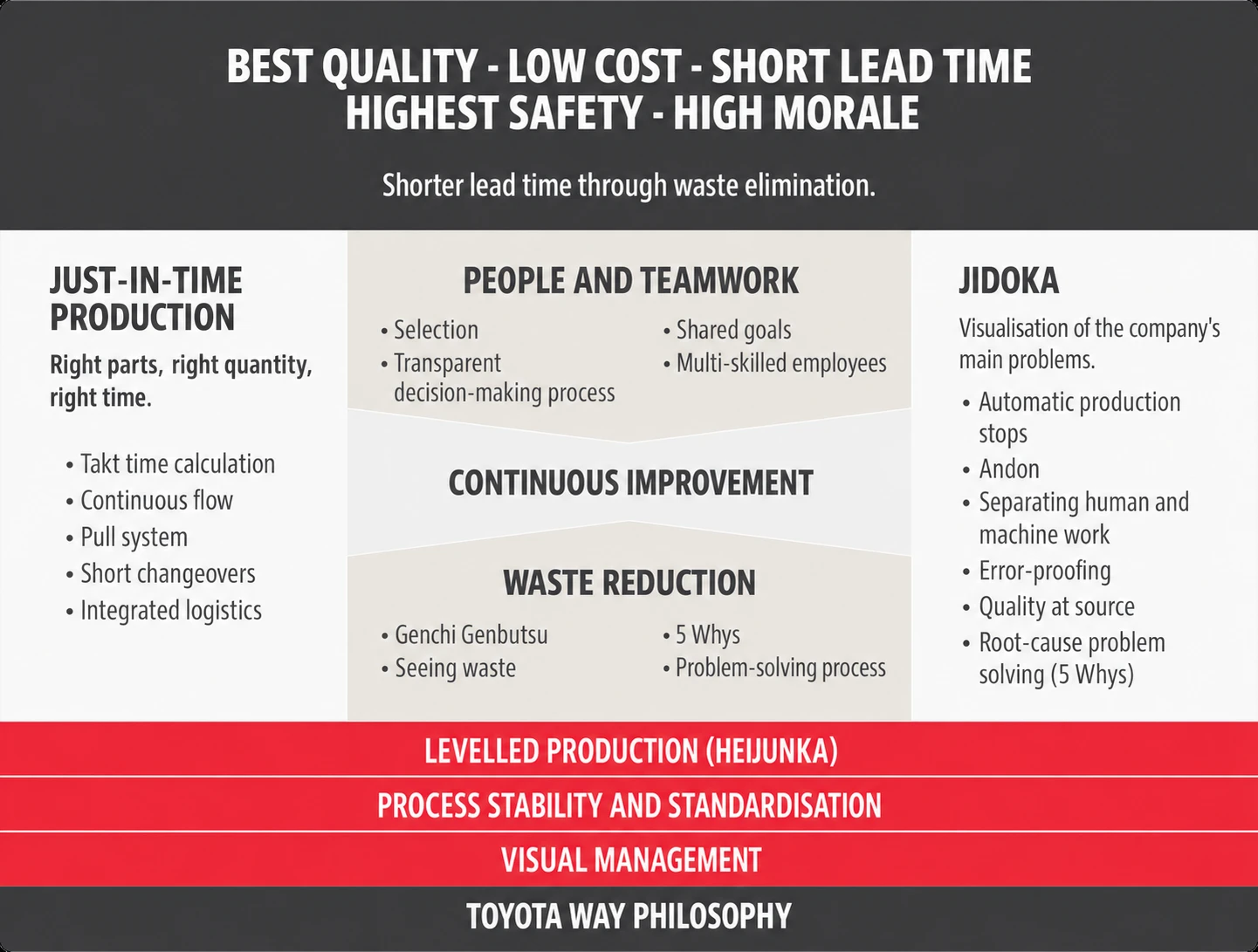 Toyota Production System
Neither pillar can function without standardized work. Just-in-Time requires each operator’s cycle time to match takt time, while Jidoka relies on detecting deviations from the standard. A repeatable work sequence and visible criteria for correct performance make it easier to identify a deviation and initiate the appropriate response.
The three elements of standardized work in TPS: takt time, work sequence and standard work in process. An instruction for a particular task does not replace a description of how the entire cycle is organized.
Three worksheets for organizing work
Toyota uses three well-known worksheets for standardized work:
- Production Capacity Sheet
- Standard Work Combination Table
- Standard Work Analysis Chart
Production Capacity Sheet
The Production Capacity Sheet presents processes and machines, including manual work, machine and changeover times. Process capacity should be compared with demand, taking into account the number of machines, available time and batch size. The time for a single machine is not enough to identify the constraint.
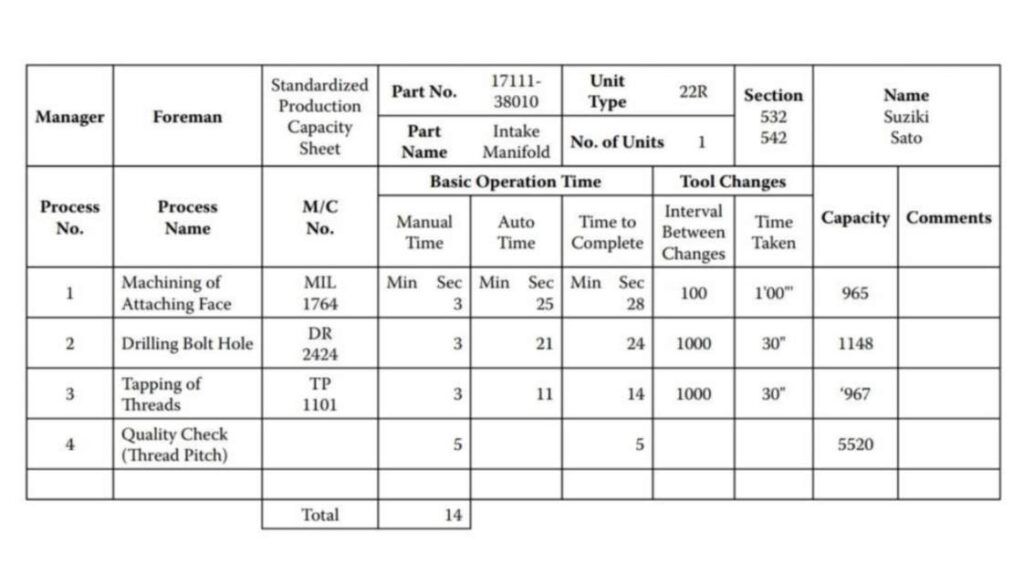 Process Capacity Sheet — standardized work at Toyota (source)
Standard Work Combination Table
The combination table is used to plan one operator’s work within a work cycle. Its horizontal axis shows cycle time, and a vertical line marks takt time — the time within which the plant must produce each item to meet demand. Individual elements are shown graphically: manual work as a solid rectangle, machine work as a dashed line, walking as a wavy line and waiting as an empty box. This makes waste, such as excessive walking or waiting, easy to see and helps adjust the sequence so that cycle time matches production takt time.
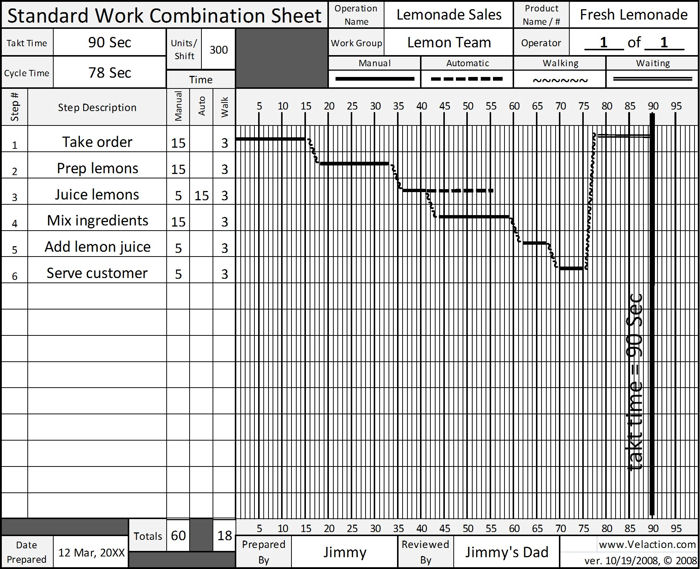 Standard Work Combination Table (source)
The table is closely linked to takt time — available production time divided by customer demand — and to the division of work into manual and machine elements. In Toyota’s model, every work element is measured in seconds and compared with takt time in the table, allowing the number of operators and machines to be matched precisely to planned production.
Standard Work Analysis Chart
The Standard Work Analysis Chart is a classic standardized work tool that visually presents an operator’s work in relation to the workstation layout and the time required.
Unlike a standardized work sheet alone, this chart focuses on linking activities to the physical process layout, helping optimize the positioning of materials, tools and the operator’s movements.
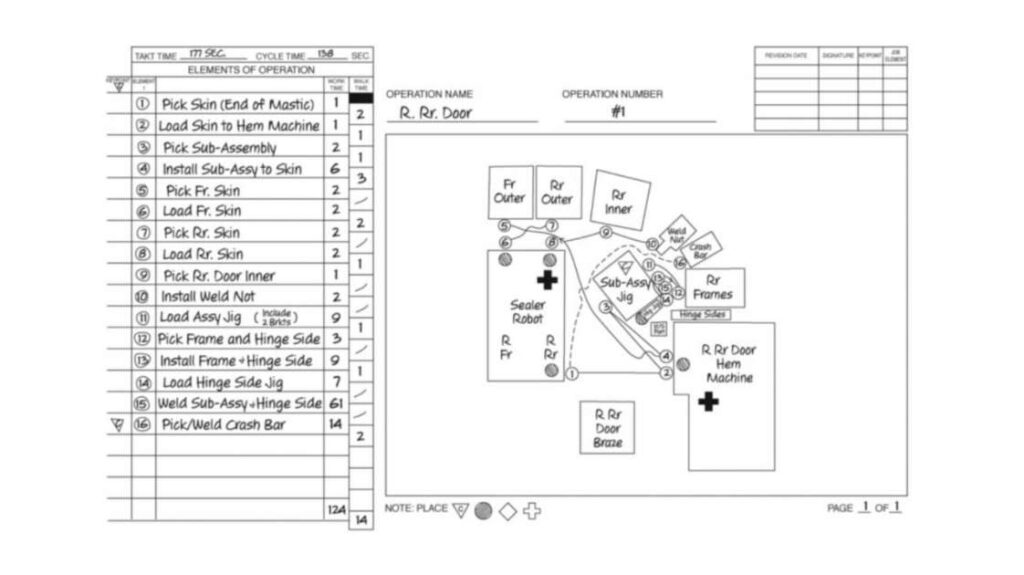 Standardized work at Toyota — Standard Work Analysis Chart
The tool is primarily used to:
-
improve the workstation layout,
-
teach employees the correct work sequence,
-
analyze quality and safety,
-
control standard work in process (standard WIP).
A typical Standard Work Analysis Chart includes:
-
Workstation layout
→ a spatial representation of the workplace and the operator’s surroundings. -
Process steps and times
→ a visualization of the sequence and duration of activities. -
Quality and safety elements
→ identification of quality-critical points and workplace hazards. -
Standard WIP (Polish)
→ the minimum necessary inventory between operations that keeps work flowing at the required pace.
By combining information about sequence, time and workstation layout, this tool makes it possible to:
-
identify waste easily, such as unnecessary motion or putting items down,
-
improve ergonomics,
-
reduce cycle time,
-
prepare the process for standardization and training.
Work standardization and TWI: methods and teaching
In the Training Within Industry (TWI) program, work standardization was present mainly in two modules:
-
TWI Job Methods (JM) — improving work methods
-
TWI Job Instruction (JI) — training employees in the best way to do the work
These two approaches complemented one another:
-
Job Methods helped define the best work method,
-
Job Instruction taught how to pass it on to an employee quickly and effectively.
Standardization in TWI was therefore a process that led to work being performed consistently according to the best known method, rather than just a document.
TWI Job Methods — improving work methods
TWI Job Methods focused on analyzing work and systematically looking for ways to improve it. It was a highly practical method created for industry, intended to increase productivity without additional investment.
- Breaking work down into work elements
The first stage was to break an operation into the smallest meaningful parts, referred to in TWI aswork elements.
A work element was a single activity performed by an employee, such as “reach for the part,” “place the part in the fixture” or “start the machine.” Each element was observed and described in detail. Unlike later Toyota approaches, TWI placed less emphasis on measuring time in seconds: logical analysis and improvement of the method were more important.
- Analysis using the 5W1H questions
For each work element, the instructor or leader asked the 5W1H questions:
-
What is being done?
-
Why is it being done?
-
Where is it being done?
-
When is it being done?
-
Who does it?
-
How is it being done?
The aim was to question the task as well as describe it:
→ Is it necessary?
→ Can it be simplified?
→ Can it be combined with other steps?
→ Can it be changed by using different tools?
→ Does it have to be done here?
This analysis generated improvement ideas intended to eliminate waste (Muda) (Polish), improve ergonomics (Polish), reduce time and decrease variation.
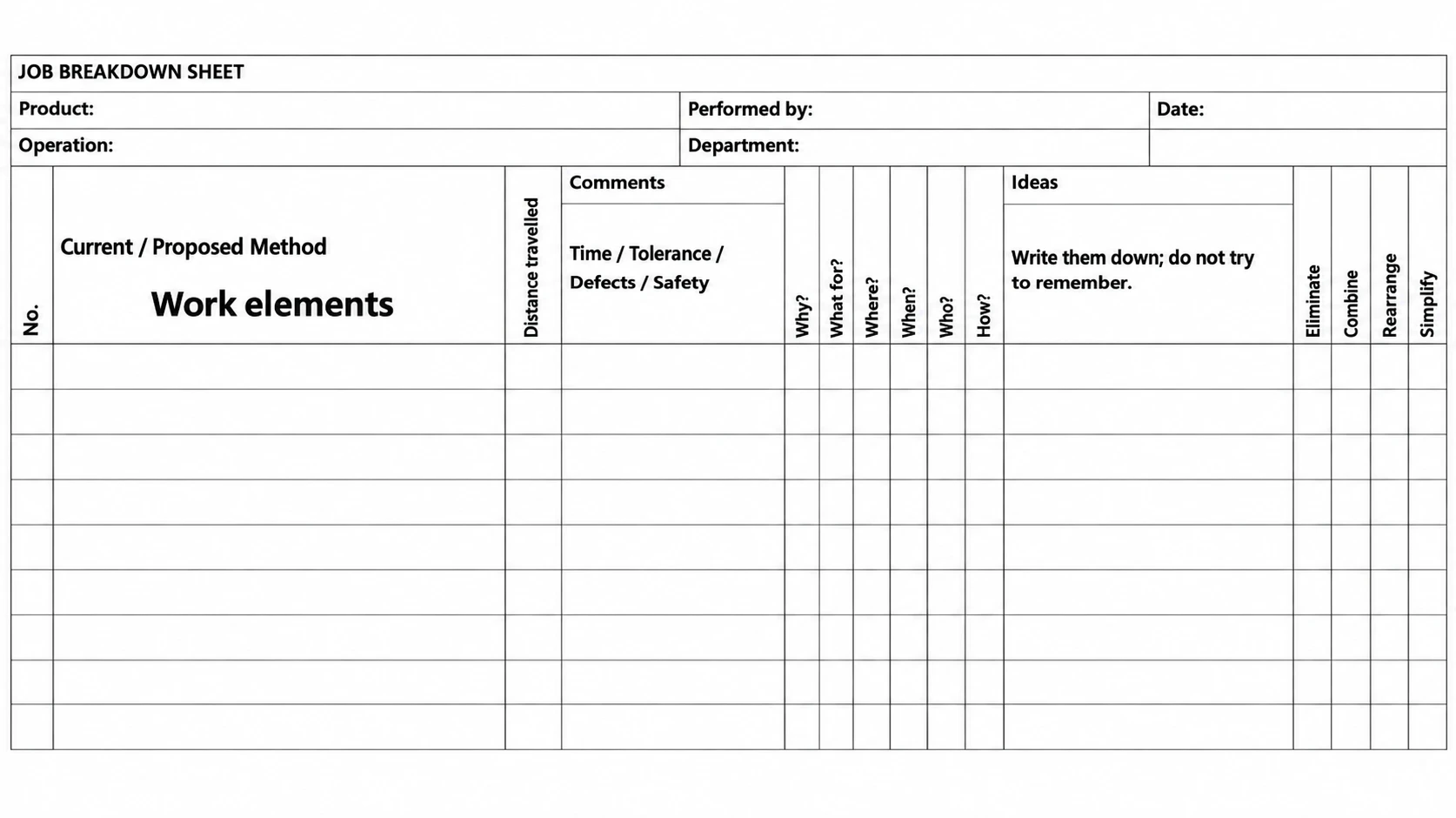 Work standardization in TWI — TWI Job Methods
Job Methods was therefore a method for developing the best known way of working.
TWI Job Instruction — standardization through training
The second pillar of standardization in TWI was effective employee training so that people could work according to the agreed best method. TWI assumed that an instruction alone was insufficient: effective teaching was essential.
The Job Instruction module therefore developed a teaching standard intended to ensure consistency and effectiveness in instruction.
Job Instruction had two key elements:
Job Breakdown Sheet (JBS)
The Job Breakdown Sheet was TWI’s basic document. It reflected work standardization at the task level. The job breakdown divided an operation into three levels:
-
Major Steps
→ What has to be done?
→ These represent the main stages of the process. -
Key Points
→ How should it be done?
→ What needs particular attention?
→ What could go wrong? -
Reasons Why
→ Why do we do it this way?
→ What is the impact on safety, quality, time or cost?
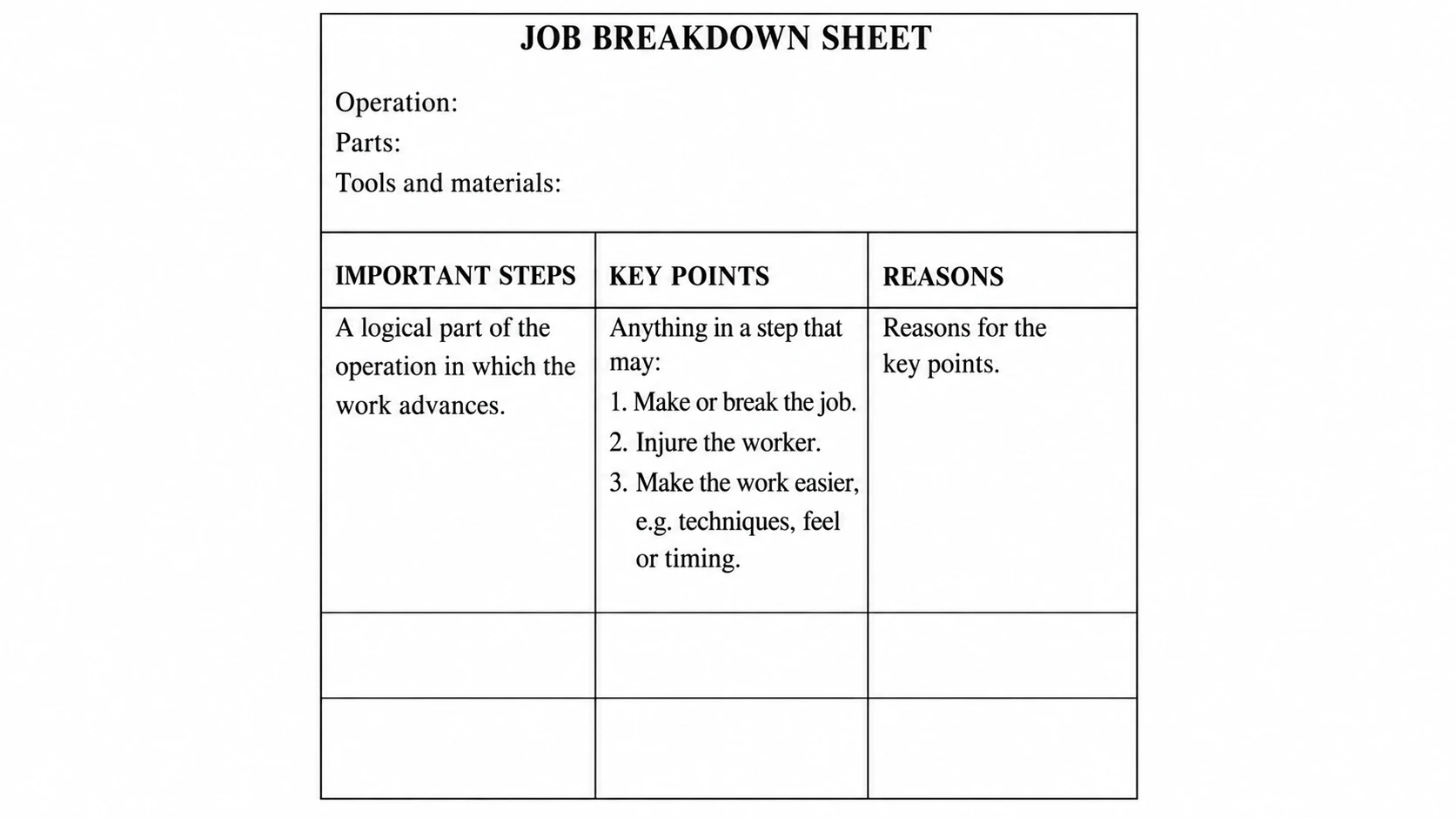 Work standardization in TWI — the Job Breakdown Sheet in TWI Job Instruction
The structure of major steps, key points and reasons helps prepare instruction. However, a TWI instruction should not be equated with a TPS standardized work sheet: the documents answer different questions. The JBS was a tool that:
-
made work easier to understand,
-
supported training,
-
provided a starting point for improvement.
The 4 steps of TWI Job Instruction
The TWI Job Instruction (JI) method taught supervisors how to train employees effectively in a work standard.
It was based on preparing an instruction in the form of a Job Breakdown Sheet — major steps, key points and reasons — and then using four training steps intended to ensure that the work could be mastered quickly and consistently.
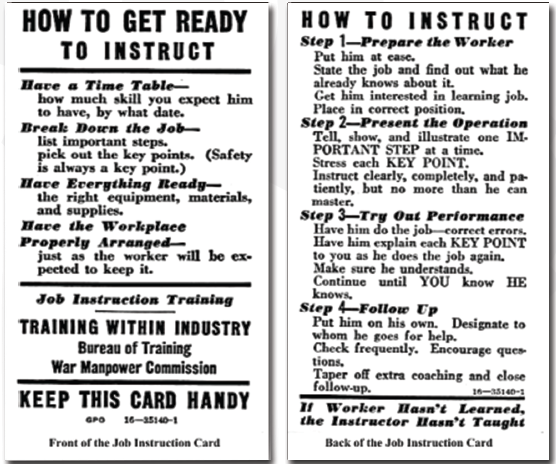 Standardized work in TWI — TWI Job Instruction
The original TWI card presented this very clearly:
Step 1 — Prepare the Worker
-
Put the employee at ease
-
Explain what the job is and find out what they already know about it
-
Get them interested in the task
-
Place the employee in the correct position
This step aimed to ensure that the employee was mentally and physically ready to learn, understood the context of the work and was not stressed by the situation.
Step 2 — Present the Operation
-
Tell, show and illustrate one major step at a time
-
Emphasize every key point
-
Teach clearly, completely and patiently
-
Do not present more than the employee can master
The instructor first demonstrated the work, explaining what to do, how to do it and why.
This was intended to distinguish good instruction from “watch me and do what I do.”
Step 3 — Try Out Performance
-
The employee does the work; the instructor corrects mistakes
-
The employee explains each key point while performing the work
-
The instructor checks understanding
-
Continue until the employee’s ability to perform the task is confirmed
This is a crucial element: employees verbalize the substance of the work, including key points and reasons, as well as repeating the movements.
The instructor makes sure that the knowledge is understood and firmly established.
Step 4 — Follow Up
-
The employee works independently
-
Agree on whom they should ask for help
-
The instructor checks progress regularly
-
Provides encouragement and guidance
-
Gradually reduces additional support
This step aimed to ensure that employees followed the standard and did not develop habits that departed from it.
The famous TWI motto:
“If the worker hasn’t learned, the instructor hasn’t taught.”
This places responsibility for learning on the instructor.
In this way, TWI introduced a structured approach to on-the-job training that remains a foundation for both work standardization systems and the development of frontline leaders.
The method was intended to ensure that every employee:
-
performed the work correctly from the first days,
-
understood how and why,
-
learned in a consistent and safe way.
Job Instruction therefore introduced a standard for teaching, going beyond simply handing over an instruction.
Toyota and TWI: how can two levels of standardization be combined?
TWI helps analyze a method and teach its execution. Standardized work in TPS also organizes the cycle, flow and workload. In practice, these documents complement one another.
| Question | TWI | Standardized work in TPS |
|---|---|---|
| What do we analyze? | The task method, steps, key points and their reasons. | The operator’s cycle, sequence, takt time and standard work in process. |
| How do we improve? | Job Methods: analyze details, then eliminate, combine, rearrange and simplify. | Observe the cycle and analyze time, movement and interaction between people and machines. |
| How do we teach? | Job Instruction: preparation, presentation, a performance trial and follow-up. | Task instruction and learning to work in the agreed sequence and conditions. |
| What sustains the result? | Instructor skills, confirmed ability to work independently and support from the leader. | Visible deviations, working conditions, daily supervision and updates after kaizen. |
A conclusion from our observations: copying worksheets alone does not create a system. The method, flow, training and daily management need to be connected. Similarities between tools do not prove that each one originated directly from TWI.
TWI’s history and its importance for standardization
Where did TWI come from?
Training Within Industry (TWI) is one of the most important approaches to developing people in industrial history. It was created in the United States during World War II, when the economy had to increase military production rapidly and millions of people with no previous experience were joining production lines. A severe shortage of skilled workers created a need for a method that could train new operators quickly and effectively, improve work effectiveness (Polish) and maintain safety in mass production.
TWI arose from a practical need: to teach people to do their work quickly, correctly and safely.
The program consisted of three main methods, also called modules:
-
Job Instruction (JI) — teaching employees
→ How to train employees so that they can quickly work independently, understand the job’s key points and know the reasons behind them.
JI helped significantly shorten onboarding and reduce errors. -
Job Methods (JM) — improving work methods
→ How to analyze and improve work by eliminating unnecessary activities and waste (Muda).
Applying JM helped increase productivity without additional capital investment. -
Job Relations (JR) — building relationships
→ How to build good team relationships, resolve personnel problems and engage employees.
JR made it possible to build a culture of responsibility and cooperation.
Additional modules appeared later, including Job Safety (JS) and Problem Solving, but the first three formed the foundation of the original TWI program.
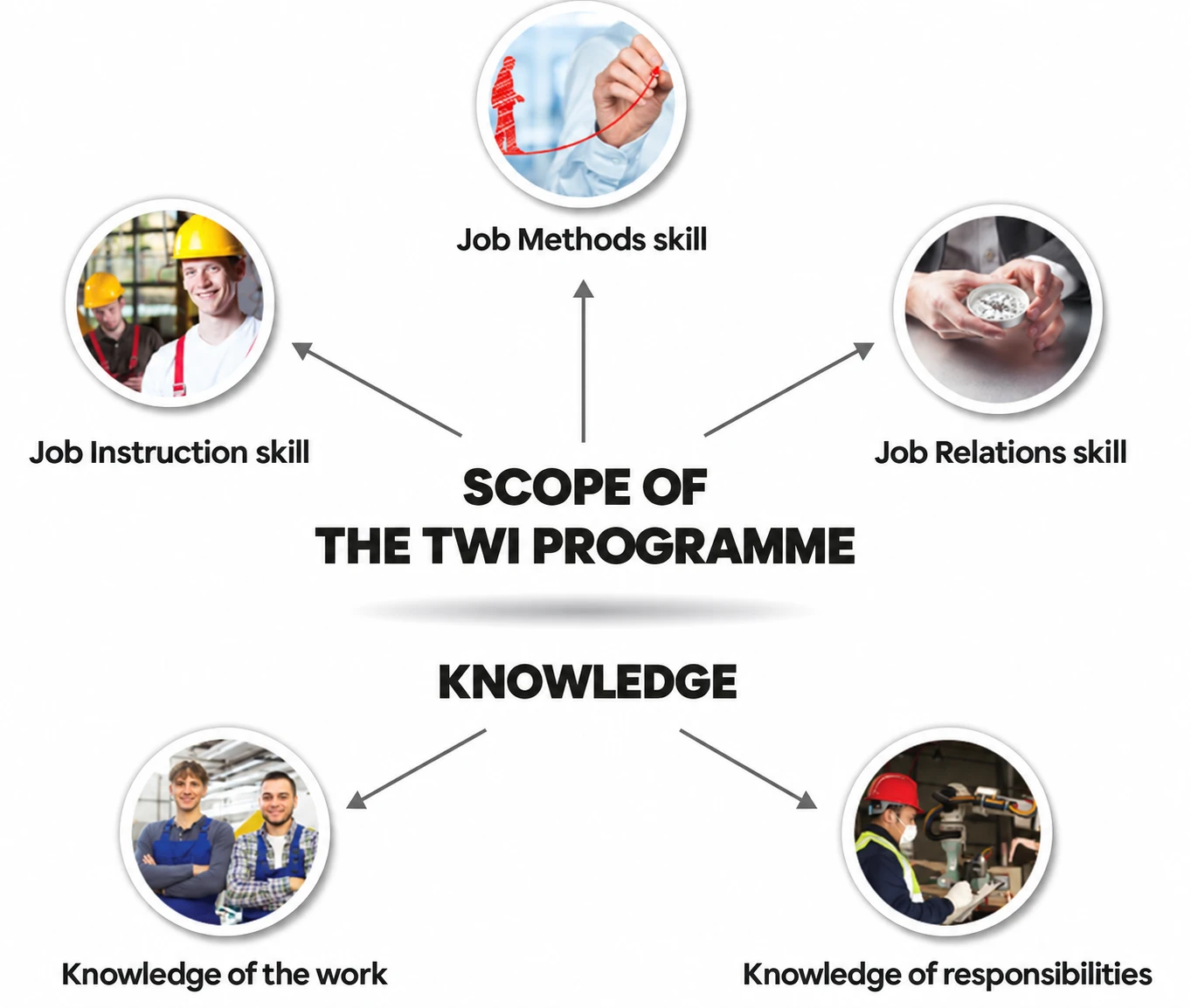 The scope of Training Within Industry: Job Instruction, Job Methods for kaizen and Job Relations
How did TWI work?
The key to TWI’s effectiveness was the simplicity and standardization of the training process itself.
TWI Job Instruction consists of four steps that structure on-the-job training:
-
Prepare the person and the workplace
-
Present the activities and explain the key points
-
Have the employee perform the work
-
Provide follow-up and support after training
This structure meant that training always followed the same pattern, enabling consistent results to be achieved quickly — a crucial requirement during wartime.
The importance of TWI — then and now
During World War II, the TWI program reached more than 16,000 US companies and trained more than one million workers.
Applying TWI shortened onboarding, reduced errors, improved safety and raised employee morale.
After the war, the program was taken overseas, including to Japan, where its potential was fully realized. Toyota integrated it into its developing production system, transforming elements of TWI into tools that remain a foundation of the Toyota Production System (Polish) and, more broadly, Lean Management.
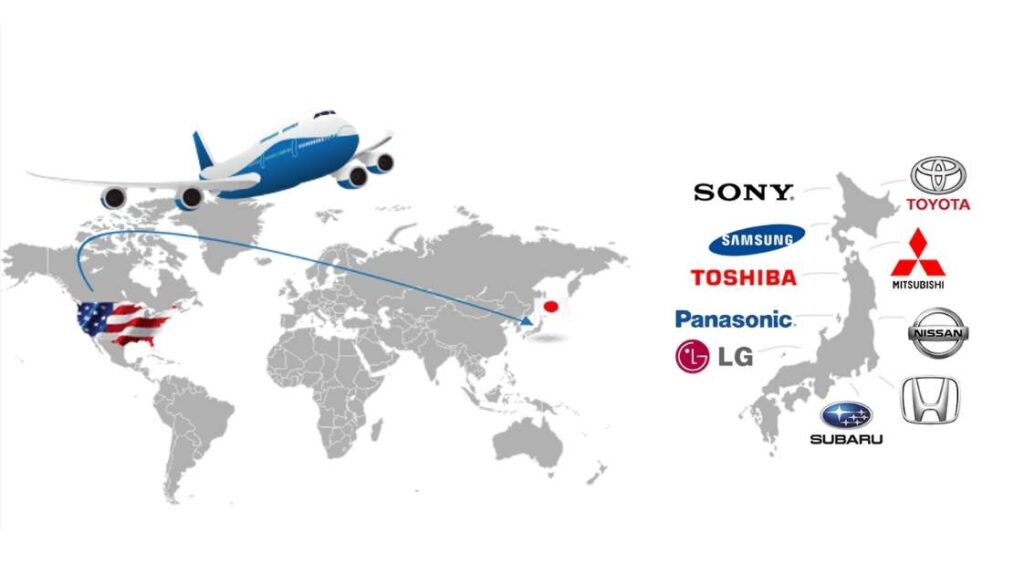 Transfer of the TWI program from the USA to Japan
TWI proved to be an effective tool for wartime survival and a lasting philosophy of work. Its foundation is developing people and standardizing work: agreeing on the best known way to perform a task, teaching it, maintaining it and improving it systematically.
An example work standard: what, how and why
The following example concerns entering an order in an office. It shows the structure of a TWI instruction. This is a teaching example; actual key points come from analyzing the specific process.
| Major step — what? | Key point — how? | Reason — why? |
|---|---|---|
| Check the order data. | Compare the customer ID, product, quantity and address against the approved source. | Reduces the risk of processing an order for the wrong customer or delivery. |
| Enter the order. | Use the correct unit and the specified product variant. | Prevents differences between the quantity or configuration ordered and the details recorded. |
| Confirm the saved order. | Check the order number and data completeness. Refer any discrepancy to the designated person before passing the order on. | Ensures traceability and stops an error before the next stage. |
Add the starting conditions, required result, version, owner and response to exceptions to the instruction. Determine processing time by observing comparable tasks, separating working time from waiting time.
How to introduce work standardization in 7 steps
- Choose the problem and process. Define the business objective, scope, work result and metric. Start in an area where variation causes errors, lost time or lengthy onboarding.
- Observe actual performance. Compare the work of different people and shifts. Record the sequence, conditions, variants, risks and times. Ask employees about the reasons for differences.
- Agree on and test the method. Use the knowledge of the people who do the work. Test the solution for safety, quality, ergonomics and results.
- Prepare the right standard. Choose the document to suit the purpose: a TWI instruction for teaching a task, standardized work sheets for organizing the cycle, or a checklist for checking completeness.
- Teach and confirm independent performance. Provide instruction, observe a performance trial and check understanding of the key points. Record confirmed competencies.
- Provide the conditions and supervision. Make the current version, tools and support available. Define the response to deviations and the leader’s workplace observations.
- Measure and improve. Compare results with the starting point. After an improvement is approved, update the document, retrain the people affected and check performance again.
First, bring one process to a standard that works. Expanding the system makes sense when you can repeat the approach to analysis, training and maintenance.
Standardization in offices, automation and services
Administration and Lean Office
Organize the required data, decision rules, responsibilities, handovers between departments and exception handling. Standardize repeatable elements without forcing every case to follow an identical path.
Work standards in Lean Office — a guide (Polish)Automated processes
Describe the human tasks: startup, checks, replenishing materials, changing variants and responding to alarms. Separate cyclical work from periodic tasks.
See the 7 steps for automation (Polish)Long and infrequently repeated operations
Divide the task into meaningful modules, define rules for choosing variants and identify shared quality and safety points. Match the scope of training to the complexity of the work.
See methods for long operations (Polish)Healthcare and services
Define requirements for identification, data completeness, preparation and handover. A process standard supports organizational consistency while allowing decisions appropriate to the situation.
See the hospital application (Polish)Digital standards and AI
Digital instructions make access, change approval, version control and links to competencies easier. eTWI supports the organization of this system. AI can help structure a description or suggest questions for analysis, but the method must be tested in the process and approved by the people responsible. A screen or QR code alone does not confirm that an employee can perform the task.
Work standardization in practice: LeanTrix case studies
See how standards, training and maintenance work together in different environments. The results relate to the implementations described and are not forecasts for every organization.
Danone / Żywiec Zdrój
Onboarding time in production areas reduced by up to 50%. An example of combining training, digital instructions and competency tracking in automated production.
Read the Danone case studyRECARO
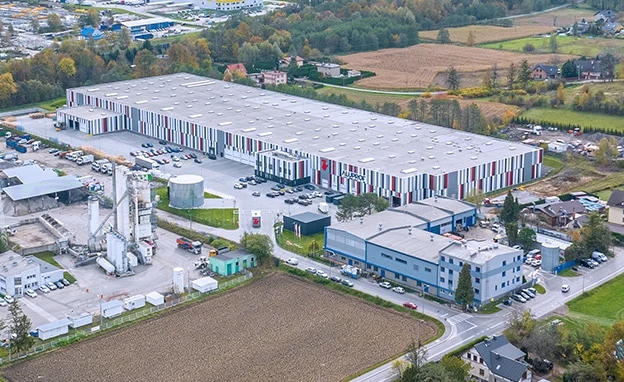
Employee onboarding time reduced by 50%, errors causing scrap by 20% and errors causing rework by 25%. Instructions, instructors, audits and the skills matrix form a shared system.
Read the RECARO case studyIkano Industry
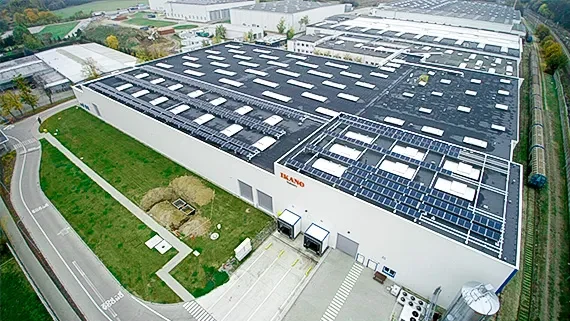
The story of a transition from a training initiative to TWI linked to strategy and production needs. The implementation is described as ongoing; the case study presents decisions and lessons without adding unconfirmed results.
Read the Ikano Industry case studyWork standardization audit: check whether the system works
An audit should compare the documented method with the actual work. Check the quality of instructions, their availability, competencies, adherence to the standard and improvement. Evidence comes from observing performance and records showing how the system operates.
- Choose one process and define the observation sample.
- Compare performance with the standard and ask about key points.
- Record evidence, score the criteria and justify “not applicable” responses.
- Agree on three actions and a date for a follow-up check.
Scoring: 0–3 points for each criterion. Percentage score = total points / (3 × number of assessed criteria) × 100. Do not average critical safety or quality gaps together with the other scores.
If you need to assess several processes and get support in setting priorities, see the work standardization audit delivered by LeanTrix.
How to measure results and avoid common mistakes
| Metric | What should you compare? |
|---|---|
| Time to independent performance | From the start of training to confirmed performance against agreed criteria. |
| Errors and rework | The number of errors relative to a comparable number of completed tasks. |
| Adherence to the standard | The percentage of compliant observations of critical elements, with a description of the sample. |
| Process time | Working time and waiting time separately, including variation between completed tasks. |
| Team flexibility | The number of people with confirmed ability to work independently on the required tasks. |
Do not judge an implementation solely by the number of documents or people trained. Read more about metric definitions: KPIs for TWI implementation.
Five mistakes that weaken standardization
- Creating instructions without observation or employee involvement.
- Ending training with a signature without checking performance.
- Working conditions that prevent people from following the agreed method.
- Making an improvement without updating the standard and retraining people.
- Checking documents without checking how people actually work.
When an employee departs from the standard, investigate why: the method’s validity, working conditions, document availability and the way training was delivered. An audit result should lead to process improvement.
Work standardization and video instructions: watch the videos
Toyota and TWI — our observations
Recording of the webinar held on November 14, 2025 (Polish).
Open the webinar on YouTube (Polish)Video instructions using TWI
A practical video about visually communicating a method (Polish).
Open the video on YouTube (Polish)More on the principles of preparing a video: video instructions using TWI (Polish). Video complements instruction and needs the same control of currency as a written instruction.
Frequently asked questions about work standardization
Are work standardization and a job instruction the same thing?
An instruction is one tool. Standardization also includes agreeing on the method, working conditions, training, supervision, measuring results and updating the standard.
How does a TWI instruction differ from standardized work at Toyota?
A TWI instruction explains steps, key points and reasons for teaching a task. Standardized work in TPS also describes the organization of the cycle: takt time, sequence and standard work in process.
Does a standard hold back kaizen?
The current standard provides a reference point for testing an improvement. Once a better method has been confirmed, the document and training are updated.
Can administrative work be standardized?
Yes. Repeatable steps, inputs, acceptance criteria and handover rules can be agreed. Exceptions require decision rules, rather than artificially making every case identical.
Who should be responsible for the standard?
The process owner is responsible for keeping it current and approving it. Employees help develop the method, the instructor teaches its execution, and the leader provides the conditions and checks adherence.
How often should a standardization audit be performed?
Frequency depends on process risk and stability. It is useful to check performance after implementation, a method change, a quality problem or a change in staffing, and to incorporate regular observations into the leader’s work.
Develop your skills: workshops and resources
After learning the principles, you can practice applying them in a real working environment. Current dates and conditions are available on the individual training pages.
PepsiCo: people and processes
Integrated TWI work standardization: combining process analysis, instructions and training.
View the PepsiCo workshop (Polish)Automation, SMED and TPM
Applying TWI to operator tasks in automated processes.
View the training program (Polish)Standards for cleaning, inspection and responding to deviations are also a foundation of TPM — Total Productive Maintenance.
The method’s foundations: what TWI is and on-the-job training using TWI (Polish).
Sources and context: LeanTrix’s own observations and materials, the case studies described, original TWI materials and Toyota Production System documentation. The worksheet illustrations retain the source references from the original article.
- Original TWI materials from the 1940s (Polish)
- Toyota: history and foundations of the Toyota Production System
Guide updated: October 4, 2026.

I am a promoter of Lean Management and the Training Within Industry program. I am a practitioner. I co-create many startups. Since 2015, I have been the CEO of Leantrix - a leading Lean consulting company in Poland, which, starting from 2024, organizes one of the largest conferences dedicated to lean management in Poland - the Lean TWI Summit. Since 2019, I have been the CEO of Do Lean IT OU, a company registered in Estonia that creates the software etwi.io, used by dozens of manufacturing and service companies in Europe and the USA.