Lean implementation in healthcare at Penta Hospitals. Penta Hospitals (Polish website) had data, reports, indicators and Lean tools. Yet change did not advance as expected. Returning to teams’ daily work revealed that Lean Healthcare in practice starts with a problem people can see, understand and want to solve.
This is the story of a journey: from believing that data alone would trigger improvement, through team resistance and scepticism, to a system built on process observation, problem solving, standardisation and leadership development. Four examples show effects on patient care, admissions, emergency readiness and inventory management. The case was presented in the Lean Healthcare stream at Lean Summit ’26, formerly Lean TWI Summit.
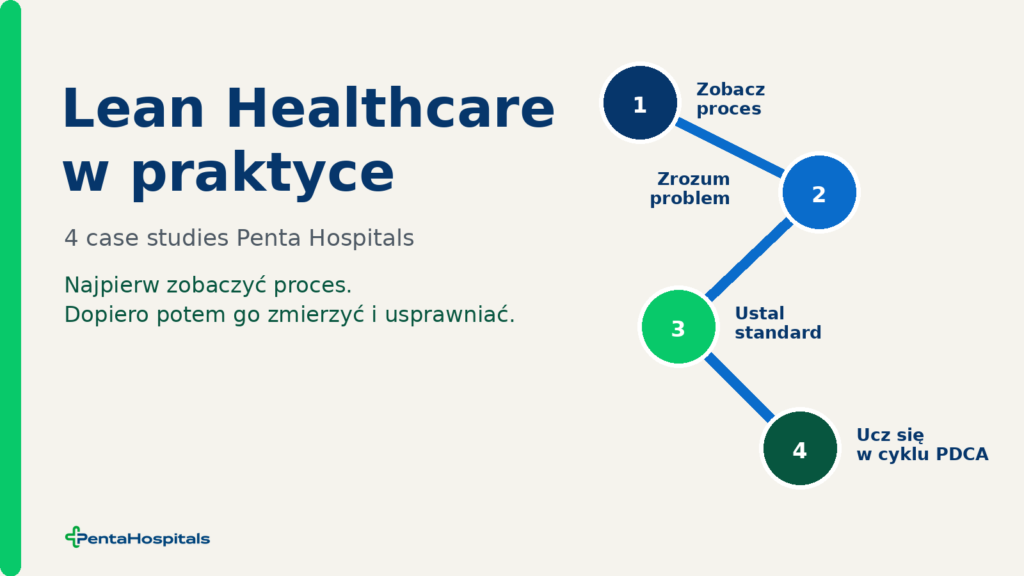
Lean Healthcare in practice: a journey of learning
Transformation often begins with a decision to implement Lean, indicators, training, a meeting schedule and tools. The apparent logic is that describing processes and collecting data will naturally change how people work.
Penta Hospitals initially also expected rapid implementation. Data revealed previously hidden problems but did not yet create engagement. Teams said they had been told to attend, called Lean another spreadsheet, emphasised their differences and said a hospital was not a screw factory. This was a significant signal: the organisation had introduced tools without adequately explaining why the change mattered to patients and staff’s daily work.
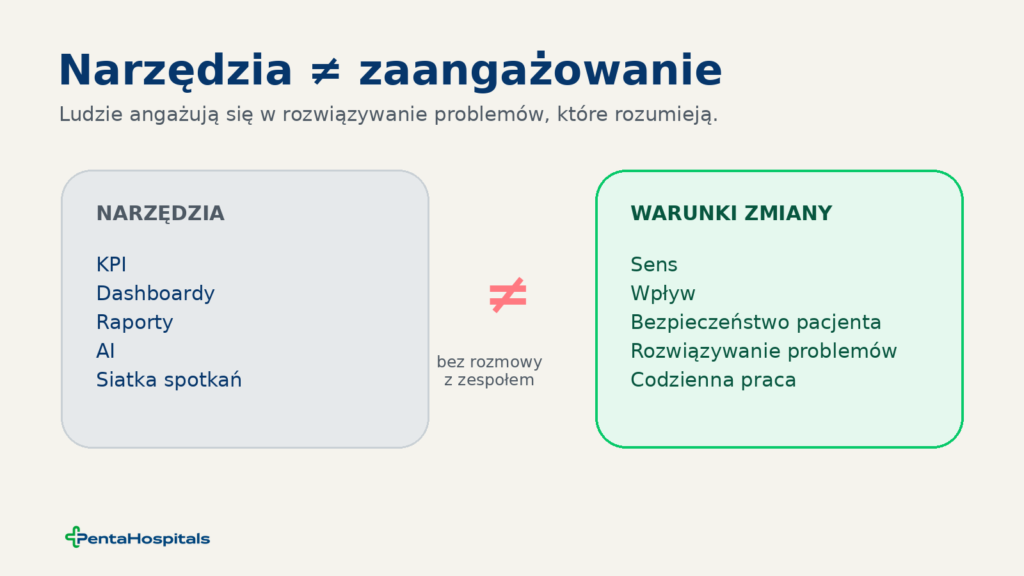
People engage in solving problems they understand and whose consequences they see in their work. Tools support that engagement.
This distinction shaped the approach. KPIs, dashboards, reports, AI and meeting structures can help, while purpose, influence and conversation remain essential. In healthcare, the purpose is clear: a more stable process means less risk of error and chaos, more time for care and a better patient experience.
Penta Hospitals: a large network with local operating problems
Penta Hospitals Polska (Polish) manages hospitals and medical facilities across Poland. The conference materials described 20 hospitals, 18 outpatient clinics, 18 long-term care facilities, eight clinical research centres and eight emergency medical units. More than 95% of activity was reported as funded by Poland’s National Health Fund (NFZ). The group therefore works close to public healthcare realities: staffing constraints, operating pressure, variability and responsibility for continuity of care.
Facilities differ in size, services and local environment, but share many organisational problems. Staff search for supplies, patients wait between stages, departments work to different rhythms and critical information arrives late. Improvements can arise locally while shared learning principles develop across the network.
From data to process observation: from the gemba walk to the spreadsheet
Penta retained data while changing its role in improvement. Teams started by going to where value is created, talking to people and observing the flow of patients, information, materials and decisions.
Data could then answer the right questions. Indicators became signals of specific process problems. The presentation expressed the sequence as “From the gemba walk to Excel, rather than the other way round.”
The Penta Kaizen system developed on this foundation, including:
- Gemba walks and observation of actual work.
- Quality improvement programmes following PDCA.
- 6S audits incorporating safety.
- Briefings, development meetings and indicator reviews.
- Recording and monitoring improvement actions.
- Developing internal improvement leaders.
The aim was a repeatable approach: see the problem, establish its cause, design a change, check the effect and sustain the standard.
Four Penta Hospitals cases: from patient safety to process flow
| Area | Problem observed | Direction of change | Observed result |
|---|---|---|---|
| ICU: nutritional treatment and pressure ulcers | Substantial nursing time caring for pressure ulcers, with new ulcers co-occurring with poorer nutritional status. | Nutritional treatment, a dietitian in the interdisciplinary team and a process avoiding additional burden on medical staff. | New pressure ulcers declined in successive periods; none were recorded in the analysed group during January–May 2026. |
| Cardiac arrest | Risk of chaos, duplicated actions and searching for equipment when time is critical. | Clear nursing roles, a standard resuscitation trolley, visible labels and a readiness checklist. | More predictable cooperation and reduced risk of omissions; no clinical outcome measurement was provided. |
| Admissions department | Different schedules, duplicated appointment times, inconsistent work rhythms and hours of patient waiting. | One schedule, differentiated slots, advance document completion and assistant support. | Time from planned admission to entering the ward fell from 181 minutes in January to 52 in September. |
| Operating theatre inventory | Intuitive ordering and “just in case” stocks without shared inventory levels. | Gemba walks, joint observation, organised materials and stable replenishment rules. | The inventory value index fell from 100 to 61.6 during the observed year, approximately 38%. |
Case 1. Nutritional treatment and pressure ulcers: a staff-time problem leads to broader investigation
The Intensive Care Unit team began by asking where staff time went. Observation revealed significant nursing work associated with pressure ulcer care, estimated in the presentation at approximately 146 hours annually.
Problem solving revealed an additional observational relationship: patients developing new pressure ulcers often also had poorer nutritional parameters. The team broadened its perspective from wound care to the whole care process.
What changed?
- Nutritional treatment became part of the care process.
- A dietitian joined doctors and nurses in the interdisciplinary team.
- Activities were designed to avoid adding administrative burden to medical staff.
- Clinical outcome evaluation was connected with staff time and material consumption.
The conference data showed 35 new pressure ulcers among 86 patients in 2023, 24 among 90 in 2024 and 10 among 107 in 2025. No new case was recorded among 35 patients during January–May 2026.
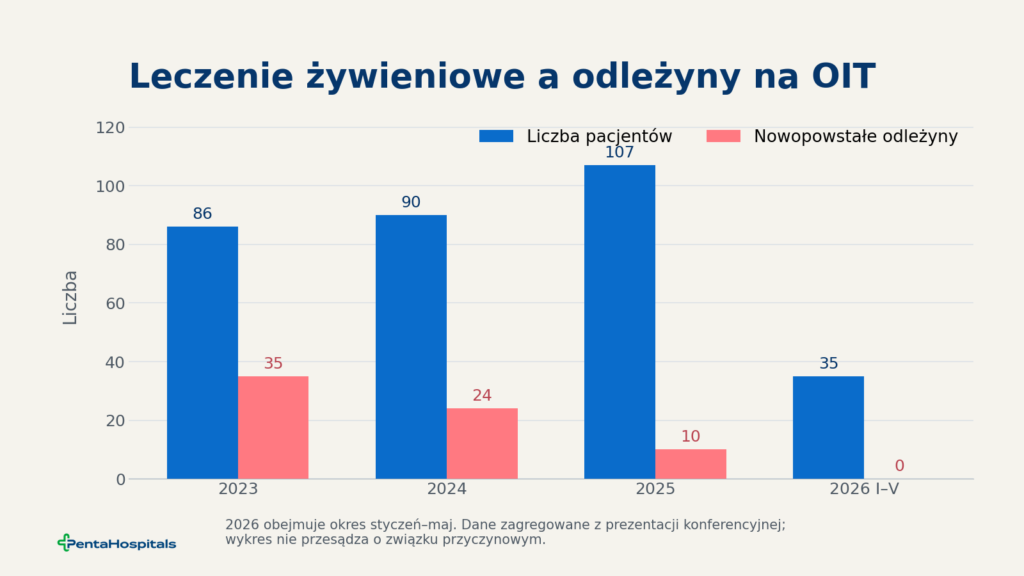
The presentation identified three benefit groups: lower risk of pressure-ulcer complications, more staff time for direct care and reduced use of some medicines and dressings. Interpretation must remain proportionate. This was a before-and-after observation without a control group, risk adjustment or publicly described indicator definition. The trend is valuable but does not establish causality or prove that nutritional treatment alone produced the entire effect.
Key lesson: the team began with staff time, and process observation led to a broader view of patient condition and interdisciplinary cooperation.
Case 2. Standardising cardiac arrest response: predictability when every second matters
Cardiac arrest is extremely demanding. Many people want to help immediately, but without clear roles actions may be duplicated and communication can become chaotic. Penta treated this as a process problem.
The example clarified roles for three nurses. The first covered tasks including medication administration and assisting with intubation; the second monitored parameters, communicated information, established intravenous access and took blood; the third oversaw compliance, documentation and the checklist. Task allocation must always fit local procedures, professional permissions and team composition. The transferable Lean principle is removing ambiguity before a critical situation.
A second element was the resuscitation trolley: a fixed equipment list, logical drawer arrangement, clear labels, daily checks and checks after every use. Trolleys on the ward were to share the same layout so staff could locate equipment immediately. The European Resuscitation Council 2025 guidelines provide the wider resuscitation context; this case concerns the organisational layer of readiness.
The conference materials did not measure the effect on clinical outcomes. The supported conclusion concerns greater process predictability and readiness, rather than a proven change in survival.
Case 3. Admissions time: one schedule aligns different work rhythms
The admissions process was fragmented. NFZ-funded and private patients were scheduled separately, two reception desks could assign identical appointment times, doctors did not always know the admission order and doctors and nurses followed different rhythms. Patients waited approximately three hours on average from arrival at the hospital to entering the ward.
The team first reorganised work:
- One schedule for NFZ-funded and private patients.
- Longer slots for oncology patients and shorter ones where appropriate to the process.
- Some documentation available for completion at home.
- An admissions assistant as an interim solution until changes to the medical system and reduced paper documentation.
In January, time from the planned admission appointment to entering the ward was 181 minutes. It then fell to 110–112 minutes, approximately 100, 70, 39 in July and 52 in August and September. The final available value was approximately 71% lower than January.
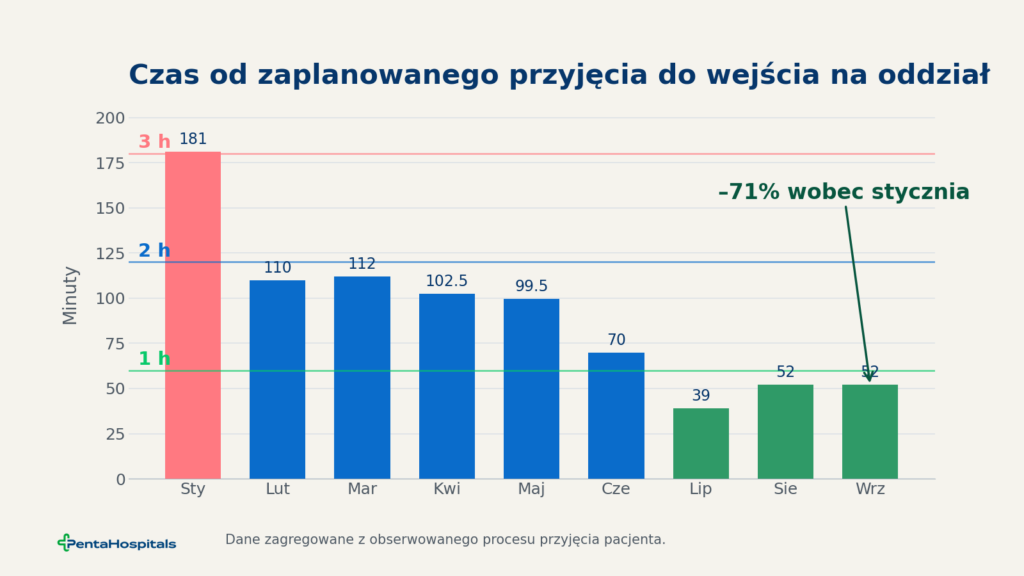
Patients experience waiting, uncertainty, repeated information and communication as well as treatment outcomes. Reducing time contributed to a more predictable patient journey.
Case 4. Operating theatre stocks: fresh eyes reveal “just in case” ordering
Analysis began with a joint gemba walk involving people outside the area, including the hospital director. They noticed practices the regular team had come to accept. Materials were ordered intuitively, often in reserve, without an agreed reference for appropriate levels.
Inventory values began stabilising after the process was organised. To protect absolute data, the chart uses an index with January equal to 100. December was 61.6, a reduction of approximately 38%. Small increases occurred during the year, but the process remained clearly below its starting level.
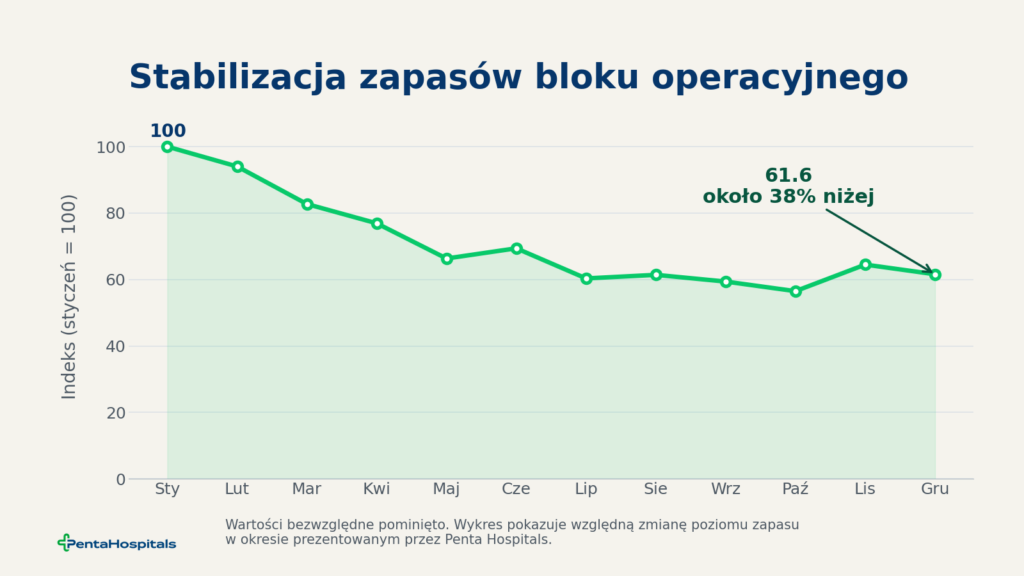
Clear stock levels facilitate replenishment, reduce searching, reveal deviations and reduce the risk of excess in one place masking shortages elsewhere. The goal is appropriate availability with less variability and better visibility.
6S audits: seeing what has become familiar
6S developed gradually. Initial audits in 2022 covered endoscopy, reception, a ward and the operating theatre. A quarterly plan followed, admissions and sterilisation were added, forms were modified and anaesthesia areas separated. By 2026, eight areas were included, with reported scores of 93–100%.
The crucial effect went beyond scoring. Auditors from other areas asked questions the regular team had stopped asking. Familiar clutter, unclear arrangements, temporary storage and excess documents can disappear from attention. 5S and 6S in healthcare (Polish) create value when they restore the ability to notice deviations.
Audits led to concrete improvements:
- Ready-made supply packs for repeat procedures.
- Organised drawers and materials on the orthopaedic ward.
- A clearer admissions board.
- More transparent storage of operating theatre equipment.
These changes reduced searching, motion, uncertainty and dependence on individual memory.
From projects to a way of working
In June 2026, Penta Hospitals reported activity beyond a single pilot:
| Scale | Meaning in practice |
|---|---|
| Over 1,500 improvement actions | Small and larger changes removing process waste; over 250 occurred in 2026 before the presentation. |
| Over 50 problem-solving meetings | Structured investigation from symptoms to causes and experimentation with solutions. |
| Over 50 leaders | People actively developing improvement culture beyond a single central project team. |
| Over 120 mapped processes | A basis for shared understanding and selecting improvement priorities. |
Scale alone does not prove maturity. Idea counts must connect with the quality of problems solved, sustained standards and effects on patients and staff. The important evolution was towards a daily management and learning system.
Five lessons from Penta Hospitals
1. Improvement must be part of work
Improvement that sits beside daily work loses to urgent tasks. It should help solve problems already consuming time, causing stress and creating risk.
2. Tools need purpose and influence
A spreadsheet, board or audit can organise activity. Teams need to understand the problem and influence the solution, or Lean feels like control or another spreadsheet.
3. People need to understand why
Patient safety, patient time, staff workload and care quality provide a strong reference. Financial goals may matter but rarely create lasting behavioural change alone.
4. Process observation changes perspective
Data reveals a deviation; the gemba shows how it arises. Without observation, organisations may invest in solving the wrong problem.
5. Patient safety begins with a stable process
Clinical knowledge needs ready equipment, clear responsibilities, visible information and predictable flow. Lean and patient safety (Polish) connect at this organisational layer.
How can another hospital apply these lessons?
Begin with one problem felt by patients and staff. Seven steps provide a practical route:
- Select a specific problem: waiting at admissions, searching for equipment or unstable stock levels.
- Go to the workplace. Observe the whole journey across departments.
- Talk to the people doing the work. Ask about workarounds, exceptions, interruptions and memory-dependent tasks.
- Collect data after observing. Define start, finish and deviation so indicators reflect reality.
- Design the smallest useful experiment. One schedule, layout standard, checklist or clear role allocation may test the hypothesis.
- Measure outcomes and side effects. Time savings must preserve safety and quality without shifting burden elsewhere.
- Assign an owner and PDCA rhythm. Review, responses to deviations and updates keep standards current.
Ask the question running through all four cases: what can people closest to the patient see that the report does not show?
FAQ: implementing Lean in healthcare
What is Lean Healthcare?
Lean Healthcare designs and improves care processes around value for the patient. It reduces waiting, errors, unnecessary motion, excess inventory and unclear handovers while engaging staff in problem solving.
Is healthcare Lean primarily about cutting costs?
No. A safe, smooth patient process and work without unnecessary obstacles should come first. Economic benefits are valuable when they follow waste elimination while preserving needed care.
Where should implementation begin?
With one recurring problem and gemba observation. Mapping, measures and solution testing follow understanding of actual work.
Is hospital 5S or 6S just tidiness?
No. It creates a clear, safe, predictable environment where shortages, deviations and risks become visible and work depends less on individual memory.
Is a new IT system necessary?
Not always. The admissions case first aligned scheduling and work organisation; an assistant bridged the period before system changes. Technology should support an agreed process.
How should effects be measured?
Combine safety and quality, patient experience, staff workload and process effectiveness. Define the period, population and calculation method for comparability.
Related LeanTrix materials
- Lean in healthcare (Polish)—support for designing and improving medical facility processes.
- Lean Healthcare: an introduction (Polish).
- Gemba walks in hospitals (Polish)—seeing actual work.
- 5S in healthcare (Polish)—a clear, safe environment.
- Patient safety and Lean (Polish)—reducing error and risk through stable processes.
Observe the process first, then measure and improve it. Data matters; lasting change develops when teams understand the problem, see its effect on patients and can jointly design a better way of working.
Source
This article is based on materials presented at Lean TWI Summit 2026 in Wrocław on 9–10 June 2026. Marta Ciechanowicz presented Penta Hospitals Polska’s case, “Seeing more—treating more effectively. Lean in healthcare”, on 10 June 2026. All operational data are aggregate figures from the conference presentation. Charts were redrawn, and details revealing documentation, equipment or internal systems were omitted.

Marta Ciechanowicz is Deputy Director of EuroMediCare Hospital and Outpatient Clinic in Wrocław and Lean Transformation Manager at Penta Hospitals Polska.
She graduated in nursing from Wrocław Medical University. She combines clinical experience with a systems approach, coordinating the development of Lean Healthcare across a network of hospitals and working with her team to establish a culture of continuous improvement at EuroMediCare Hospital.
Her work focuses on ensuring that team engagement supports patient safety and stable processes.