


Train consistently
Reduce learning time and errors with TWI Job Instruction.

LeanTrix Knowledge is a practical map of Lean Management, TWI, Toyota Kata, TOC, quality and transformation resources. Start with a core method, a business challenge or one of our original publications and case studies.
A structured knowledge base for leaders, practitioners and improvement teams. Learn the foundations, explore proven methods and move from an idea to measurable change in daily work.
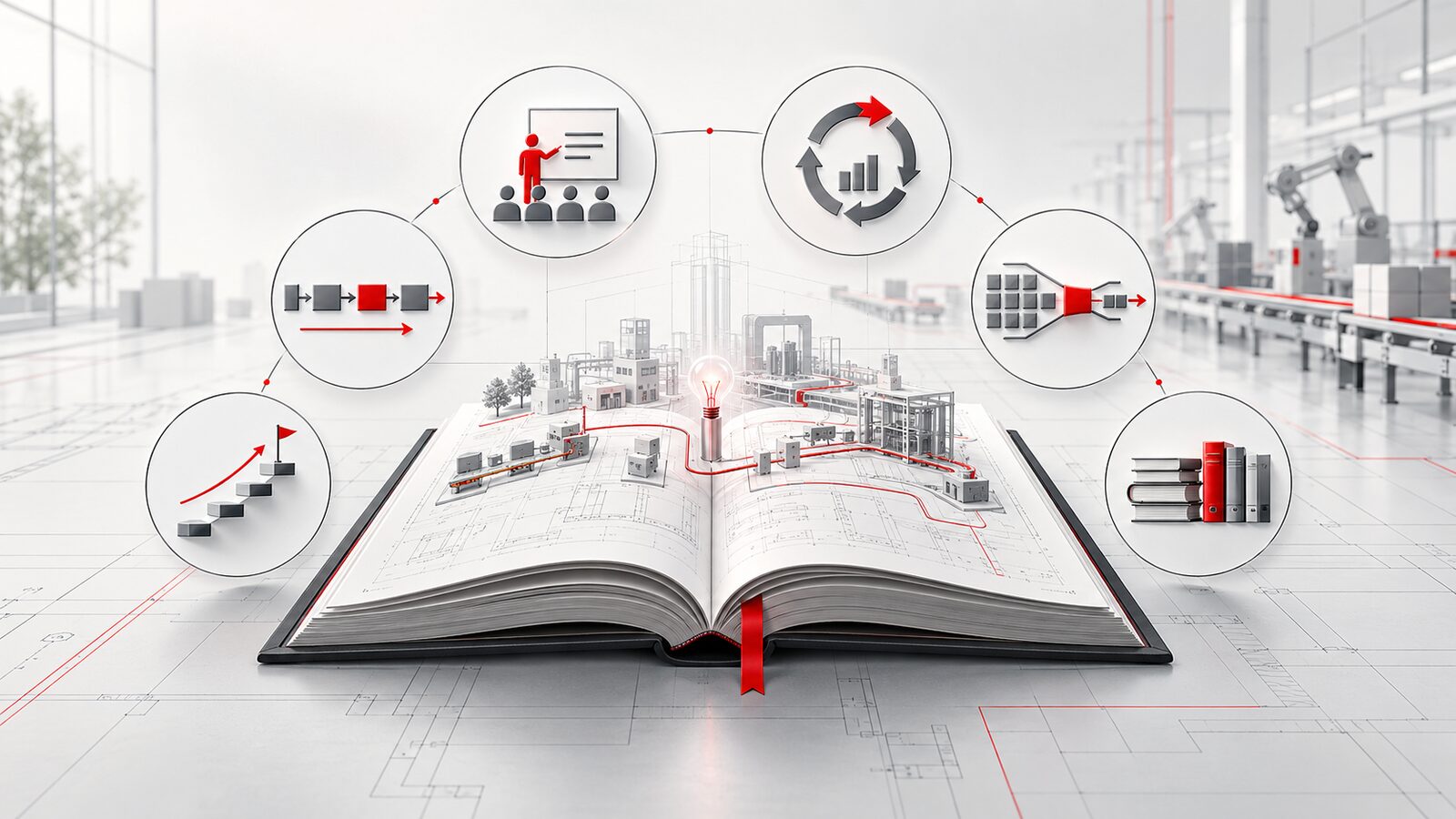
Each pillar answers a different management question. Use these pages as your starting points and follow the internal links to more specialised methods, examples and services.
You do not need to know the name of the method first. Start with the operational result your organisation needs.
Reduce learning time and errors with TWI Job Instruction.
Engage employees in safer, simpler work with TWI Job Methods.
Recover capacity and flexibility with SMED.
Prevent losses and build ownership with TPM.
See queues, delays and bottlenecks with VSM, Kanban and Heijunka.
Create visual standards and stable conditions with the 5S system.
Develop quality at the source with TWI Job Quality.
Connect strategy, people and processes through the LeanTrix Transformation Loop.
Evergreen guides, current insights, implementation evidence and source materials remain available at their existing addresses—now organised in one place.
Definitions, methods and practical explanations designed for structured learning.
Browse articlesEnglish-language perspectives on TWI, Toyota Kata, innovation and management practice.
Read latest insightsSee how organisations applied Lean, TWI and improvement systems in real conditions.
View case studiesA standard becomes useful only when people can learn it, apply it and improve it. These three steps form one practical pathway.
Use the library when you need more than a summary: primary TWI documents, downloadable working materials, client evidence and a complete transformation model.
Looking for proof from clients? Visit our client references or meet the practitioners behind this knowledge on the LeanTrix team page.
Choose the path that matches your current level: fundamentals, a concrete operational challenge, original materials or implementation support.
Begin with Lean Management, then choose one concrete challenge. If the challenge is training and standardisation, continue with TWI. If it is flow, start with VSM; if it is a system bottleneck, explore TOC.
Articles explain lasting concepts and methods. Insights collect newer English-language perspectives and commentary. Case studies show what was implemented, in what context and with what result.
Yes. The TWI archive page provides six historical manuals in PDF format together with context that helps readers understand their origin and modern use.
Yes. The principles of flow, capability building, problem solving and daily management apply to services, healthcare, logistics, administration and other knowledge-work environments.
Use the relevant service page to define your starting point, review our case studies, and book a consultation. We will help connect the method with your organisation’s actual constraint and management system.
Our experts combine Lean, TWI, TOC, Toyota Kata, quality and digital tools. We can help you select the right starting point and turn knowledge into a measurable implementation.