
TWI implementation at Ikano Industry began with a setback. The first initiative brought together enthusiasts, launched training and generated activity, but lacked a strong connection to production needs and strategic goals. Tensions, weak instruction quality and growing resistance emerged instead of lasting change.
Hanna Glinka, Production Director at Ikano Industry, presented a valuable account of the journey from an initiative alongside the process to a system intended to support strategy. Implementation was still under way. The decisions designed to produce measurable improvement therefore deserve attention without inventing outcomes.
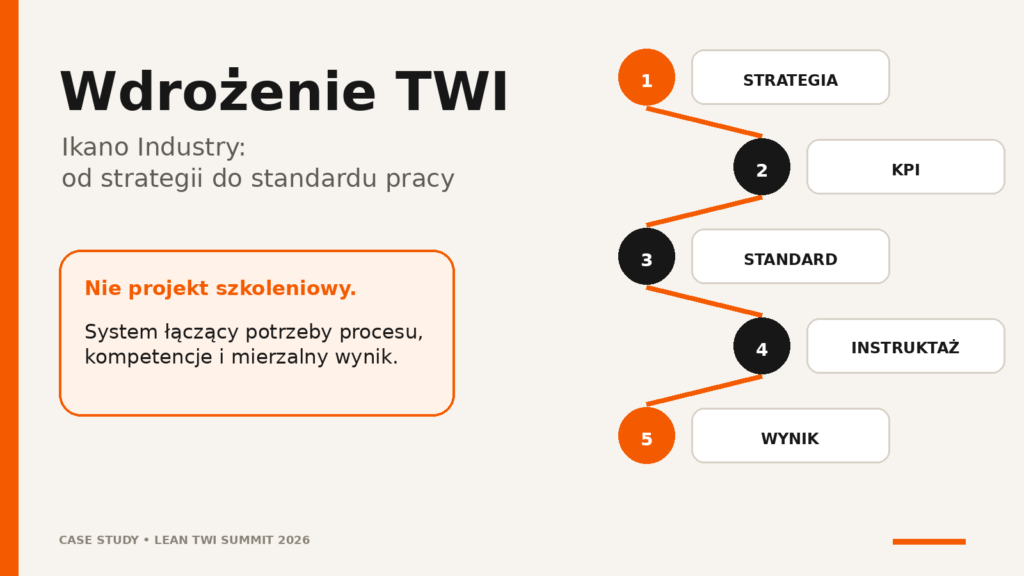
This implementation demonstrates why standards must arise from process needs. Foundations, examples and system evaluation are discussed in the standardised work compendium (Polish).
TWI implementation as a result of cascading strategic goals
The presentation title—“TWI implementation as a result of cascading strategic goals at IKANO Industry”—sets the perspective immediately. TWI should respond to specific business and development problems visible in the process rather than compete with production as a separate training project.
This distinction is crucial. Instructors can be trained, sheets prepared and instruction sessions counted without improving process capability. Activity becomes meaningful when standards and measures reveal whether new employees reach independence sooner, operations become more productive and errors decrease.
TWI should solve an important process problem and support a goal for which someone is genuinely accountable.
Ikano Industry: the manufacturing context
Ikano Industry (Polish) manufactures mattresses through an integrated process including foam production, component preparation, cover sewing and assembly. According to company information, it has two plants in Poland, employs approximately 1,000 co-workers there and produces almost three million mattresses annually.
At this scale, employee onboarding affects line capacity to meet the plan, quality stability, the workload of experienced operators and leaders and the time needed for a new employee to work safely and independently.
“Difficult or easy?”: an exercise exposing the instruction problem
Hanna Glinka opened with an apparently simple task: putting a cover on a small mattress. Four volunteers acted as new Ikano employees. They needed to meet quality requirements within the specified takt time.
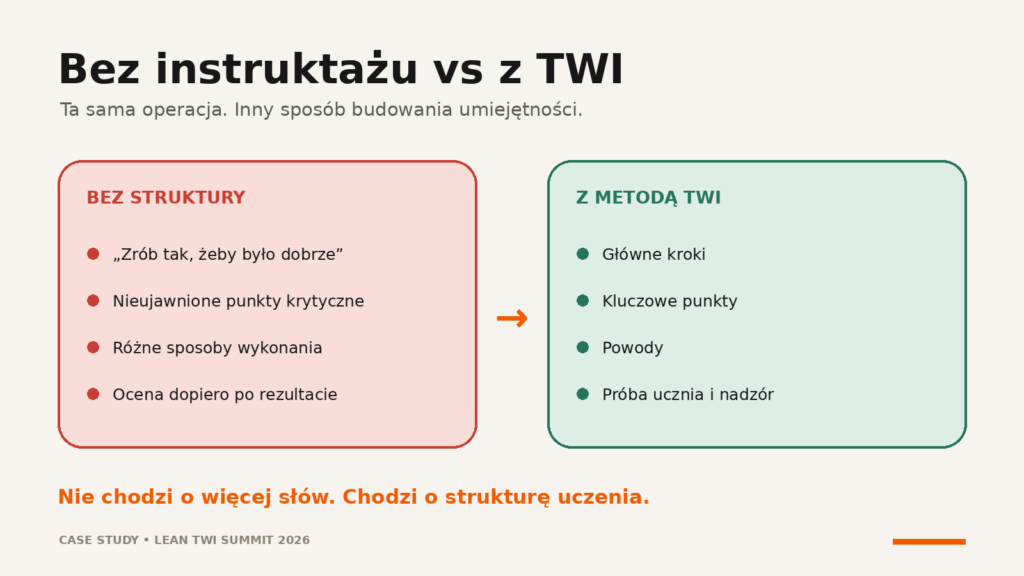
First, participants performed the operation without structured instruction. They then learned through TWI. The presentation did not provide a numerical comparison, so no time or quality difference should be inferred. The exercise nevertheless illustrates a typical onboarding problem: an operation obvious to an expert may contain a sequence, critical points and reasons unknown to a newcomer.
Why did the first TWI attempt generate resistance?
Ikano analysed the implementation conditions rather than treating resistance as an employee attitude problem. The presentation identified four causes:
- A small group of enthusiasts operating outside Production: the initiative lacked strong roots where results were expected.
- No outcome measures or link to company strategy: training counts did not reveal whether the process improved.
- A training plan disconnected from real production needs: activity was linked to instructors’ bonus system rather than process skill gaps.
- Pressure on instructors to “optimise” instruction: teaching was expected to be shortened or modified before stable application of the method had been established.
These decisions created a predictable chain. Without a clear customer for the change, people were pulled away for training, creating conflicts with production leaders. Poor preparation and haste lowered instruction quality. Instructors became frustrated, some withdrew and Production grew resistant to TWI.
The turning point: identify the customer for change
If implementation is to improve production performance, process owners must understand its purpose, help set priorities and protect learning time. The customer for change must include the person or team responsible for the problem TWI is intended to solve.
The conversation therefore shifts from the number of instructors trained towards the process with the largest skill gap, the errors or losses caused by differences in work methods and the indicator that will reveal improvement.
TWI then becomes part of cascading strategy. Company goals translate into area goals, process requirements, the standard for an operation and the skills each employee needs.
What is TWI Job Instruction?
Training Within Industry originated in the United States in the 1940s. Job Instruction is one of its core programmes: a structured approach that prepares supervisors and experienced employees to teach work effectively. Training Within Industry builds stability, skills and safety through practical workplace learning.
The instructor–learner relationship and confirmation that employees can perform the task are central. The Job Breakdown Sheet helps instructors organise knowledge. It supports practice rather than replacing it with a long procedure to read.
The Job Breakdown Sheet: three layers of work knowledge
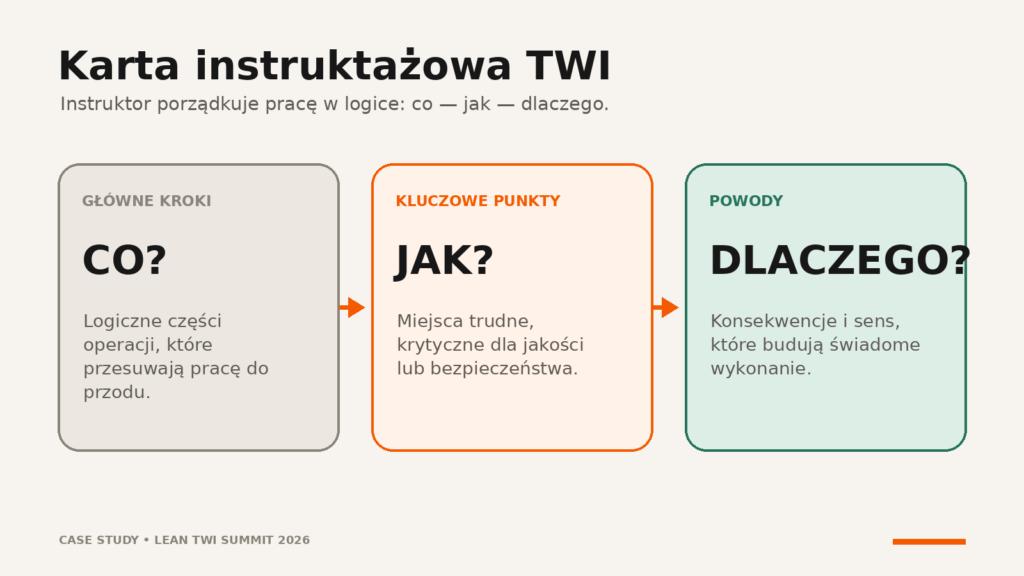
The cover assembly example in the presentation used three columns:
- Important steps: what do we do? Logical sections that advance the operation.
- Key points: how should a difficult or critical element be performed? Points where an error, safety risk or difficulty can arise.
- Reasons: why does the point matter? Understanding that supports conscious action and recognition of the consequences of departing from the standard.
The third layer distinguishes teaching from mechanically demonstrating movements. Employees understand how a particular method protects quality, safety or completion time.
The four steps of TWI Job Instruction
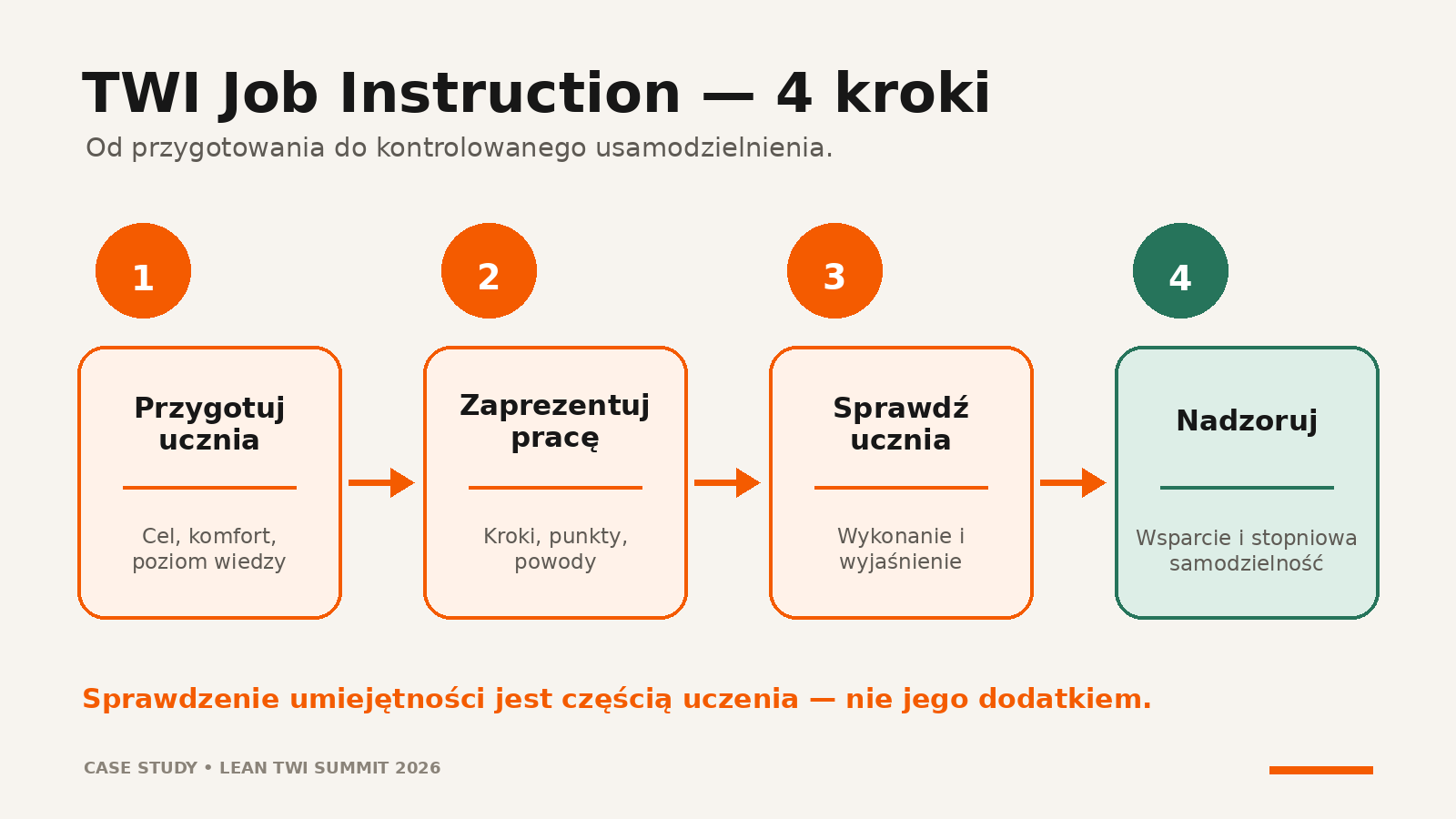
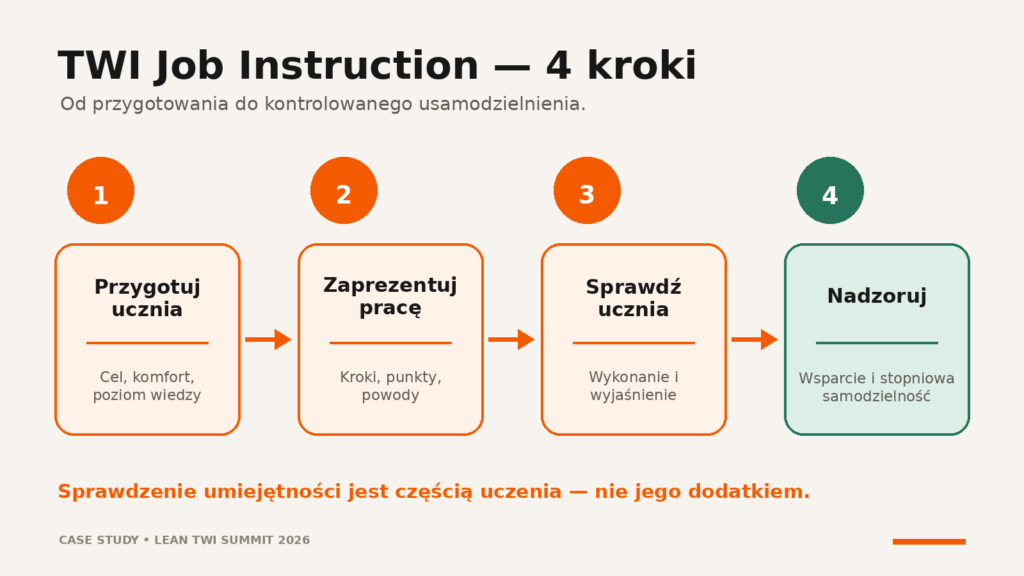
Step 1. Prepare the worker
The instructor creates a calm atmosphere, explains the learning objective, checks prior experience and places the learner safely for observation. This reduces tension and adapts explanations to the employee’s actual knowledge.
Step 2. Present the operation
The job is demonstrated in a controlled way: first as a whole, then through important steps, key points and reasons. The instructor focuses on what correct performance requires without overwhelming the learner with every detail at once.
Step 3. Try out performance
The learner performs the work and progressively explains more: demonstrates performance, names the important steps, identifies key points and finally gives their reasons. The instructor checks understanding and the ability to reproduce the standard consciously, alongside the final outcome.
Step 4. Follow up
After assigning the task, the instructor ensures the employee knows whom to ask for help, checks progress, corrects deviations and gradually reduces support. Independence follows confirmed ability.
TWI implementation in six stages
The presentation set out six stages from diagnosis to organisational scale. Instructor training is one element of the system.
| Stage | Purpose | Key management question |
|---|---|---|
| 1. Current-state audit | Understand existing teaching and the largest gaps. | Where do missing standards or skills affect performance most? |
| 2. Select a pilot area | Focus on an important, measurable process. | Who owns the problem, and do they need the change? |
| 3. Train instructors and managers | Build shared understanding of the method and roles. | Can leaders create the conditions for TWI use? |
| 4. Prepare trainers and Job Breakdown Sheets | Confirm trainers’ competence and prepare pilot materials. | Do the sheets reflect the best-known working method? |
| 5. Pilot | Test the method in the real process and measure its effect. | What improved, and what needs adjusting in the system? |
| 6. Scale | Expand after effectiveness has been confirmed. | How can instruction quality be sustained as scale grows? |
At Lean TWI Summit 2026, Ikano reported being at stage four: preparing and certifying trainers and developing Job Breakdown Sheets. Piloting and scaling remained next steps. The presentation described the design and objectives of the renewed approach rather than a completed implementation with confirmed results.
How to progress without repeating the first mistakes
Audit teaching practice as well as documents
Examine how new employees actually learn: who teaches, which method is used, how many work variants exist, when independence is recognised and how gaps are recorded. Instructions alone do not prove standards are known or applied.
Choose a pilot with a problem owner
A good pilot has a visible problem, an available measure and a leader interested in improvement. If Production sees the project as someone else’s initiative, daily scheduling pressure will take priority over even well-prepared training.
Teach leaders their role in the system
Instructors own teaching quality, while management determines priority, time, staffing, measurement and responses to deviations. Joint preparation keeps TWI connected to operations.
Confirm the pilot before scaling
Scale multiplies effective solutions and errors. A pilot should establish whether sheets are useful, instructors apply the full method, leaders provide follow-up and selected KPIs respond as expected. That evidence supports deliberate expansion.
Three measures linking TWI with strategy
Ikano selected three measurable improvement areas directly connecting skills with operational outcomes:
- Shorter new employee onboarding: time-to-productivity in days.
- Higher operational productivity: units per hour on the line.
- Reduced production defects: the defect percentage after quality control.
At the conference, the team aimed to achieve measurable improvement in each area by the end of 2026. No baselines or post-implementation results were presented. These remain objectives and evaluation measures.
Define time-to-productivity before measuring
Specify the start date, productivity criteria, simultaneous quality and safety requirements and who confirms independence. Otherwise, reporting changes may move the indicator without changing learning.
Read the KPIs together
Faster onboarding is no success if defects increase. Higher hourly output is no improvement if key points are skipped. Together, the three measures describe learning speed, productivity and quality.
How to design TWI pilot measurement
The presentation defines three KPIs without a detailed measurement plan. The following practical development of the case is not an account of additional Ikano activities. It helps prevent a pilot from generating many observations without a clear outcome assessment.
1. Establish a baseline before the first instruction session
Collect comparable data on time to independence, productivity and quality for the operation. Cover natural process variation rather than one good or bad week. Record relevant conditions: newcomers’ experience, product variant, staffing, shift and instructor availability.
2. Measure teaching quality alongside outcomes
If results fail to improve, determine whether the hypothesis was ineffective or the method was incompletely applied. Useful process measures include instruction sessions completing all four steps, timely follow-up, alignment between the current sheet and work standard and consistent criteria for confirming independence.
3. Compare comparable groups
Differences between people may reflect prior skills, variant complexity, practice hours and available support. Preserve that context and avoid broad conclusions from a single case or small group.
4. Set review rhythms and decision rules
Agree in advance how often data is reviewed, who may change a sheet, how reasons are recorded and which conditions permit scaling. KPIs then support learning and decisions throughout the project.
DOJO: practice before full responsibility for results
The presentation also featured a company DOJO used for practical skill development. It did not detail the programme, equipment or measures, so unreported outcomes should not be attributed to it.
Its role is nevertheless clear: separating initial attempts from full workstation pressure, practising standards, observing instruction and correcting errors safely. A DOJO can prepare and align learning in the real process.
Technology supports TWI implementation
Ikano used external support and eTWI software. The presentation emphasised reducing administration so users did not have to build the whole solution in spreadsheets.
Software can help manage sheets, standard versions, skills and instruction plans. It cannot supply missing priorities, resolve staffing conflicts or define success. Technology reinforces the management system, so purpose, process ownership and measurement decisions must come first.
How to scale TWI while sustaining instruction quality
Stage six should expand a repeatable management model learned from the pilot. More areas, sheets and instructors create greater risk of standards diverging.
- The standard owner maintains the working method and approves changes.
- TWI trainers observe instructors, give feedback and protect the four-step method.
- Production leaders plan time, address skill gaps and include outcomes in daily management.
- One source of the current version reduces outdated instruction.
- Periodic skill confirmation reveals returning habits and changed conditions.
Scaling replicates the ability to create standards, teach and respond to deviations. If the system is unstable in the pilot, adding areas enlarges the problem.
Eight lessons from TWI implementation at Ikano Industry
- Start with a strategic problem. Training activity is a means to an outcome.
- Root the change in Production. People accountable for results should be customers and co-owners.
- Measure process effects. Include speed to competence, productivity and quality.
- Build training plans from real needs. Priorities follow process gaps and the skills matrix.
- Learn to apply the method before shortening it. Establish quality and repeatability first.
- Prepare managers alongside instructors. Leaders protect learning time and conditions.
- Pilot before scaling. A small area makes system errors easier to see and correct.
- Communicate the actual implementation stage. A credible case can describe work in progress when goals and results are clearly distinguished.
Checklist before launching a TWI pilot
- Which specific business or operational problem should TWI solve?
- Which strategic goal connects to it?
- Who owns the process and is the customer for change?
- How are employees currently onboarded?
- Where do skill differences create the largest loss or risk?
- How will independence and time-to-productivity be defined?
- How will learning speed, productivity, quality and safety be balanced?
- Who will prepare and verify Job Breakdown Sheets?
- How will leaders provide time for instruction and follow-up?
- Which criteria will determine progression from pilot to scale?
What can be transferred from this case?
The logic is transferable: strategy → process need → standard → skill → outcome. The six stages provide a planning framework, and the three KPI groups can initiate discussion about effects.
Job Breakdown Sheets should still be based on observing your own work. Measures need local definitions, and implementation must fit the structure, culture and problems of the process. Standards describe the best-known method for a specific job.
FAQ: TWI implementation
Is TWI simply a better work instruction?
No. The Job Breakdown Sheet prepares the instructor; Job Instruction centres on a four-step process for teaching and checking the worker. Documentation alone does not develop skill.
How long does TWI implementation take?
The Ikano presentation offers no universal duration. Audit, pilot selection, people and sheet preparation, piloting and scaling are involved. Pace should follow the quality achieved at each stage.
How should TWI effects be measured?
Ikano selected time-to-productivity, units per hour and the defect percentage after QC. Other organisations may use a broader set, but measures should connect skills with process results and be clearly defined before the pilot.
Does TWI replace procedures and the quality management system?
No. TWI turns required working methods into effective instruction. Procedures, quality requirements and safety rules still define the process framework, and Job Breakdown Sheets must align with them.
About the presenter
Hanna Glinka presented this case at Lean Summit 2026, formerly Lean TWI Summit, as Production Director at Ikano Industry. Her role is also confirmed on the official Ikano Industry management team page (Polish). The article attributes the presentation and professional perspective to her. People shown on slides announcing subsequent sessions are not co-authors of the Ikano material.
Effective TWI implementation begins before the first instruction session
The Ikano Industry case shows that an approach disconnected from Production, ownership, strategy and meaningful measures can create conflict and frustration even among committed instructors.
The renewed approach connects business goals, process needs, standards, instruction quality and three outcome indicators. At the time presented, trainers and sheets were being prepared ahead of the pilot and scaling. Ikano had created the conditions to test the method’s effect on performance rather than assume it in advance.
This article is based on Hanna Glinka’s presentation, “TWI implementation as a result of cascading strategic goals at IKANO Industry”, delivered on 10 June 2026 at Lean TWI Summit 2026 in Wrocław. Implementation stage and planned measures reflect the conference presentation. Final pilot results were not included.

I am an effective, proactive production manager. Year after year, this is reflected in the strong performance of the processes I oversee in upholstered furniture manufacturing and, previously, in bus manufacturing. I continually develop these processes by embracing the principles of Lean Management and consistently applying Lean tools.
My knowledge and experience in project management, change management and people management, both within production and beyond, give me the confidence to act and deliver measurable results for the company. Challenges motivate me, so when it comes to development, my answer is yes.