TWI implementation at Danone — a LeanTrix case study
TWI implementation at Danone reduced the time needed to prepare employees for independent work by up to 50%. The programme at Żywiec Zdrój plants combined systematic on-the-job training, digital instructions, instructor development and objective skills monitoring. The result was faster onboarding and more flexible teams in highly automated production.
Danone demonstrates how to connect work standards, job instruction and skills development. We explain the principles behind this system in our guide: standardised work — definitions, tools and implementation (Polish).
TWI implementation at Danone: the challenge
Food production is highly automated, and an operator’s work involves much more than one short, frequently repeated task. Employees need to understand equipment operation, changeovers, component replenishment, responses to problems and autonomous maintenance tasks. This breadth of knowledge makes the path to independent work longer. At the same time, the organisation faces seasonal demand, market fluctuations and labour-market pressure. Internal constraints included a lengthy onboarding process, inconsistent progress monitoring, knowledge held mainly in experienced operators’ heads and an unstructured approach to developing employees who moved to a different workstation.
The risk
When knowledge is passed on informally, the time needed to work independently depends on the individual instructor, expert availability and immediate production pressure.
The response
One system for preparing instructions, teaching work, certifying instructors, auditing results and managing the skills matrix.
Four objectives of the TWI programme
The project’s vision was an organisation able to respond flexibly to market requirements by systematically developing skills and digital capabilities. The TWI programme aimed to shorten onboarding and make employee development less dependent on the knowledge of individual experts.
A pilot in automated production
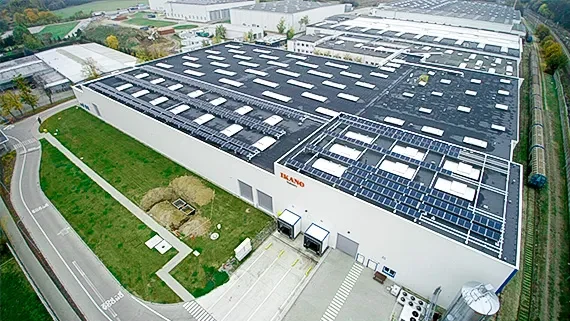
Pilot areas were selected at two Żywiec Zdrój production plants. The first wave covered operators at the end of the bottling line, where finished products are packed, and warehouse employees. This environment provided a demanding test for TWI Job Instruction: processes were longer and more variable, and it was not always possible to repeat a complete job several times during one instruction session. The team retained the method and adapted how selected training sessions were delivered: fewer complete repetitions during instruction, combined with closer observation and support afterwards. The logic of TWI was preserved while delivery was adapted to the realities of an automated line.
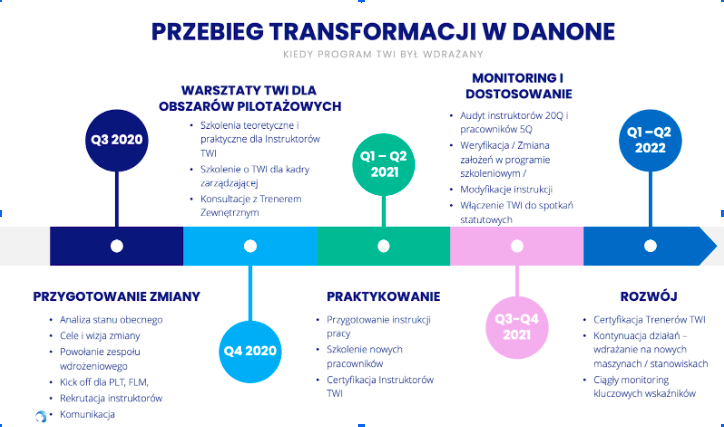
Five transformation phases: 2020–2022
TWI implementation at Danone progressed through successive stages. This made it possible to understand the starting point, develop instructors, and then scale the system and integrate it into daily management.
Who built the TWI system?
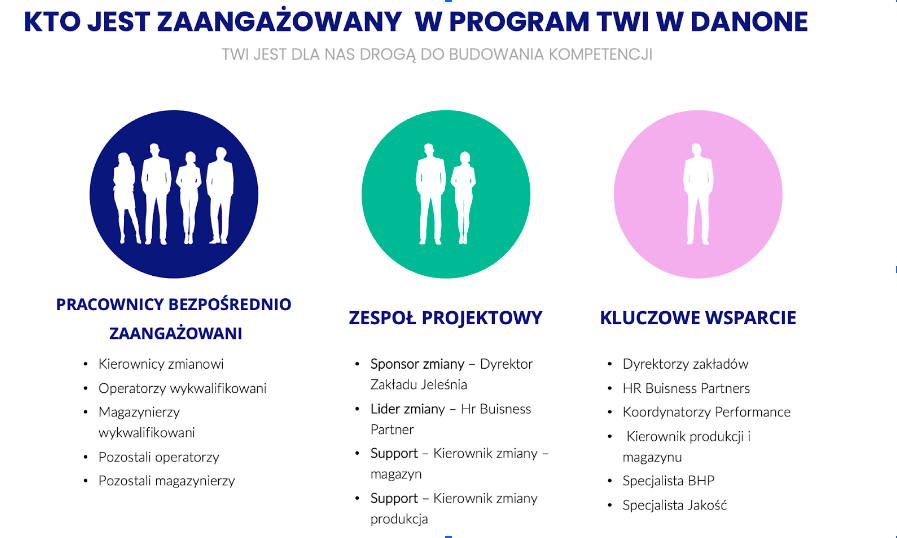
The project was not the responsibility of a single department. The plant director sponsored the change, the HR Business Partner led the project, and key decisions involved production, warehousing, quality, health and safety, and operational performance teams. Leaders, experienced operators and warehouse employees played the most important part in day-to-day delivery.
1Direct participants
- shift managers
- experienced operators
- warehouse employees
- trainees
2Project team
- plant director as sponsor
- HR Business Partner as leader
- production and warehouse managers
3Key support
- quality and health and safety
- performance coordinators
- HR Business Partners
- plant directors
From paper instructions to knowledge management
The time required to create and maintain documentation proved to be a barrier. Alongside TWI, the organisation introduced POKA, gradually replacing paper instructions with electronically available standards.
- easier communication with employees,
- one place to manage operational knowledge,
- instructions connected to the skills matrix and training plan,
- greater visibility of training progress and readiness for independent work.
Results: faster onboarding and greater flexibility
The results of TWI implementation at Danone demonstrate improvements in both learning speed and the team’s ability to operate more workstations. The effects extended beyond training time to staffing decisions and workforce planning.
- objective monitoring of employee progress to support development decisions,
- the ability to start seasonal recruitment later and reduce employment costs,
- more positive employee views of onboarding, supporting recruitment through referrals,
- retention of expert knowledge and easier onboarding for new machines.
What was most difficult?
The case study also highlights obstacles to account for when planning a similar transformation:
- a lack of readily available indicators to establish a reliable baseline,
- the need to make time for practical training while the plant continued operating,
- the considerable effort required to create, update and distribute documentation.
LeanTrix’s role
Kamil Müller of LeanTrix supported instructor development, reviewed instructions and on-the-job training, and helped adapt TWI to long, infrequently repeated automated processes. Within the organisation, the project was led by Natalia Galbarczyk, HR Business Partner and TWI implementation leader at the Żywiec Zdrój plants. Building internal capability was an important part of the programme: certified TWI trainers could deliver workshops, develop instructors and oversee the programme without ongoing dependence on an external consultant.
Five lessons for other organisations
Frequently asked questions
What results did TWI implementation at Danone achieve?
Onboarding time fell by 50% in production and 37% in the warehouse. The average number of workstations or machines operated per employee increased from two to three.
Does TWI work in automated production?
Yes, although selected instruction sessions may need adaptation. For long cycles, the number of complete repetitions during training was reduced, with closer follow-up afterwards.
How long did the transformation take?
More than 18 months — from preparing for change in Q3 2020 to system development and trainer certification in Q1–Q2 2022.
Why was the six-month practice phase important?
It enabled instructors to create real work instructions, deliver training and discuss difficulties with the trainer before final certification.
Want to shorten employee onboarding?
LeanTrix helps build a TWI system that connects work standards, internal instructors, a skills matrix, audits and measurable operational results.
Source: adapted from the article by Natalia Galbarczyk and Kamil Müller describing TWI implementation at Żywiec Zdrój SA. All results and programme stages come from the published source material.

Training Within Industry and Lean Management Practitioner.
He is a lecturer at the WSB University in Wrocław. He is the author and co-author of several pieces of literature on the TWI program.
He is a managing partner in the LeanTrix company and a master Trainer for Europe. Additionally, he is involved in projects such as eTWI System and Lean Community
He has run projects for: Lotte Wedel, Danone, Kompania Piwowarska, eobuwie.pl, Arvato, Whirlpool, B / S / H, Geberit, RECARO, Tenneco, Sumitomo Electric, Stadler, Vesuvius Poland

HR Business Partner at Żywiec Zdrój S.A., responsible for two production plants in Rzeniszów and Mirosławiec. From the very beginning of her HR career, she has been associated with manufacturing companies in the automotive and FMCG industries. For the past two years, she has been leading a project implementing the Training Within Industry (TWI) methodology across all Żywiec Zdrój factories. She holds a degree in Human Resource Management from the University of Economics in Katowice. In her free time, she is passionate about water sports such as kitesurfing and wakeboarding.