
Lean in a hospital: SP ZOZ in Kościan (Polish website). A patient had waited almost three years for elective surgery. The date was set, the theatre and team ready, yet the procedure had to be postponed. Lack of readiness emerged at the end of the process, too late to save the operating schedule. This case shows that hospital Lean begins much earlier: where patient readiness is first checked.
The team’s central discovery concerned information and responsibility flowing between the orthopaedist, administration office, anaesthesiology clinic, ward and patient weeks before hospitalisation. An end-to-end view revealed why an apparently sound plan could collapse on admission day.
Hospital Lean begins earlier than intuition suggests
The analysis covered the orthopaedics and musculoskeletal trauma department at the Independent Public Healthcare Complex (SP ZOZ) in Kościan. This NFZ-funded public provider had 260 beds, three operating theatres and 25 specialist clinics. In 2025, it recorded 20,427 hospitalisations, with 664 employees and co-workers involved in its activity and a catchment population of approximately 77,000.
Between August 2025 and January 2026, 34 of 398 planned procedures were postponed: 8.5%. For the hospital, postponements meant unused theatre time, additional organisational work and rescheduling. For patients, they meant further weeks or months of pain, uncertainty and reduced mobility.
| 8.5% | 34 | Almost 3 years |
|---|---|---|
| Share of elective procedures postponed | Postponements in six months out of 398 planned procedures | The patient’s waiting time for surgery |
The first hypothesis was natural: if postponement occurred on admission day or in the theatre, the cause must be there. A documentation error, missing test or ward oversight seemed plausible. The gemba walk showed that the point of detection differed from the point of origin.
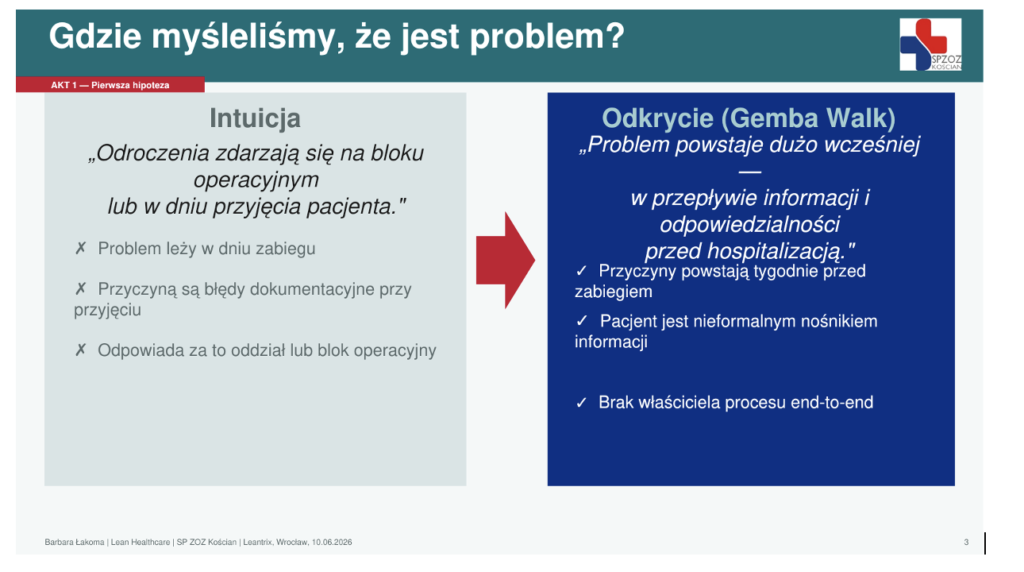
Gemba walk: formal process and actual work differed
The team spoke with medical secretaries, the coordinating nurse, an anaesthetist and an orthopaedist. It used a gemba walk, an A3 report, 5 Why, an Ishikawa diagram, SIPOC, RACI and an AS-IS process flowchart. Observation and conversations revealed three discrepancies:
- Telephone contact lacked a consistent script and confirmation of critical actions, so patients could receive different messages.
- Anaesthetic assessment results entered the Eskulap system, but orthopaedics administration received no active notification or visible readiness status.
- After years of waiting, no standardised health screening took place sufficiently early before the scheduled procedure.
People sustained the process through memory, calls, reminders, searches and filling gaps. The process could appear stable until one informal mechanism failed.
Mapping the patient journey exposed a critical handover
The team mapped the journey from referral to surgery or postponement. Of 15 stages, eight carried risk, one represented a critical gap and none provided a mechanism to confirm patient readiness.
The critical step came before hospitalisation. Administration told patients to visit the anaesthesiology clinic but did not book them during the call. Patients had to arrange this themselves, and the hospital did not monitor booking or attendance. Patients became informal carriers of information between departments.
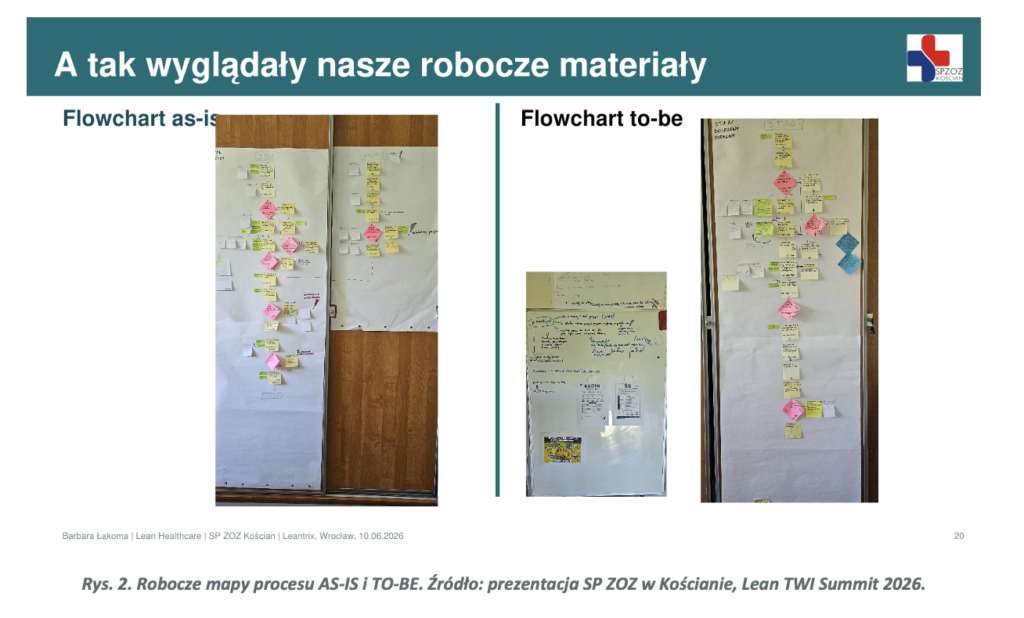
Mapping revealed three system gaps hidden when departments viewed only their own work:
- The patient owned a critical step. The hospital communicated the requirement without taking responsibility for booking and confirming completion.
- No visible readiness status existed. Information in the system had not become a simple operating signal available to the admissions planner.
- No end-to-end process owner existed. Responsibility was dispersed, leaving nobody managing the entire journey from qualification to confirmed readiness.
5 Why: from a missing document to a missing managed standard
Stopping at “the patient lacked anaesthetic clearance” or “documentation was missing” would probably have led to more reminders. The 5 Why analysis explored the mechanism repeatedly producing those symptoms.
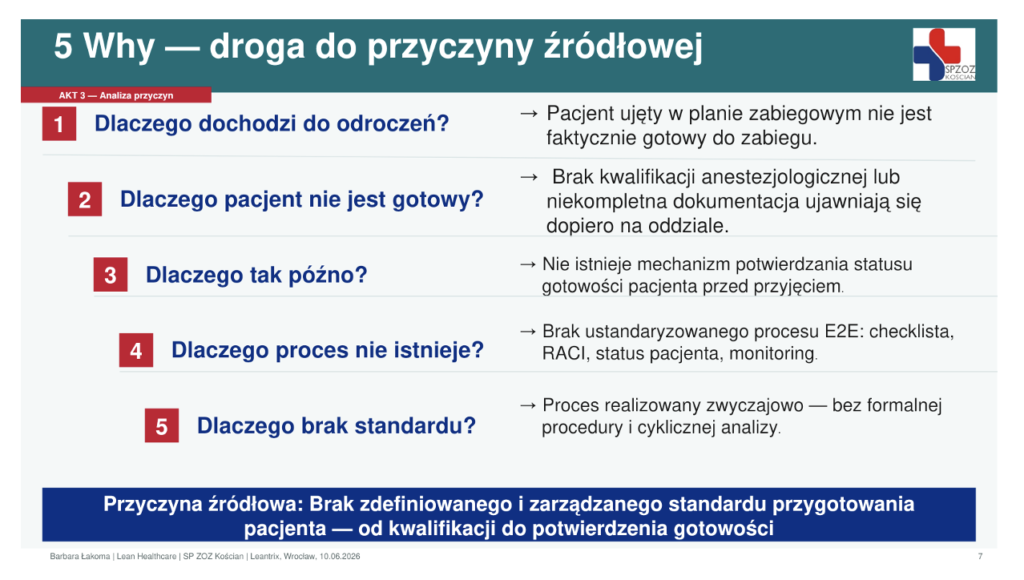
| Root cause No defined and managed patient preparation standard, from orthopaedic qualification to confirming readiness before admission. |
This distinction matters. If the cause is labelled inattention, the response becomes an appeal to be more careful. If a process is missing, responsibility, information, checkpoints and responses to deviations need to be designed.
Three types of waste: waiting, defects and information transport
Waiting
The patient had waited almost three years, and postponement could add months. Further waiting involved tests, consultations and clearance confirmation. In healthcare, time affects pain, function, security and trust.
Defects and rework
Incomplete documentation or missing clearance emerged on admission, after the theatre, team and time had been reserved. Each event generated communication, rescheduling and renewed patient preparation.
Information transport through the patient
The patient carried information between the anaesthesiology clinic and orthopaedics administration. The internal process depended on the patient booking, receiving the right message, bringing documents and knowing whom to give them to. Patients retain responsibility for participating in care, while the hospital should integrate its own systems and departments.
The TO-BE design: four stages and one condition for the final schedule
The target design organised four stages, assigned owners and created a clear readiness status without requiring an additional administrative layer or advanced technology.
| Stage and responsibility | Target standard |
|---|---|
| A | Orthopaedic qualification | Owner: orthopaedist. Qualification for surgery, entry on the waiting list and telephone health screening approximately six weeks before the date to reassess current health after a long wait. |
| B | Contact after setting the date | Owner: administration. During the call, staff book the anaesthesiology appointment and provide a written list of tests, documents and the schedule. |
| C | Anaesthetic qualification | Owner: clinic / anaesthetist. The patient attends with complete test results, and the assessment enters the system visibly to orthopaedics administration. |
| D | Readiness confirmation | Owner: administration. A checklist confirms tests, documents and clearance. The patient then receives READY FOR SURGERY status and may enter the final operating schedule. |
| Scheduling principle Only patients with READY FOR SURGERY status enter the final operating schedule. Missing status is a visible deviation requiring action before admission day. |
The simplest change was organisational
The central difference was a verb: administration would book the anaesthesiology visit during the call. The critical step would become a controlled element of the hospital process.
- From an information call to a call completed with booking and confirmation.
- From loosely stated requirements to a checklist of tests, documents and clearance.
- From information stored in a system to visible readiness status.
- From dispersed responsibility to an end-to-end process owner.
- From admission-day response to screening approximately six weeks earlier.
- From isolated incidents to monthly reviews of postponements by cause category.
The hospital information system can support the standard. The presentation proposed a paper checklist or simple spreadsheet as an interim solution if Eskulap development required time. Responsibilities and rules need agreement before digitalisation.
Measurement: change continues beyond a new procedure
A small indicator set was intended to sustain the standard. Starting from 8.5% postponements, the target design proposed three goals:
| KPI | AS-IS | TO-BE target |
|---|---|---|
| Elective surgery postponement rate | 8.5% | Maximum 3% |
| Patients with READY status before admission | Not measured | At least 95% |
| Patients booked into the anaesthesiology clinic | No stable measurement | At least 95% |
The process owner should review indicators regularly. Postponement counts need clinical, organisational and information-related cause categories to establish whether change removes the source or moves it elsewhere.
The conference material presented diagnosis and a designed TO-BE standard, rather than a completed implementation. It does not establish that the hospital achieved the 3% target. Effects require confirmation after stable implementation and several PDCA cycles.
A three-phase hospital Lean implementation plan
The six-month plan began with actions possible before full IT support. Phase one clarified the checklist, booking procedure and clinic schedule. Phase two standardised communication, screening and process ownership. Phase three strengthened status visibility in the system and the management review rhythm.
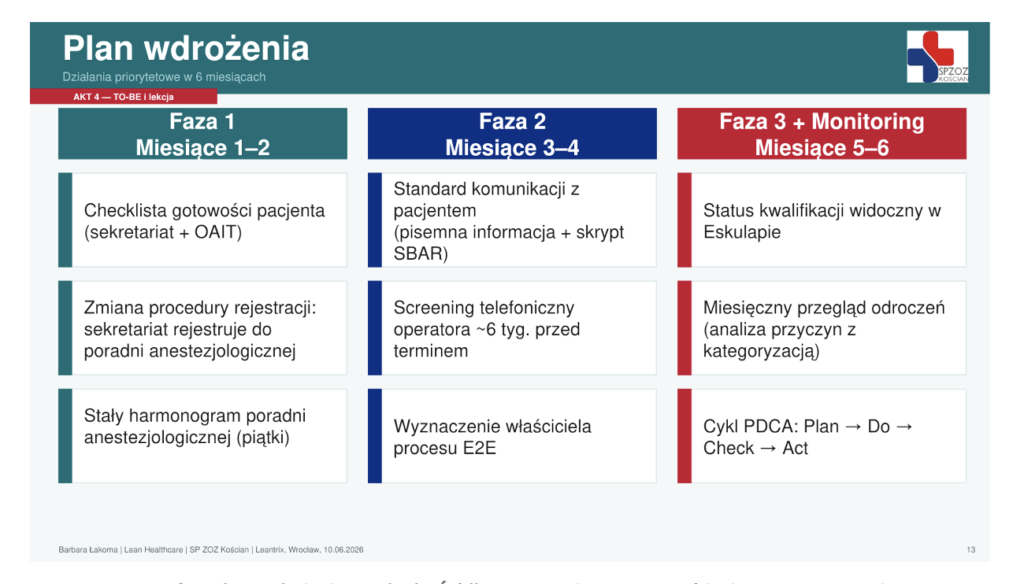
The sequence defines work, roles and information before embedding them in IT. Real constraints still require management: anaesthetist availability, IT support, staff resistance and patients’ understanding of the rules.
What this case teaches about Lean in a public hospital
- Postponement is a system signal. Repeated patterns point towards process design. Blame can prevent discovery of the mechanism reproducing the problem.
- The detection point may differ from the origin. The theatre sees consequences of gaps created weeks earlier in calls, statuses or handovers.
- The gemba reveals undocumented workarounds. Conversations expose calls, printouts, reminders and memory-based mechanisms, distinguishing necessary work from hidden gaps.
- Patients participate in the process; the hospital integrates it. Internal information flow should be designed and monitored by the organisation.
- A simple change can close a critical gap without another position. Booking during the call changes responsibility, visibility and control.
- Lean requires standards and measurement. Ownership, status, KPI review and PDCA turn a checklist into an improvement system.
Applying Kościan’s lessons in another hospital
Start with a specific recurring problem visible to patients and staff. For elective surgery postponements, ask:
- When can readiness first be assessed reliably?
- Who sees the whole journey from qualification to admission?
- Which critical steps depend on memory, calls or patient initiative?
- Is readiness unambiguous and visible to the admissions planner?
- What happens if tests, consultations or clearance are late?
- Does the team distinguish clinical postponements from organisational and information failures?
- How often does the owner analyse deviations and initiate PDCA?
If answers differ, the process may need an agreed standard, owner or early-warning mechanism.
FAQ: hospital Lean and elective surgery postponements
What does Lean in a hospital involve?
It designs safe, predictable patient-centred processes by reducing waiting, errors and unnecessary handovers, assigning clear responsibility and engaging staff in continuous improvement.
How can elective surgery postponements be reduced?
Begin before admission day: map preparation end to end, identify critical points, create a checklist, readiness status and ownership, then regularly analyse postponement causes.
What does a hospital gemba walk reveal?
Actual work, including calls, workarounds, handwritten notes and informal information transfers often absent from procedures and systems.
Does process improvement require new IT?
Not always. First agree roles, standards and readiness signals. IT can embed them later; a well-managed checklist or simple register may bridge the transition.
Related LeanTrix materials
- Lean in healthcare (Polish)—LeanTrix’s approach to improving medical facilities.
- Gemba walks in hospitals (Polish)—observing the actual process.
- Patient journey mapping (Polish)—analysing the whole pathway.
- Standardised work in hospitals (Polish)—building safe, stable processes.
LeanTrix has supported healthcare organisations in implementing Lean Management methods and tools for many years.
| The key insight The team changed its question from who failed on surgery day to where the earlier process allowed a patient to enter the schedule without confirmed readiness. This is where Lean in a hospital begins. |

Barbara Łakoma is Head of the Human Resources and Payroll Department at SP ZOZ Kościan. In her work, she combines a people-management perspective with the practical improvement of healthcare processes. At the Lean TWI Summit 2026 in Wrocław, she presented a case study on standardizing patient preparation for planned orthopedic surgery. She demonstrated how analyzing the entire patient pathway, clarifying responsibilities, and introducing a clear readiness standard can reduce the risk of procedure postponements. Her work focuses on designing processes that support healthcare staff and do not rely solely on individual memory, experience, or personal commitment.