


Events are not discussed or converted into preventive action because reporting feels complicated or blame-oriented.
Training Within Industry · Job Safety
TWI Job Safety (TWI JS) develops a leader's ability to recognise hazards, remove or control risk and establish a safer work method before an incident occurs.
TWI Job Safety – prevent hazards where the work happens
Move safety from documents and post-incident reaction into daily observation, near-miss learning, safer work design and consistent instruction at the workplace.
Beforelearn from hazards and near misses
At the jobobserve the real method and conditions
Into standardteach and maintain the safer method

Start with the operating problem
When the formal safety system and real work drift apart
Job Safety is relevant when procedures exist but frontline leaders still struggle to see risk early, respond consistently and convert learning into a better standard.
The written method does not reflect production pressure, awkward access, tool condition or the way work is actually performed.
Supervisors wait for a specialist instead of treating daily hazard recognition as part of leadership.
Teams retrain people without changing the machine, material, method or environment that created the exposure.
The working method
The four-step TWI Job Safety method
TWI JS gives supervisors a repeatable routine: spot the hazard, decide what to do, take action and check the results. LeanTrix connects it with the hierarchy of controls, Job Instruction and the existing EHS system.
The original four steps, extended for today's operating system
The four named TWI JS steps remain the core. Observation of person, machine, material, method and environment, the hierarchy of controls and TWI JI strengthen implementation without replacing that core method.
- Spot the hazard
- Decide what to do
- Take action
- Check the results
From workshop to operating system
How we implement TWI Job Safety
We begin with a real risk and build capability through coached observation, practical countermeasures and integration with the existing EHS system.
Choose a critical job
Use incident, near-miss and risk data to select work where prevention can create visible value.
Observe with the people doing the work
Understand normal conditions, variation, pressure points and the reasons behind current workarounds.
Design and teach a safer method
Apply the hierarchy of controls, update the standard and use TWI JI to teach critical points and reasons.
Build the daily routine
Review near misses, check controls at the workplace and escalate conditions that require engineering or system action.
Management evidence
Use leading indicators, not only injury statistics
A safe system improves the organisation's ability to see, remove and control risk before an incident. Lagging metrics alone cannot show that capability.
| Measure | What it answers | Example |
|---|---|---|
| Hazards closed at source | Are teams removing exposure rather than adding warnings? | Share of actions using elimination or engineering controls |
| Near-miss learning | Are signals reported and converted into action? | Quality of reports, response time and recurrence |
| Safe-method adherence | Does the standard work under normal conditions? | Workplace observation and deviation follow-up |
| Critical-job capability | Can leaders and employees explain key safety points and reasons? | Observed instruction cycles and verified performance |
Proof from real organisations
TWI JS application and related evidence around repeatable work
The first material demonstrates the four-step Job Safety method. The other cases show the wider TWI and standard-work system around safe, repeatable work; they are not presented as stand-alone TWI JS outcome studies.
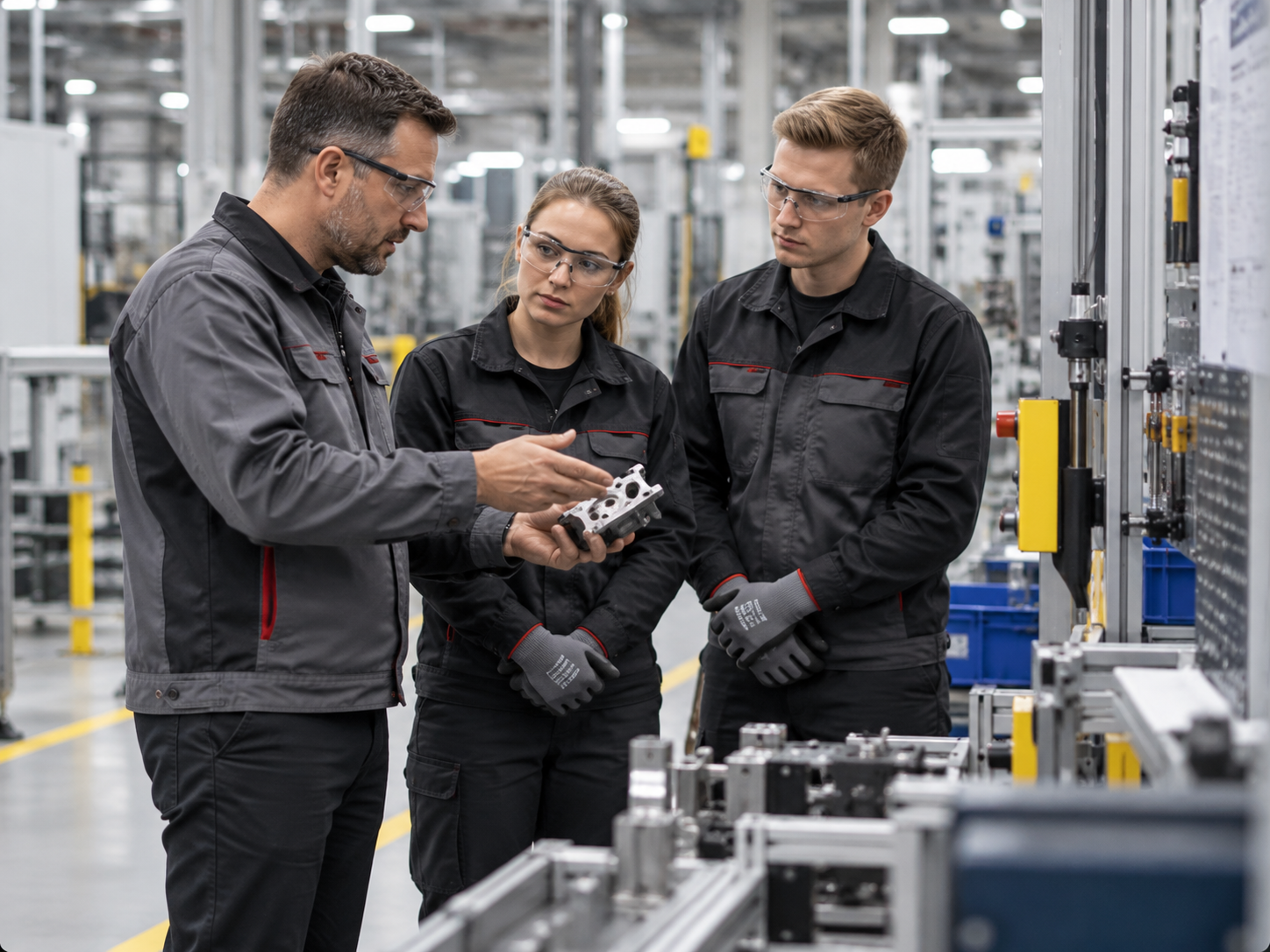 Application example · constructionHow the four-step TWI JS method worksA practical application example showing how a supervisor can spot a hazard, decide what to do, take action and check the results.Read the case study →
 Related TWI transformationFaster learning around real workA multi-module TWI programme illustrating the wider capability system around consistent and repeatable work; it is not presented as a stand-alone TWI JS result.Read the case study →
 Related standard-work caseFaster learning with fewer errorsA standard-work and onboarding case illustrating the wider system around teachable work; it is not presented as a stand-alone TWI JS result.Read the case study →
Signed client references, not anonymous quotes
See original client documents and verified testimonials covering Lean, TWI, leadership development and operational transformation.
People behind the system
TWI practitioners connecting safe work, instruction and leadership
LeanTrix integrates Job Safety with Job Instruction, standard work, problem solving and the client's formal EHS responsibilities.

Dr Bartosz Misiurek
TWI Master Trainer and author-practitioner. Global BTO coach in the Cooper Standard transformation and co-creator of scalable TWI systems.
View expert profile →
Rafał Wrona
LeanTrix practitioner combining TWI Job Instruction, Job Methods and Job Safety with production, TPM and Six Sigma experience.
View expert profile →Build a connected operating system
Continue with a related capability
Each method is stronger when it is connected to standard work, leader routines and measurable process performance.
FAQ
Frequently asked questions about TWI Job Safety
TWI JS supports the safety management system; it does not replace legal duties or specialist controls.
Does TWI Job Safety replace occupational safety procedures?
No. It complements the organisation's legal, EHS and technical requirements by developing daily hazard-recognition and prevention capability close to the job.
How is Job Safety connected with Job Instruction?
Job Safety helps create a safer method. Job Instruction ensures that critical safety points and their reasons are taught, practised and followed up consistently.
Is JS only for manufacturing?
No. It can be applied in logistics, maintenance, construction, healthcare and services wherever real work creates physical or process risk.
What is the role of near misses?
Near misses are learning signals. The aim is not only to count them, but to understand exposure, improve the method and verify that corrective action prevents recurrence.
Who should participate?
Frontline leaders, experienced employees, EHS specialists, maintenance or engineering and the process owner should work together according to the risk and control required.
Where should we start?
Select one critical job with visible risk and a willing supervisor. Use the pilot to demonstrate observation, control selection, standard revision, instruction and follow-up as one loop.
Start with the business problem
Build prevention into the real method of work
Describe the critical job, near-miss pattern or safety challenge you want to address. We will help you plan a practical pilot and leader-development path.
Free consultation
We first understand the process, the expected result and the conditions for implementation. Then we propose the right expert and the next practical step.
Discuss your challenge