Relaunching TWI at VELUX demonstrates that training instructors, preparing standards and building skills matrices are not enough to change everyday working practices. The first attempt gave the organisation tools but failed to establish new behaviours. The second approach, treated as a cultural change project involving management, supervisors, trainers and employees, delivered measurable results.
This case study explains why pressure to deliver results pushed the earlier initiative back towards a “watch and copy” approach, how VELUX prepared the relaunch and which mechanisms helped embed Training Within Industry in daily work. It is particularly relevant to companies that have already introduced TWI without achieving lasting change.
Relaunching TWI at VELUX: the starting point
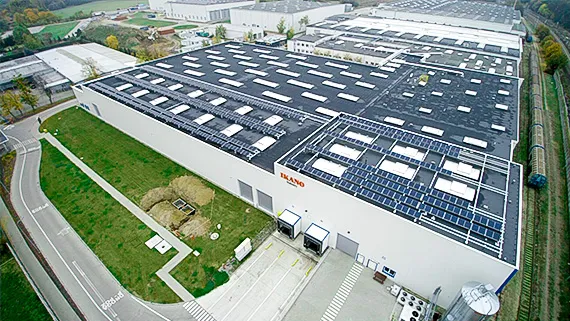
VELUX manufactures roof windows and skylights. According to the figures presented at the conference, the company had production and sales operations in 37 countries, 14 factories in nine countries and approximately 11,700 employees worldwide. The Polish site featured in the presentation began production in 2003 and employed 763 people. VELUX Poland publishes current information about the company and its sites.
The organisation faced a familiar combination of manufacturing challenges: high employee turnover, lengthy onboarding, limited flexibility of skills between areas, low efficiency and unstable processes. Expectations for TWI were therefore specific: stabilise processes, structure onboarding, standardise operational knowledge, increase employees’ ability to perform different tasks and enable rotation between departments.
Why did the topic return?
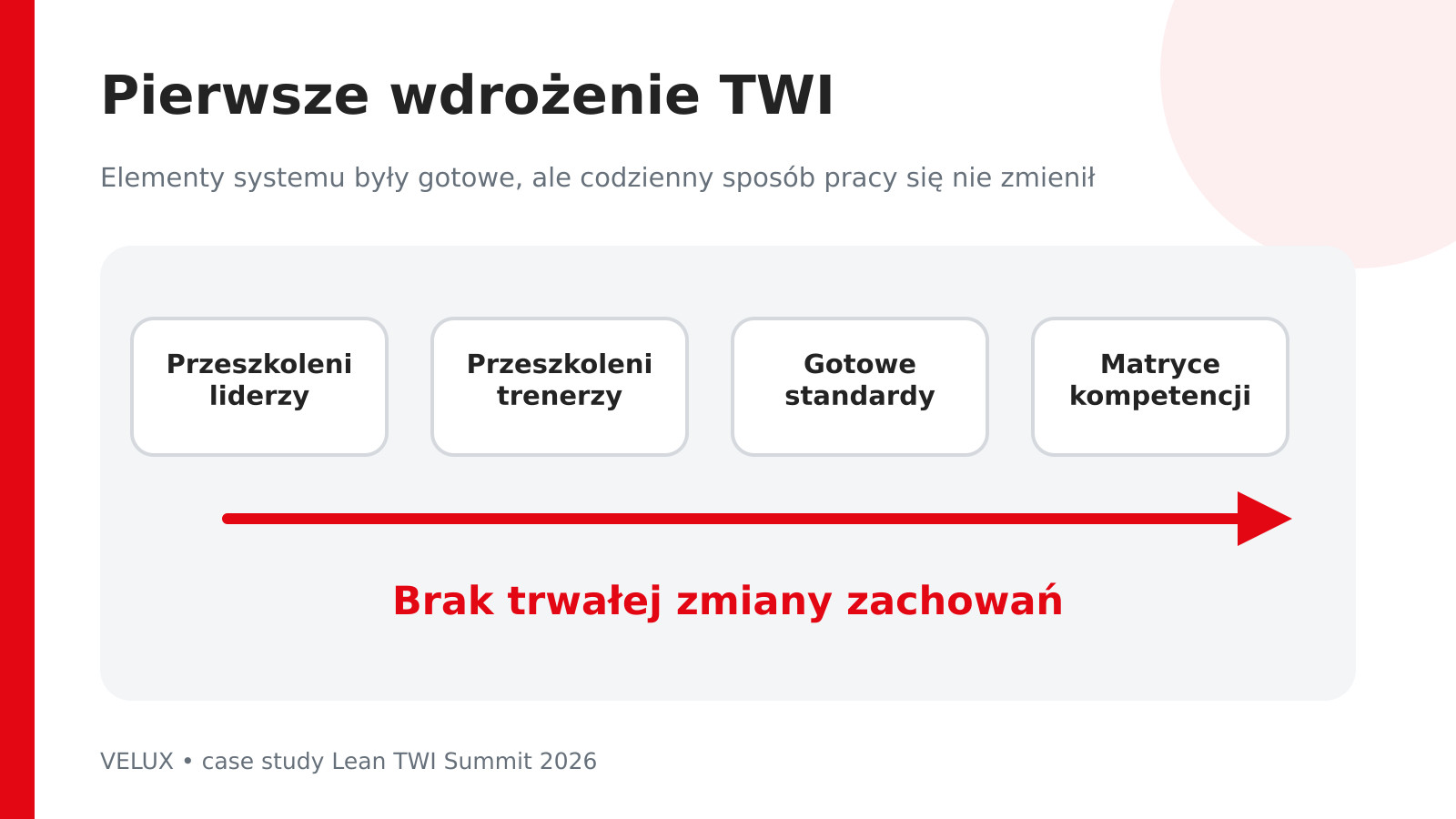
Many elements of the first initiative appeared to be in place: leaders and trainers had been trained, instructions prepared and skills matrices made available. Yet results barely changed. Operators did not see value in the new teaching method; instruction reverted to watching an experienced colleague, standards went unused and supervisors did not reinforce implementation. Audits were also missing, leaving the organisation without a way to check whether agreed working practices were actually being followed.
Why did the first TWI implementation fail?
VELUX’s central lesson can be expressed simply: training does not yet mean a change in behaviour. Participants may know the method and understand its four steps, but pressure to deliver results makes them revert to the fastest familiar approach. The team did not interpret this as sabotage. Employees were choosing routines supported by the existing management system.
The presentation identified six reasons for failure:
- inappropriate selection of trainers,
- insufficient support from management and HR,
- a lack of ownership of TWI among leaders,
- undefined success measures,
- too much theory and too little time for practice,
- treating TWI as another Lean tool rather than part of the working culture.
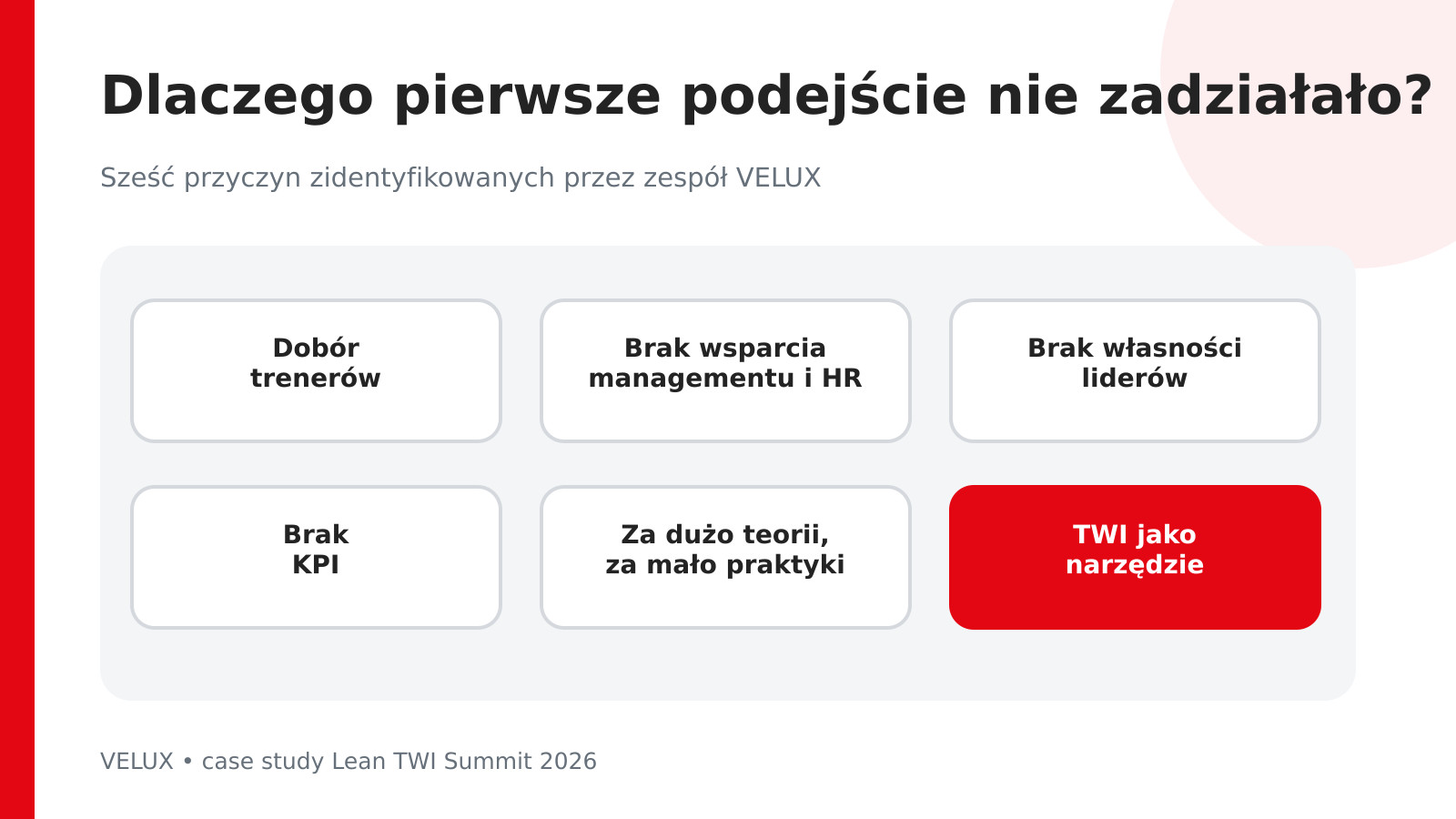
“People were not sabotaging TWI. They were returning to their old way of working under pressure to deliver results.”
Conclusion presented in the VELUX case study; translated from Polish
This diagnosis changed the direction of the next approach. The problem was not a shortage of instructions or forms. What was missing was an environment in which the new standard was expected, practised, checked and supported every day.
Relaunching TWI as a cultural change project
The second approach was described as a move “from an implementation project to a working culture”. The TWI relaunch did not begin with another round of identical training. Roles, expectations and relationships between the people expected to use or reinforce the system were clarified first.
The workshop programme covered four groups:
- Management — to establish realistic expectations and sponsorship of the change.
- Supervisors — department managers, production supervisors and leaders responsible for maintaining the standard every day.
- Trainers — to align teaching methods and understand the difficulties faced by those delivering job instruction.
- Trainers together with employees — to develop practical standards incorporating the operation, quality, safety and ergonomics.
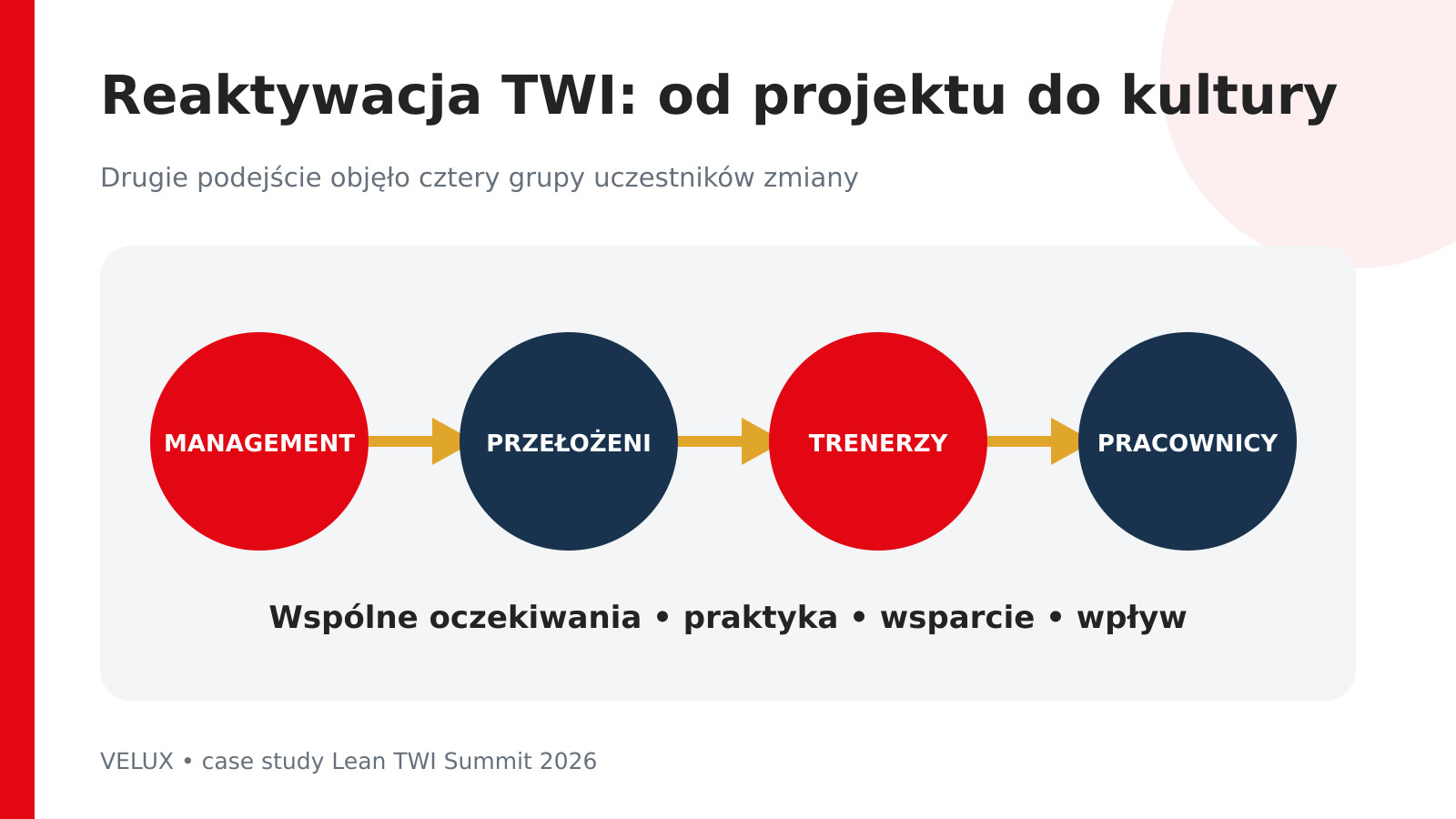
How did VELUX prepare management and supervisors for the TWI relaunch?
Realistic management expectations
The management workshop demonstrated that TWI results require time and consistency. Efficiency may temporarily decline in the initial phase because trainers do more than operational work: they teach, observe, correct and check understanding. If management interprets this learning cost as failure, pressure for immediate results quickly recreates the old approach to onboarding.
A consistent approach among supervisors
Workshops for managers, production supervisors and leaders aligned expectations regarding standards and clarified the supervisor’s role. According to the presentation, daily contact between leaders and employees had the greatest influence on sustaining the change. Employees accept a new working method more readily when supervisors participate, check progress and remove obstacles rather than delegating the entire implementation to trainers or HR.
In practice, TWI Job Instruction must be integrated into the management system. It needs to become part of work planning, operational conversations, skills assessment and the response to quality problems.
The role of trainers and employees in relaunching TWI
Trainers were not treated solely as recipients of training. Workshops revealed their needs, aligned approaches and created space to exchange experience. VELUX emphasised that trainers also need a standard, support and opportunities to practise instruction in a real working environment.
Joint work by trainers and employees made it possible to prepare instructions that reflected how operations actually took place. A good instruction was intended to describe more than the sequence of activities. It needed to combine operational knowledge with quality requirements, safety and ergonomics. This made the standard a useful way of doing the job rather than a document stored away from the workstation.
Selecting and certifying TWI trainers
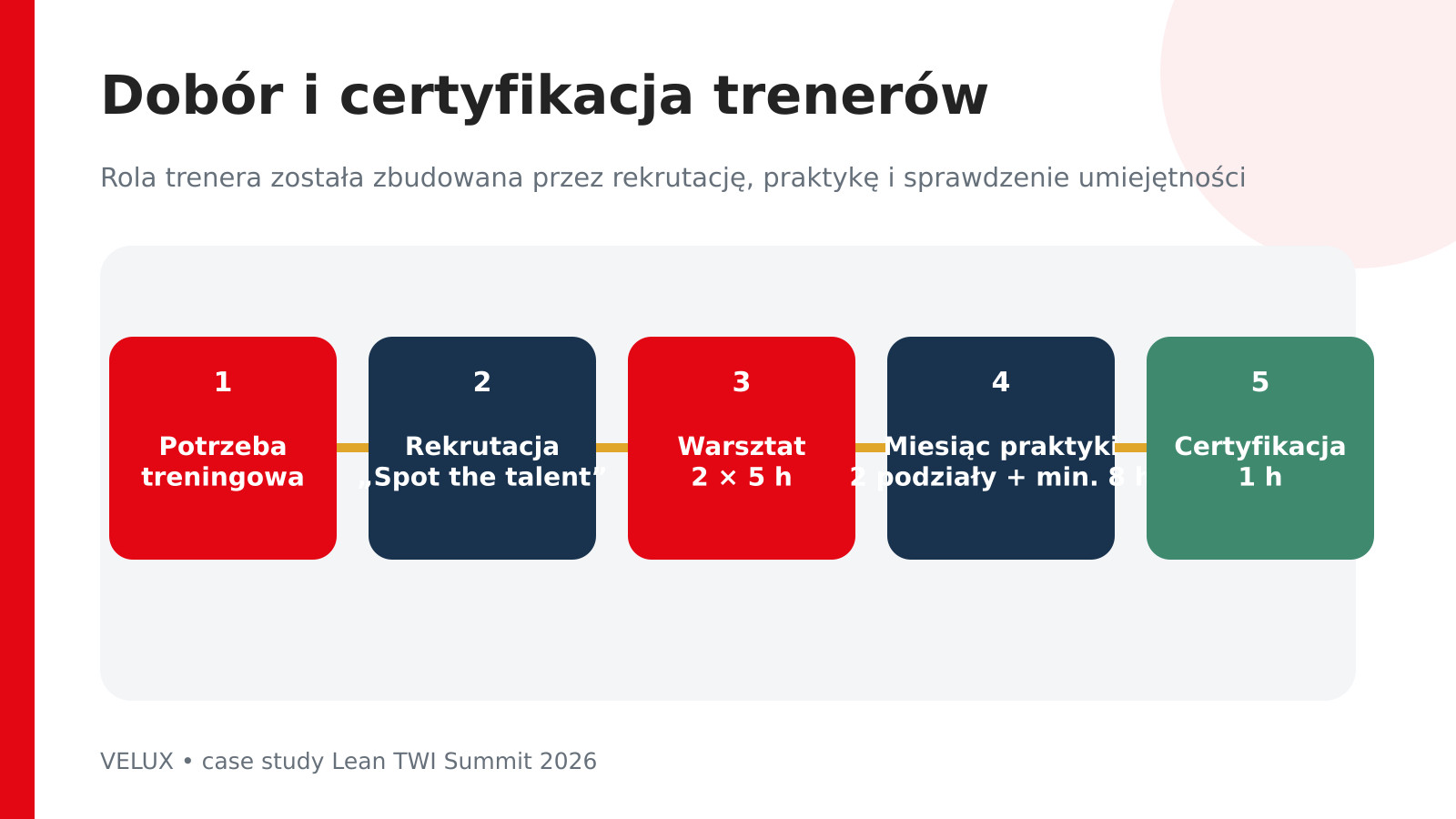
Inappropriate trainer selection was one lesson from the first attempt. In the second programme, identifying a training need, announcing recruitment and holding a “Spot the Talent” interview preceded selection for the role. Only then were people chosen for trainer development.
The certification pathway combined theory and practice. The material describes two five-hour classroom blocks, followed by a month of practice in production involving two job breakdowns and at least eight hours of practice, and finally a one-hour certification assessment. This structure reduces the risk of trainers knowing the method only from the classroom.
Relaunching TWI through everyday routines
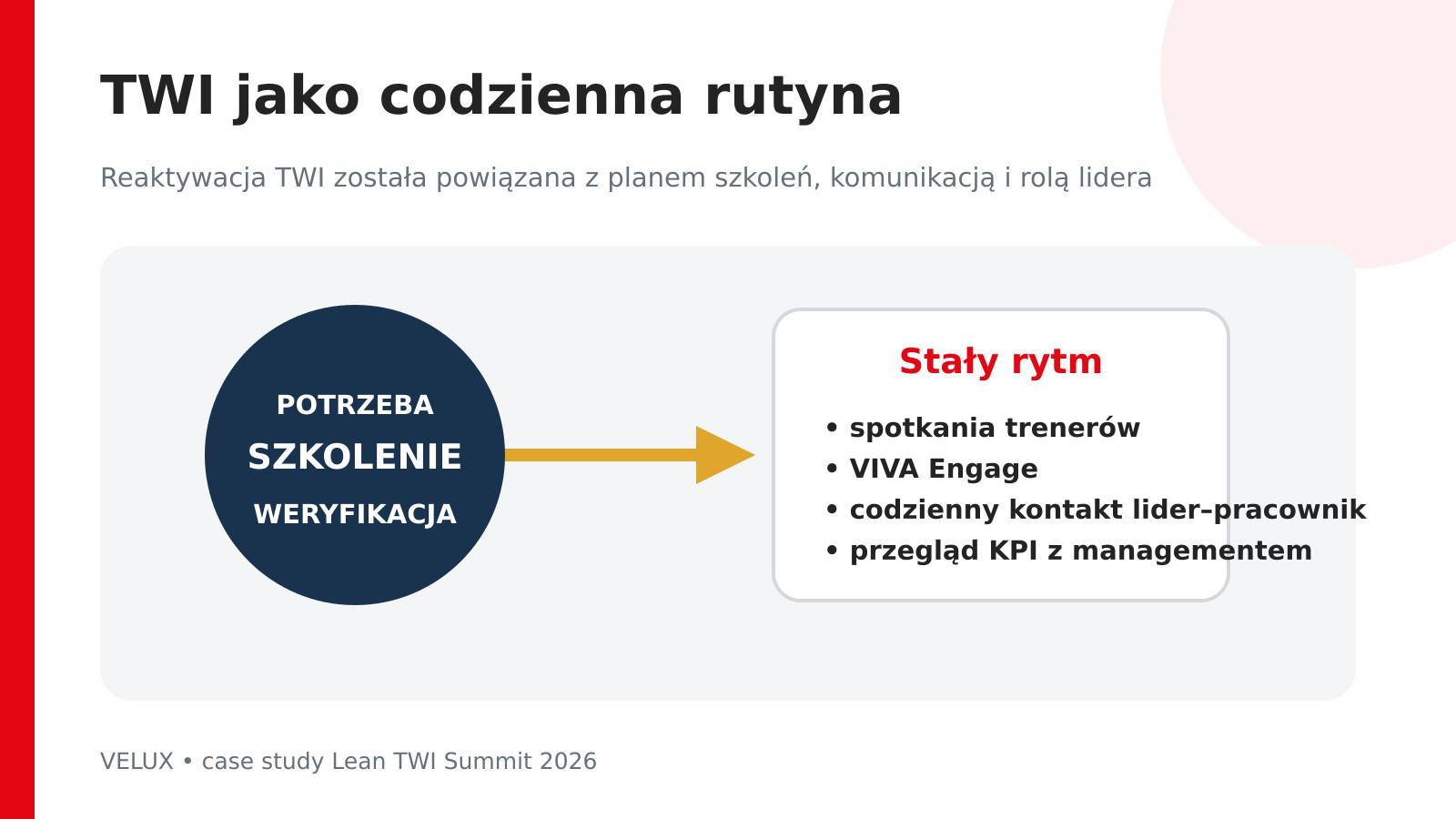
The most significant difference between the two approaches was embedding TWI in daily work. The process covered identifying training needs, scheduling instruction, practice and verifying competence. The presentation illustrated this rhythm as a five-day process, but the number of days is not a universal standard. It should depend on the difficulty of the operation, the risk involved and the criteria for independent work.
The TWI relaunch was also connected to development pathways. Employees could build further skills towards technical, leadership or trainer roles. Learning therefore extended beyond preparation for one workstation, becoming part of personal development and greater organisational flexibility.
KPIs and communication supporting the TWI relaunch
The first implementation lacked measures and progress reviews. The second approach introduced three basic KPIs: the number of certified trainers, the number of employees trained and completion of the training plan. These measure implementation of the system, so it is useful to complement them with process outcomes: quality, safety, time to independent work and productivity following training.
Communication used several channels: trainer meetings, VIVA Engage, daily operational meetings between leaders and employees, and Management Meetings. Multiple channels helped expose problems more quickly, but their number was not the main strength. What mattered was that information led to a response from the process owner.
Results of the TWI relaunch at VELUX
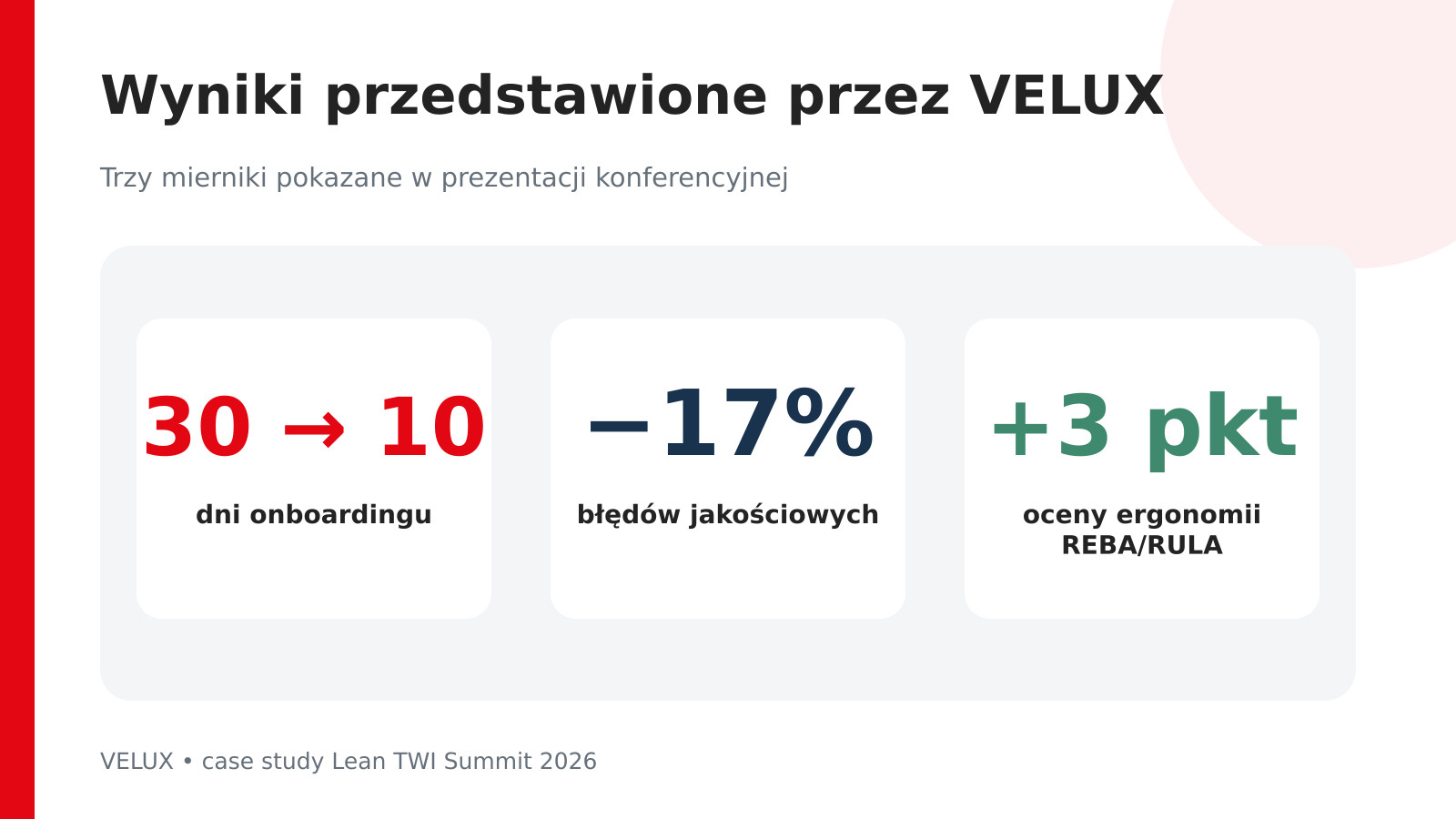
According to the data presented by VELUX at Lean TWI Summit 2026, the second approach delivered results in three areas:
| Area | Result shown in the presentation | Operational significance |
|---|---|---|
| Onboarding | Reduced from 30 to 10 days | Employees ready for work sooner |
| Quality | 17% fewer quality errors | More consistent execution of operations |
| Ergonomics | A three-point improvement in REBA/RULA assessment | Greater attention to how work is performed |
How should these results be interpreted?
The data show the direction and scale of the change reported by the organisation. However, the presentation does not specify the baseline period, number of observations or detailed definition of a quality error. It also does not separate the effects of TWI from other activities undertaken in parallel. These figures should therefore be treated as results presented by VELUX rather than independent evidence of causality.
For ergonomics, the material uses the term REBA/RULA and reports a three-point improvement. Before using these figures in formal materials, the exact method, direction of the scale and population measured should be confirmed. Such clarification strengthens the credibility of the case study.
Relaunching TWI: what can other organisations repeat?
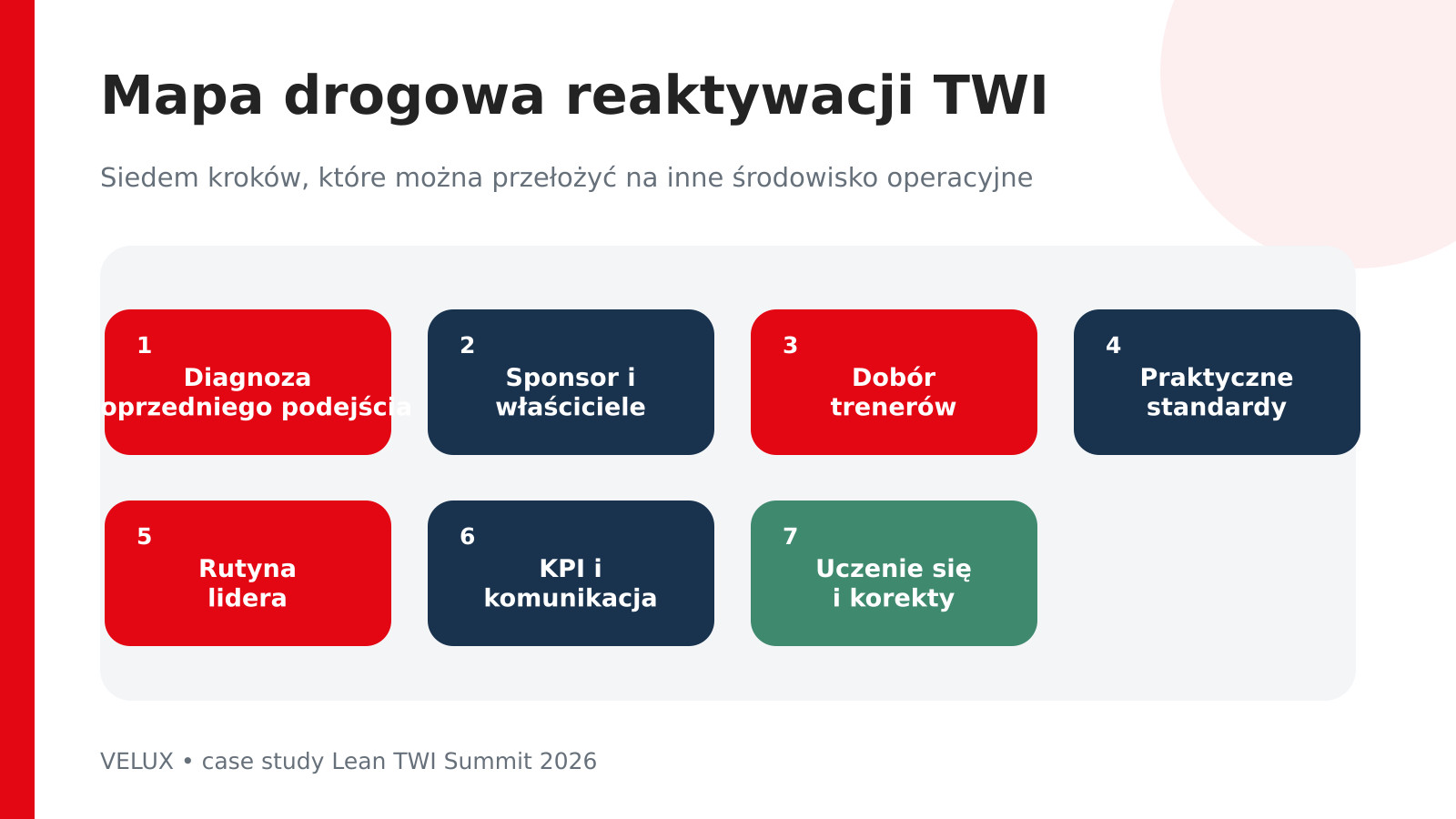
The VELUX story is not a simple instruction for copying a solution. It does, however, provide a set of questions for organisations planning to relaunch TWI:
- Diagnose the previous implementation. Separate gaps in knowledge of the method from management system problems.
- Appoint a sponsor and owners. HR, Lean specialists and trainers cannot replace supervisors’ accountability.
- Select trainers deliberately. Process knowledge matters, as do observation and feedback skills.
- Design the standard with its users. Combine quality, safety, ergonomics and the experience of the people performing the work.
- Allow time for practice. Do not judge the programme solely by a temporary productivity dip during learning.
- Embed TWI in leadership routines. Regularly check skills, use of the standard and obstacles.
- Measure adoption and process outcomes. Training counts alone are insufficient without quality, time to independent work and safety measures.
The most important lesson from relaunching TWI
VELUX summed up its experience in the presentation with the statement: “TWI is not a tool. TWI is people.” The instruction method is necessary, but lasting change depends on leadership behaviours, the quality of standards, trainer selection, time for practice and how the organisation responds to pressure for results.
The TWI relaunch worked because the organisation went beyond simply “training everyone again”. It redesigned the implementation system and gave participants a real voice. Supervisory support and joint development of standards helped overcome resistance, while KPIs and communication kept the subject within daily management. This is the difference between a one-off training project and building a culture of on-the-job learning.
The TWI relaunch versus the first implementation: key differences
Comparing the two approaches shows that success came from changes in implementation design and management rather than repeating the programme alone.
| Element | First approach | Second approach |
|---|---|---|
| Understanding of TWI | A tool and a set of training sessions | A learning system and part of the working culture |
| Management’s role | Limited support | Setting expectations and accepting the time needed to learn |
| Supervisor’s role | Implementation left to trainers | Daily support, observation and maintenance of the standard |
| Trainers | Selection without sufficient verification | Recruitment, practice and certification |
| Work standard | An insufficiently used document | Developed with employees and combining the operation, quality and ergonomics |
| Measurement | No defined KPIs or audits | Monitoring trainers, training, plan completion and process outcomes |
This comparison is also relevant to companies whose first attempt was unsuccessful. Failure does not necessarily mean that TWI is unsuitable for the organisation. It may reveal missing system conditions: sponsorship, leadership ownership, appropriate trainer selection, practical standards or a routine for verifying skills.
FAQ: relaunching TWI
When should an organisation consider relaunching TWI?
When instruction reverts to “watch and copy”, standards are available but unused, trainers work without leadership support, or completed training does not translate into quality and time to independent work. Another signal is TWI appearing only for an audit or new project rather than during everyday onboarding.
Does implementation need to start again from scratch?
Not always. First assess trainers’ existing skills, the quality of instructions, whether skills matrices are current and supervisors’ behaviours. Some elements prepared previously may remain useful. A TWI relaunch should retain what works and redesign the points where the system lost consistency.
Which KPIs are worth monitoring?
Beyond the number of trainers and people trained, useful measures include time to independent work, quality after training, safety, ergonomics, completion of the instruction plan and retention of competence after a defined period. Measures should follow from the business problem the programme is intended to solve. This helps the team distinguish training activity from operational impact.
What is the supervisor’s most important role?
Supervisors create the conditions for learning: they protect time, expect work to follow the standard, observe performance, provide feedback and respond to obstacles. Without this support, even a good trainer becomes the lone owner of the change. The VELUX case study shows that regular contact between leaders and employees was one of the key mechanisms for sustaining the new working method.
VELUX case study presenters
Piotr Hofbauer
Piotr Hofbauer is a certified TWI Trainer of Trainers and an experienced specialist in process improvement and project management. He has worked at VELUX since 2009. He began his career in production, including work on an assembly line and in a paint shop, subsequently developed as a Lean leader and now holds the position of Senior Experienced Project Technician. He helped create the organisation’s TWI system and presented its practical relaunch at the conference. The linked presenter profile is in Polish.
Barbara Łyjak-Menczyńska
Barbara Łyjak-Menczyńska is an HR Business Partner with more than 20 years of HR experience. She combines skills development, employee engagement, recruitment and leadership support with implementing TWI solutions. In the VELUX case study she demonstrated HR’s role in creating conditions that allow job instruction to become a lasting part of organisational culture. The linked presenter profile is in Polish.
This article is based on the materials “Why did the first TWI implementation fail… and the second work?”, presented by Piotr Hofbauer and Barbara Łyjak-Menczyńska at Lean TWI Summit 2026. Numerical data and implementation conclusions come from the VELUX presentation. Process graphics were developed by LeanTrix; the featured photograph comes from the official VELUX website. Original presentation graphics are retained, with English captions and alternative text.