

Firefighting remains the norm
Leaders solve problems for the team instead of making problems visible and developing problem-solving capability.


Leadership development becomes sustainable when leaders practise observable behaviours in real work, receive coaching and connect people development with process performance.
LeanTrix support area
An effective leader turns strategy into everyday team behaviour. We develop supervisors, team leaders and managers in their own working environment: leading dialogue, teaching standards, solving problems and building people’s capability. The result is not a one-off training event, but a management system that continues after the workshop.
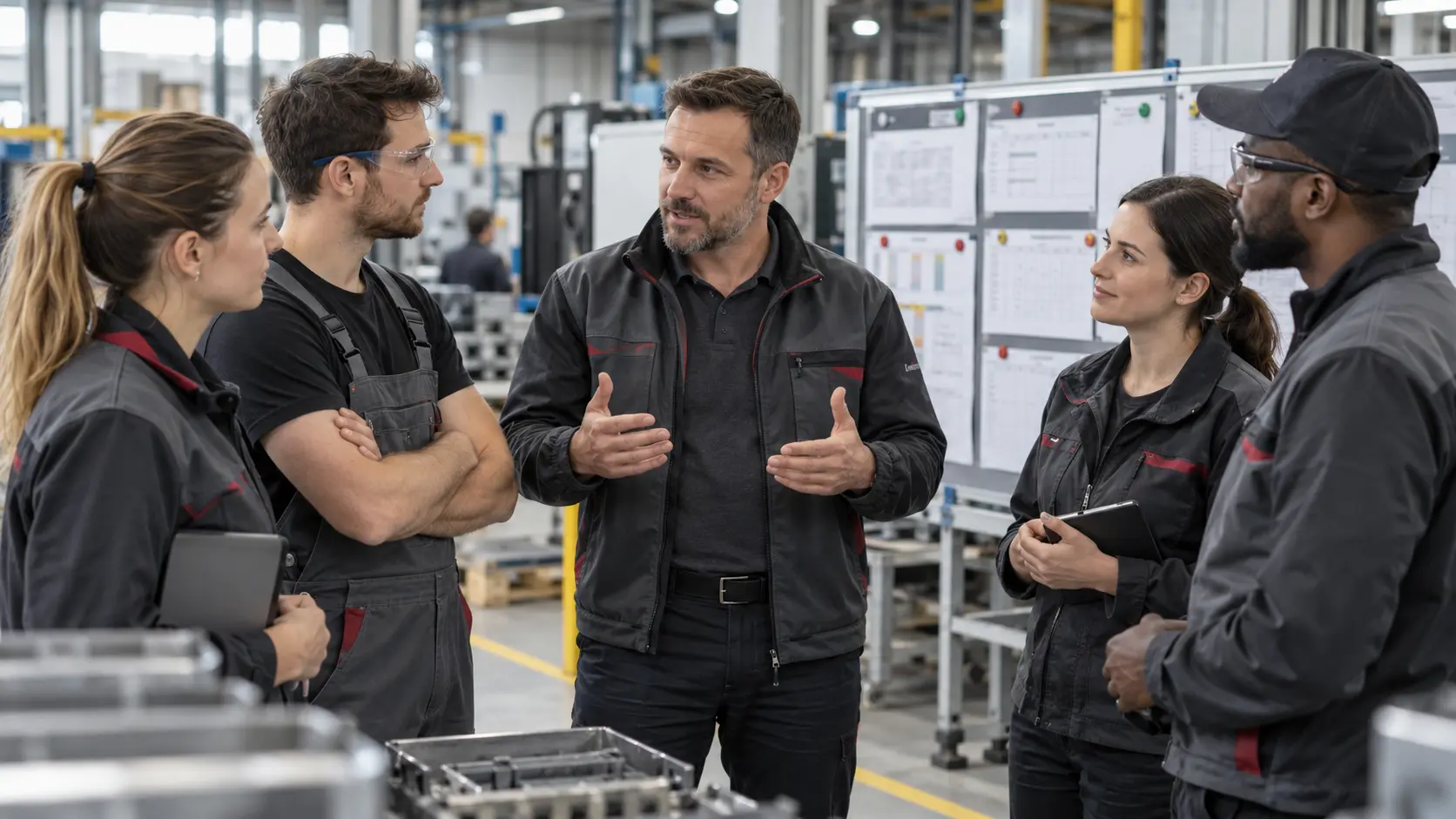
From role to behaviour
Knowing a model is not the same as using it during a missed target, a quality concern, an employee conversation or an improvement experiment.
Leaders solve problems for the team instead of making problems visible and developing problem-solving capability.
The organisation trains people, but does not give first-line leaders one repeatable way to teach and follow up work.
Expectations differ between shifts and managers. Difficult conversations are delayed until the situation has escalated.
Participants enjoy a workshop, yet no one observes the new behaviour or connects it with safety, quality, delivery and engagement.
One coherent system
A practical leadership system links organisational direction, daily management, standard work and a repeatable coaching rhythm.
Learning by doing
Each engagement is built around real leadership situations and an agreed operational outcome, not a generic list of soft skills.
We clarify business priorities, decision rights, current routines and the situations in which leaders have the greatest influence.
Together we translate values into visible practices: how to run a meeting, teach a task, respond to a deviation and conduct a difficult conversation.
Short learning modules are followed by application in Gemba. Participants work on their own people, process and improvement challenges.
A trainer and the participant’s manager observe the practice, give precise feedback and agree the next repetition.
We review both adoption and results: quality of instruction, response to problems, meeting discipline, employee capability and selected performance indicators.
Methods that reinforce one another
We select the method according to the behaviour and process that must improve. The page remains one hub; each specialist area develops a specific capability in depth.
A practical four-step method for handling people problems while maintaining good relations and using facts before action.
Explore TWI Job RelationsBuild a daily routine of setting direction, understanding the current condition, experimenting and learning through coaching questions.
Explore Toyota KataConnect instruction, relations, work improvement, safety, quality and problem solving in one frontline leadership system.
Explore TWI implementationTurn declared values into repeated management practices, reinforcement mechanisms and decisions people experience every day.
Explore organisational cultureGive leaders a shared process for defining problems, finding causes, testing countermeasures and preventing recurrence.
Explore Problem SolvingAlign leadership development with organisational priorities, constraints, experiments and capability building across the system.
Explore the Transformation LoopWhat changes
We agree leading indicators that show whether leaders are using the new standard and lagging indicators that show whether the process benefits.
Leaders know what good daily management looks like and employees receive a more consistent experience.
Feedback, escalation and difficult conversations happen earlier, with facts and clear follow-up.
Training is planned from process needs and leaders can verify whether a person can perform independently.
Teams make deviations visible and leaders coach thinking instead of repeatedly providing ready-made answers.
Meetings, visual controls, escalation and action reviews operate as one management rhythm.
Leaders can explain direction, involve employees and adapt standards through evidence-based learning.
Evidence from implementation
See how organisations connected leader development, work standards and improvement to the daily process.

A structured approach to instruction and leader capability supported consistent onboarding and operational learning in a dynamic logistics environment.
Read the case study →
Lean and TWI were connected with management routines and capability development so improvement could be sustained beyond isolated workshops.
Read the case study →Review client recommendations, transformation stories and evidence of long-term cooperation with LeanTrix.
Your implementation team
Our experts combine TWI, Lean, operational leadership and coaching experience. They work with leaders in Gemba and help managers create conditions that reinforce new behaviour.

Author and practitioner of TWI-based leadership systems. He connects work standards, leader routines and transformation so organisations build capability rather than dependence on consultants.
Meet the LeanTrix team
Supports leaders in implementing TWI, standard work and continuous improvement. His focus is practical transfer: from a workshop to routines supervisors can use and verify in everyday operations.
Meet the LeanTrix teamFrequently asked questions
Short answers to the questions organisations usually ask before designing a programme.
Begin with the organisation’s direction, the role of the target leaders and a small number of high-impact situations in their daily work. This makes it possible to define observable behaviours, choose the right method and establish a baseline.
No. The approach applies to logistics, services, healthcare and support functions as well. We always anchor the work in a real process, real decisions and the actual environment of the leaders.
Programmes may be designed for team leaders, supervisors, production managers, department heads, senior leaders or candidates for leadership roles. A cohort works best when its responsibilities and development challenges are reasonably similar.
Communication and relationship skills are connected with process knowledge, standard work and daily management. Participants practise in Gemba, complete implementation tasks and receive feedback on behaviour that can be observed.
A leader can apply a method immediately, but a dependable habit requires repetition, observation and support from their manager. The programme length therefore follows the behaviour and work cycle rather than a fixed number of classroom days.
We combine leading measures — such as quality of instruction, feedback cadence or problem-escalation discipline — with selected operational and people outcomes, for example safety, quality, delivery, skill coverage, absenteeism or employee retention.
Tell us which roles, behaviours and results need to change. We will propose a practical first step: diagnosis, a pilot programme or a coaching-based implementation path.