


Standardised Work at RECARO: 50% Shorter Onboarding
Standardised work at RECARO — a LeanTrix case study
Standardised work at RECARO reduced employee onboarding time by 50%. The TWI programme brought together consistent instructions, instructor development, a training centre, audits and a skills matrix. This reduced human errors, rework and training costs in the demanding environment of aircraft-seat production.
The most important changeBefore the transformation, training a new employee took three months, and the way knowledge was transferred depended mainly on the trainer’s experience. Implementation created one measurable, TWI-based skills development system.
RECARO shows how a work standard operates in practice. Definitions, tool selection and implementation stages are covered in our guide to standardised work.
Standardised work at RECARO: the starting point
RECARO Polska manufactures aircraft seats in Świebodzin. Quality, legal and documentation requirements are demanding. Operators use technical drawings and multiple production documents, while individual operations take between 7 and 20 minutes. Product variety adds complexity: requirements depend on the airline, aircraft and specific seat configuration.
Before implementation, training took about three months. Knowledge was held mainly in experienced operators’ heads, so employees could be taught in different ways. Meanwhile, the aviation market was accelerating again after the pandemic, the company was preparing to increase employment, and the local labour market was highly competitive with significant turnover.
Operational risk
Lengthy onboarding, different working methods, errors causing scrap and rework, and a heavy burden on experienced operators.
A system-wide response
TWI instructions, certified instructors, a training centre, a skills matrix, audits and regular training-plan management.
Objectives in the sponsorship agreement
The project was planned for one year. It formally began with a sponsorship agreement signed by the president of RECARO Polska. The document described the baseline, internal and external factors, team membership, meeting frequency and three measurable objectives prioritised by the management board.
The agreement distinguished targets from subsequent results and enabled regular checks of whether the project was progressing as intended. TWI therefore operated as a programme linked to business results, rather than a one-off training course.
A pilot across the whole factory
The first wave included pilot areas in every department: assembly, packing, sewing, machine operation and the goods-in warehouse. This scope made it possible to test TWI Job Instruction in processes with different characteristics, pace and complexity.
Workstation optimisation ran in parallel. Process improvements were immediately incorporated into TWI instructions. This connection mattered: the standard documented and sustained the new, improved process.
From learning the method to a stable system
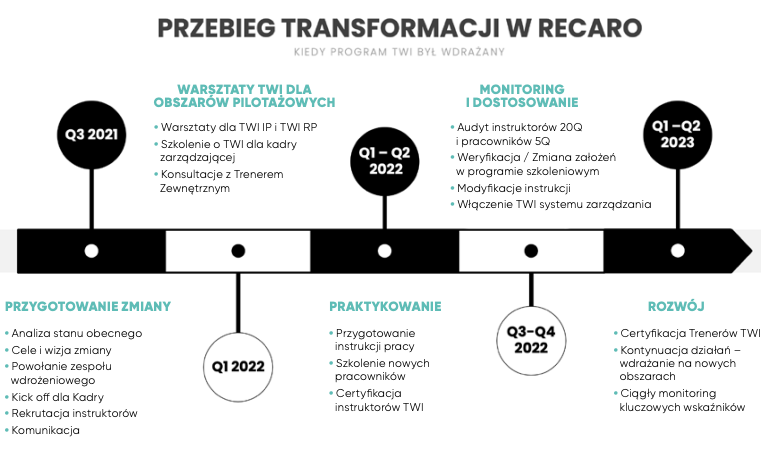
The path to standardisation was not linear. The first contact with TWI came in 2019, but the pandemic halted the project. The organisation returned to it in December 2021 as the recovering aviation market increased the need to develop new employees quickly and consistently.
- 2019Learning about TWIInitial training and the decision that TWI could replace the approach used for about a decade.
- PandemicProject suspendedAviation-market uncertainty temporarily postponed implementation.
- December 2021RelaunchSponsorship agreement, baseline, objectives, measures, pilots, implementation team and change ambassadors.
- Instructor developmentWorkshops and certificationFour-day TWI Job Instruction and Job Relations workshops, practice, instruction writing and confirmation of instructor competence.
- ScalingTWI Center and systems integrationTraining centre, regular meetings, new qualifications matrix, career-path changes and adaptation of paperless working.
- SustainingMonthly plans and auditsTraining linked to staffing, weekly work with instructors, indicator reviews and updates to standards.
Instructors and the TWI Center
Instructor candidates were selected with HR involvement. Each person completed Job Instruction and Job Relations workshops, followed by certification that required preparing an instruction and delivering on-the-job instruction using TWI.
A TWI Center was established near production: a dedicated space where new employees begin onboarding and learn key repeatable operations. Instructors and team leaders meet regularly, solve problems and plan further training. Skills development became a managed process, rather than an extra task fitted around immediate production demands.
Seven elements that sustain the change
Standardised work at RECARO extends beyond publishing instructions. Seven connected mechanisms embed the system in daily management:
- TWI Center
Initial onboarding and basic instruction in key operations.
- 5Q, 10Q and 20Q audits
Support for the employee, area and instructor after training.
- Skill Matrix
A qualifications matrix connected to instructions and actual tasks.
- Standardisation sheets
Work steps based on the logic of TWI instructions.
- Monthly plans
Training based on planned recruitment and area needs.
- Instructor meetings
Weekly review of problems, progress and next actions.
- Indicator monitoring
Training time, number of instructions and number of training sessions delivered using TWI.
Leading the change
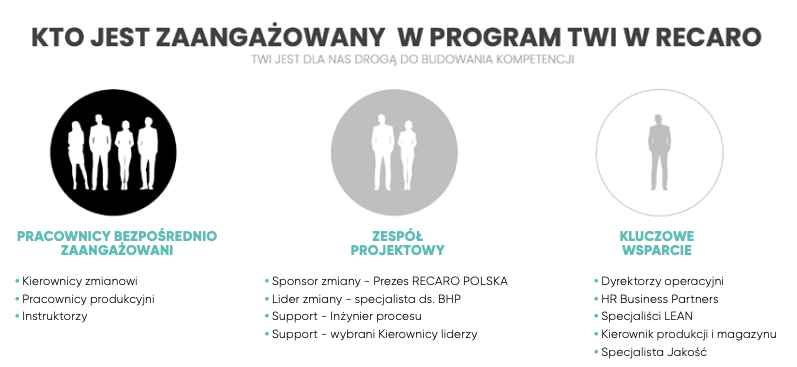
The programme was sponsored by the president of RECARO Polska, with a safety specialist serving as project leader. The implementation team included managers, engineers and shift leaders. Ambassadors among production employees also played an important part.
Management support was demonstrated in practice: senior managers attempted to learn operations on the line using TWI themselves. This visible involvement helped overcome resistance among people accustomed to the previous training approach and strengthened the credibility of the change.
The qualifications matrix, paperless working and optimisation
The new division of work required changes to the qualifications matrix and career paths. Skills were linked to specific tasks and TWI instructions, while team leaders changed how they sequenced and allocated work. The paperless system used to record documentation and task completion was adapted to the new instruction structure.
Initially, workstation optimisation and TWI were managed separately. Connecting the two initiatives created a coherent system: improvement changed the process, while standardisation sustained the better method and transferred it to other employees.
Results of standardised work at RECARO
The results covered speed of skills development, quality and costs. The rework target was achieved, while the other indicators improved substantially and provided a foundation for further improvement.
- greater awareness of quality and how work should be performed,
- greater employee ability to work across different stations,
- more candidates recruited through the employee-referral programme,
- fewer situations requiring immediate firefighting,
- more time to develop and improve management systems.
Implementation difficulties
The transformation required practical work at the workstations and organisational discipline. The main challenges involved changing established behaviours and connecting the system’s many elements, rather than the technique of writing instructions itself.
- resistance to moving away from an approach in which an experienced employee mainly supervised the trainee,
- the need to keep instructions updated as processes changed,
- the initial separation of workstation optimisation from the TWI programme,
- the need to connect instructions, the qualifications matrix, LMS and the paperless system.
The strongest result emerged when TWI became part of the daily system for managing work and skills.The key lesson from the RECARO Polska transformation
Five lessons for other organisations
- Start with an agreement
Set the sponsor, baseline, measures and meeting rhythm before the pilot.
- Make management support visible
Visible leadership participation builds the credibility of change more than communication alone.
- Connect TWI with Kaizen
Improve the process first, then capture the best working method in the instruction.
- Build the infrastructure
Instructors need space, time, audits, meetings and a plan linked to staffing.
- Integrate systems
Instructions, Skill Matrix, career paths, LMS and paperless documentation must describe the same work.
Frequently asked questions
What results did standardised work at RECARO achieve?
Employee onboarding time fell by 50%, errors causing scrap by 20%, errors requiring rework by 25%, and training costs by 20%.
Why was TWI needed in aircraft-seat production?
The process involves complex documentation, technical drawings, operations lasting between 7 and 20 minutes, and many product variants. TWI provided a consistent way to transfer this knowledge.
What is the TWI Center?
It is a dedicated space near production where new employees begin onboarding and learn the most important repeatable operations before developing further at their workstations.
How does RECARO sustain the standard after training?
The system uses 5Q, 10Q and 20Q audits, weekly instructor meetings, monthly training plans, Skill Matrix and monitoring of training time, instructions and instruction sessions delivered.
Want to shorten onboarding and reduce errors?
LeanTrix helps connect TWI instructions, instructor development, audits and a skills matrix into one system supporting quality, flexibility and organisational development.
Source: RECARO Polska case study by Michał Rączkowski, Beata Waśko and Kamil Müller. All figures, stages and roles described above come from the published source material.
Want to develop a similar skills system?Explore the complete six-method programme, company training formats, dates and LeanTrix trainers.Explore TWI training — six methods

Process Engineer in the Production Preparation Department, working at Recaro for 2 years. Member of the TWI project team and a certified TWI trainer. Coordinates daily operations and supports instructors in assembly, sewing, and warehouse areas. Responsible for certifying new instructors. Specializes in continuous optimization of production processes, production line balancing, tool purchasing, and implementing employee suggestions.

Beata Waśko – a Health and Safety enthusiast, graduate of the Main School of Fire Service in Warsaw and the Faculty of Mechanical Engineering at the University of Zielona Góra, as well as numerous courses and trainings. She follows the principle of working in line with her own conscience, staying open to people and all kinds of innovations. Occupational Health and Safety should be promoted and associated with good, human-friendly solutions.

Training Within Industry and Lean Management Practitioner.
He is a lecturer at the WSB University in Wrocław. He is the author and co-author of several pieces of literature on the TWI program.
He is a managing partner in the LeanTrix company and a master Trainer for Europe. Additionally, he is involved in projects such as eTWI System and Lean Community
He has run projects for: Lotte Wedel, Danone, Kompania Piwowarska, eobuwie.pl, Arvato, Whirlpool, B / S / H, Geberit, RECARO, Tenneco, Sumitomo Electric, Stadler, Vesuvius Poland