Implementation case study
Developing informed machine users through TWI, autonomous maintenance and a shared system for skills development.
This case describes the implementation and company profile at the time of the original article; historical figures are retained.
Wienerberger’s experience of implementing TPM through TWI. This article summarises the presentation “The operator as an informed machine user — the foundations of TPM”, delivered by the Wienerberger team at the first Lean TWI Summit (Polish), held on 19 June 2024.
At LeanTrix, we supported Wienerberger in connecting Training Within Industry (TWI) with Total Productive Maintenance (TPM). This collaboration improved performance indicators and, above all, helped operators understand their role as the key users of their machines.
About Wienerberger
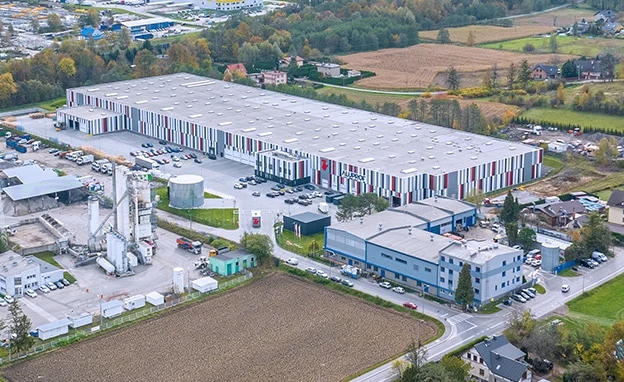
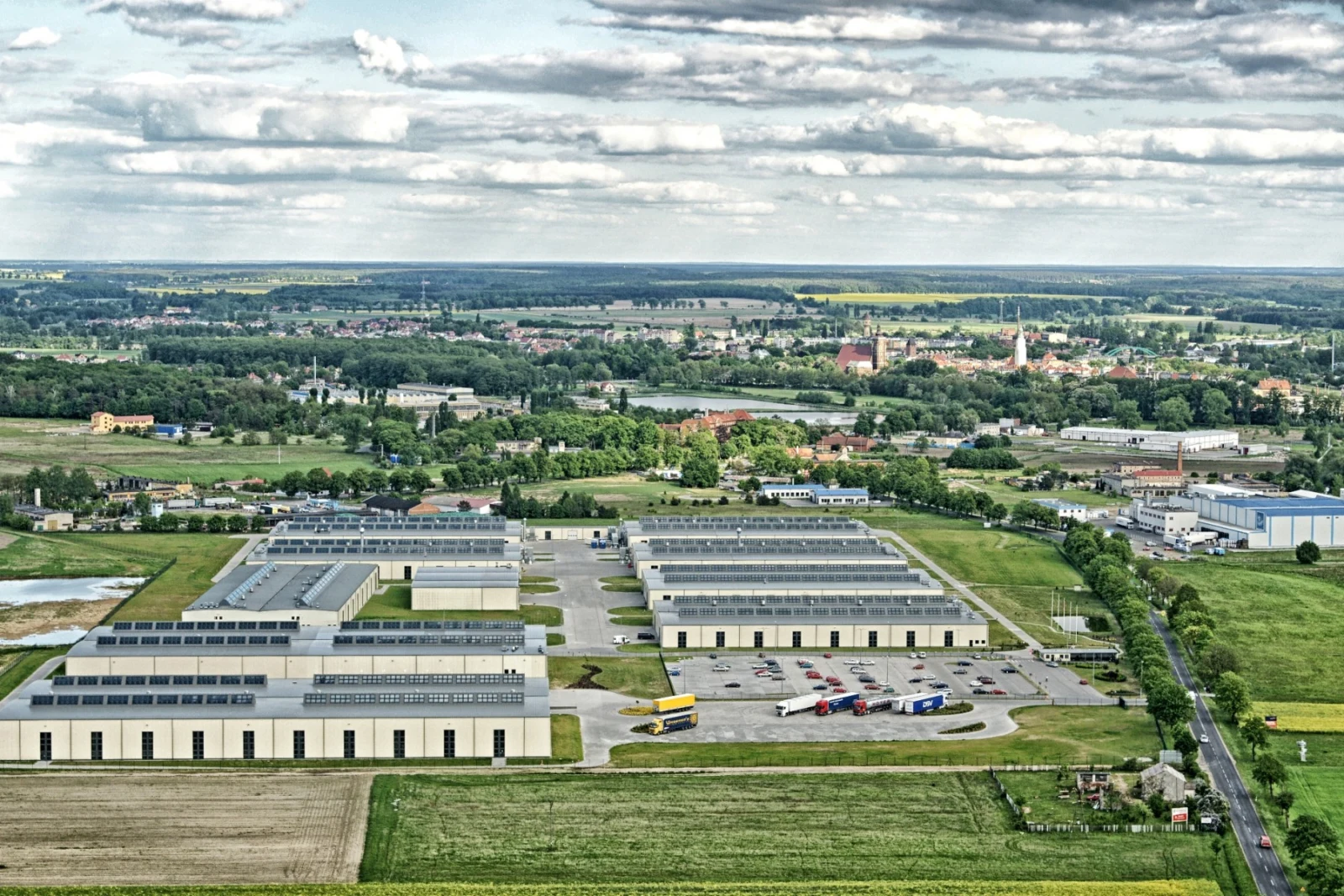
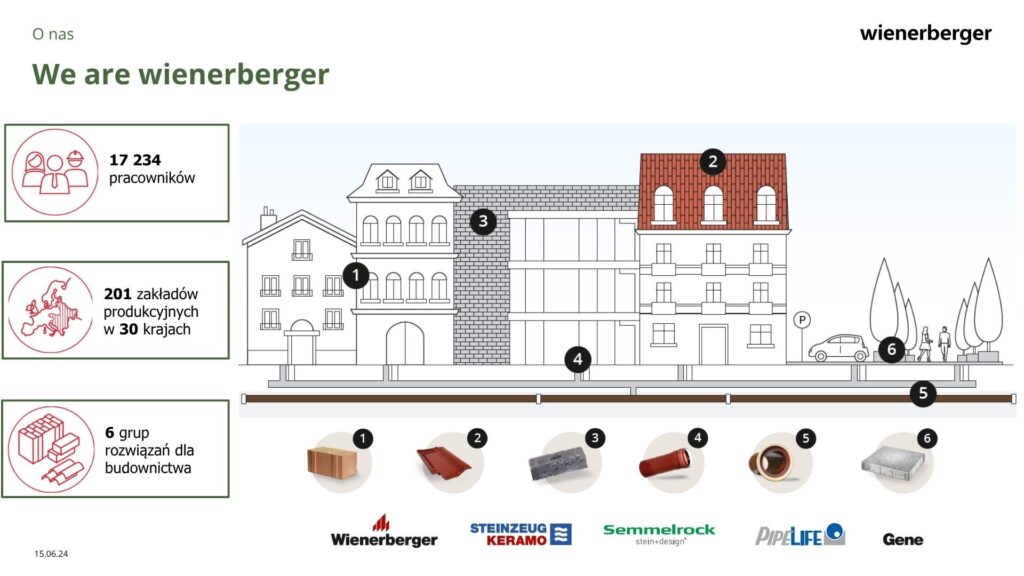
At the time described in the source presentation, Wienerberger AG was a global leader in building materials, employing more than 17,000 people at 201 plants in 30 countries. The company offered six groups of building solutions, including bricks, roof tiles and plastic components.
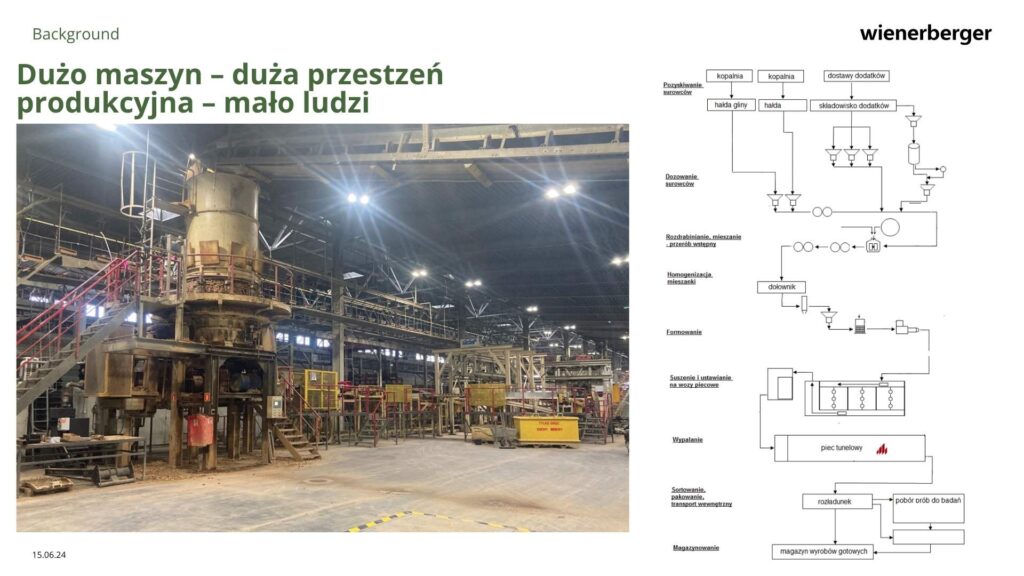
Wienerberger plants typically have:
-
a large number of machines,
-
extensive production areas,
-
relatively few employees,
which places high demands on operators and production leaders.
These conditions created a need for TPM at Wienerberger based on informed machine use and standardised operator work.
Organisational background
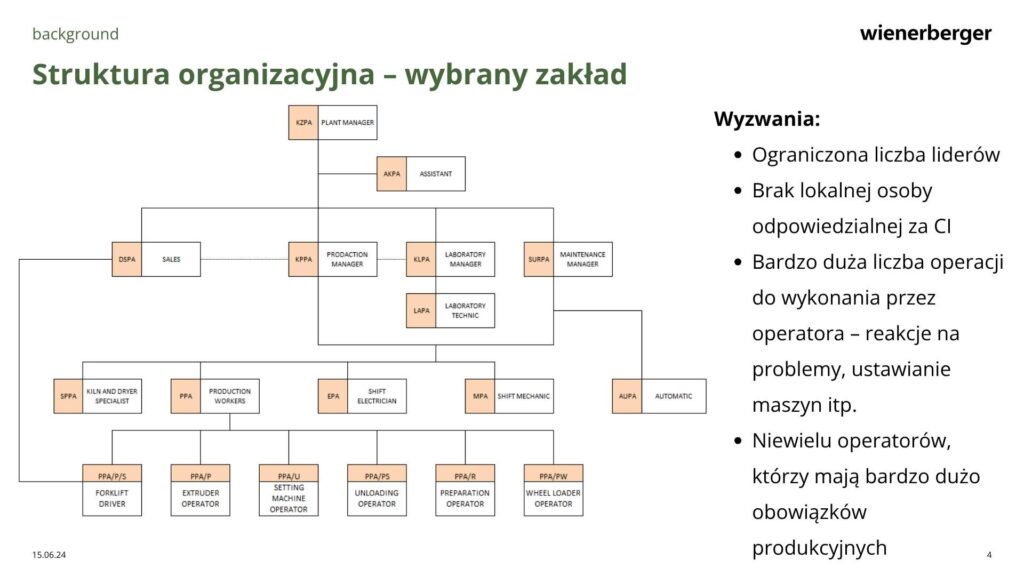
The analysis of the Wienerberger plant identified several key organisational challenges:
-
a limited number of leaders,
-
no local person responsible for continuous improvement,
-
an overly broad scope of operator duties, including machine setup, problem response and quality checks,
-
a lack of consistent work standards.
As a result, operators performed many activities intuitively, and production effectiveness (Polish) varied between shifts and according to employee experience.
Problems identified
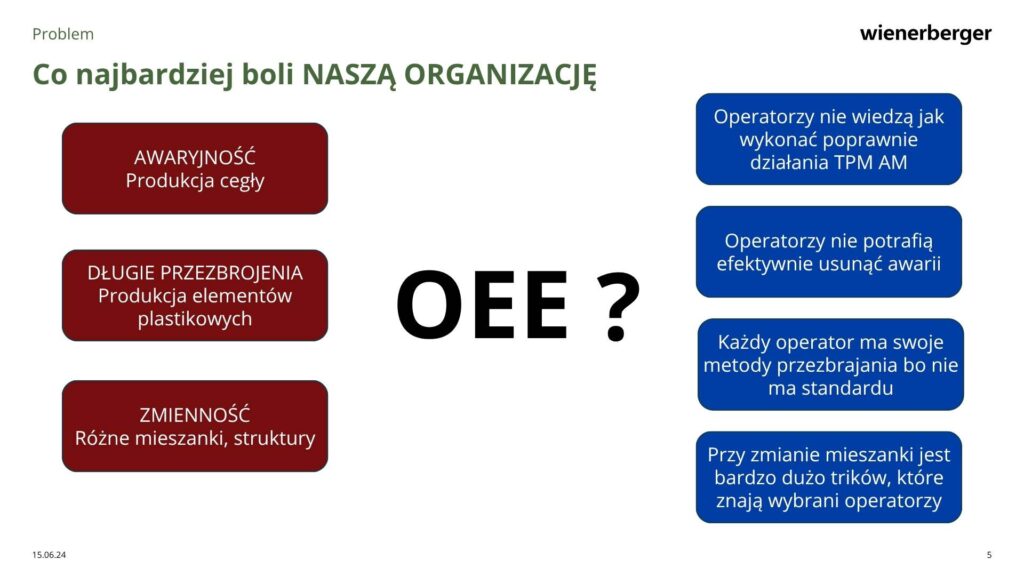
The TPM diagnosis at Wienerberger identified several sources of loss:
-
OEE and breakdowns — difficulty maintaining machine readiness.
-
Long changeovers — a lack of consistent methods and standards.
-
Process variation — many undocumented techniques known only to experienced operators.
-
Gaps in TPM AM (Autonomous Maintenance) knowledge — operators struggled to recognise and resolve minor faults effectively.
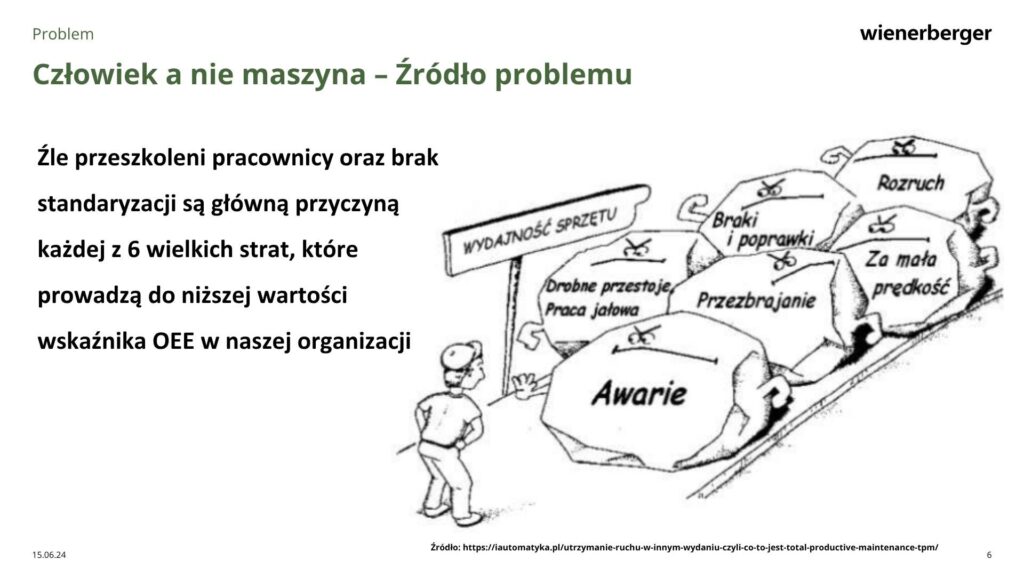
The presentation emphasised the human contribution to machine-related problems. Its practical conclusion was that skills development and standardised activities are central to improving effectiveness.
Operator skills analysis and the need for TPM at Wienerberger
The analysis showed that:
-
94% of employees had at least two competencies,
-
only 15% had more than five, predominantly leaders,
-
most operators were limited to simpler tasks, such as sorting roof tiles.
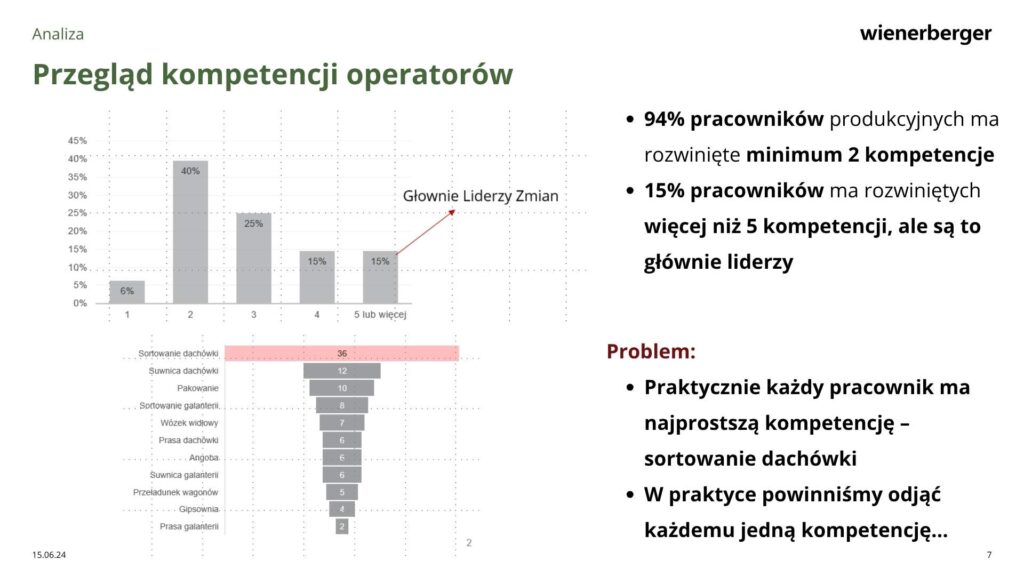
The TPM programme therefore aimed to develop operators into informed machine users: people able to recognise symptoms of faults, respond preventively and support improvement.
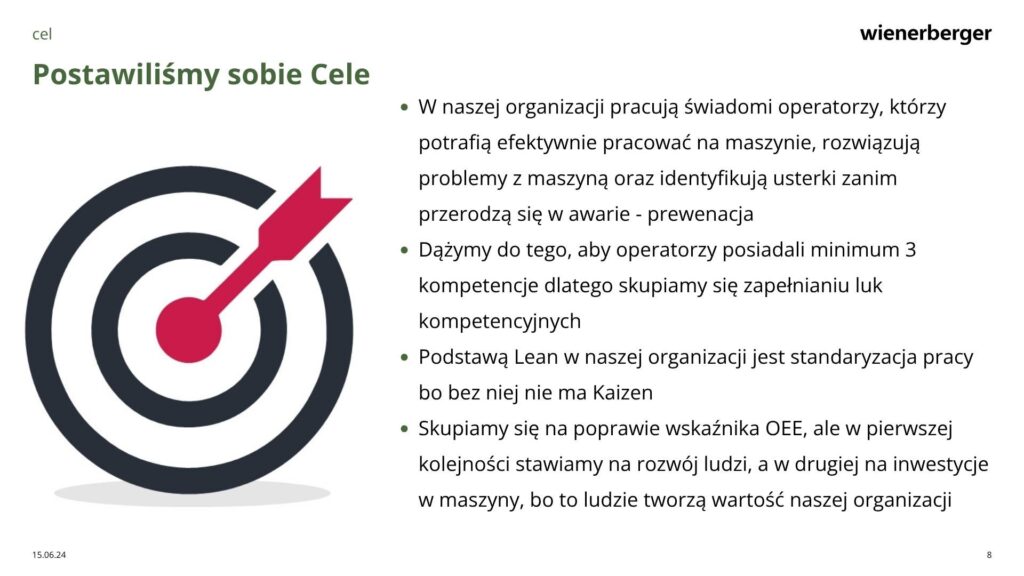
Objectives of the TPM project at Wienerberger
The project combined TWI and TPM in one coherent approach. Its main objectives were:
-
Understand processes and skills — map activities on production lines in detail.
-
Close skills gaps — develop operators in key areas of autonomous maintenance.
-
Develop people before investing in machines — people create value through how equipment is used.
-
Improve OEE through standardisation and education, alongside technical work.
Solutions implemented at Wienerberger
Process mapping and skills matrices
The team developed detailed process maps for every production line and skills matrices showing employee proficiency levels.
This made skills gaps clear and provided a basis for planning employee development.
A TPM red-tag system
A red-tag fault-reporting system was introduced, with each abnormality visibly marked and reported.
Operators participated in:
-
basic cleaning and inspections,
-
fault identification,
-
root-cause analysis (Polish) and elimination of recurring errors.
TPM became a way to learn every day at the workplace.
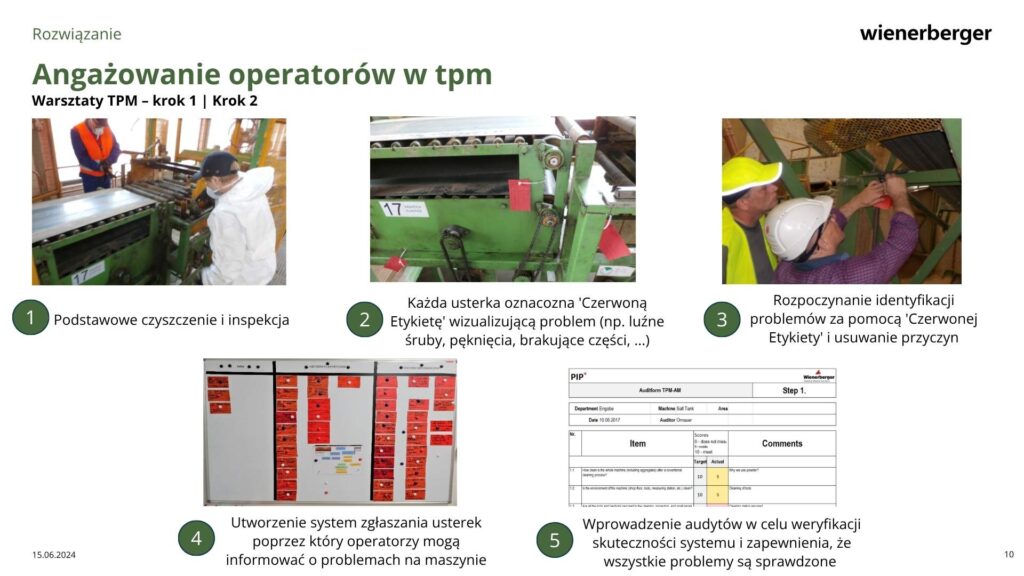
TWI-based TPM work instructions at Wienerberger
Workplace documentation was modernised.
The previous instructions were overly descriptive and focused on the machine rather than the working method.
The new instructions, prepared using TWI Job Instruction (JI), are:
-
concise and visual,
-
divided into important steps, key points and reasons,
-
focused on teaching operators how to perform work safely, to the required quality and efficiently.
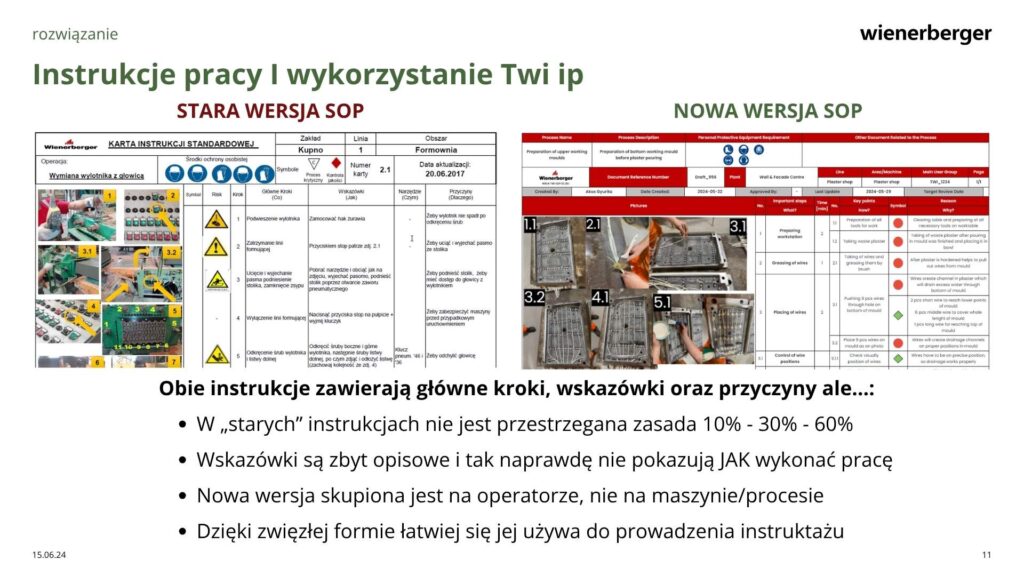
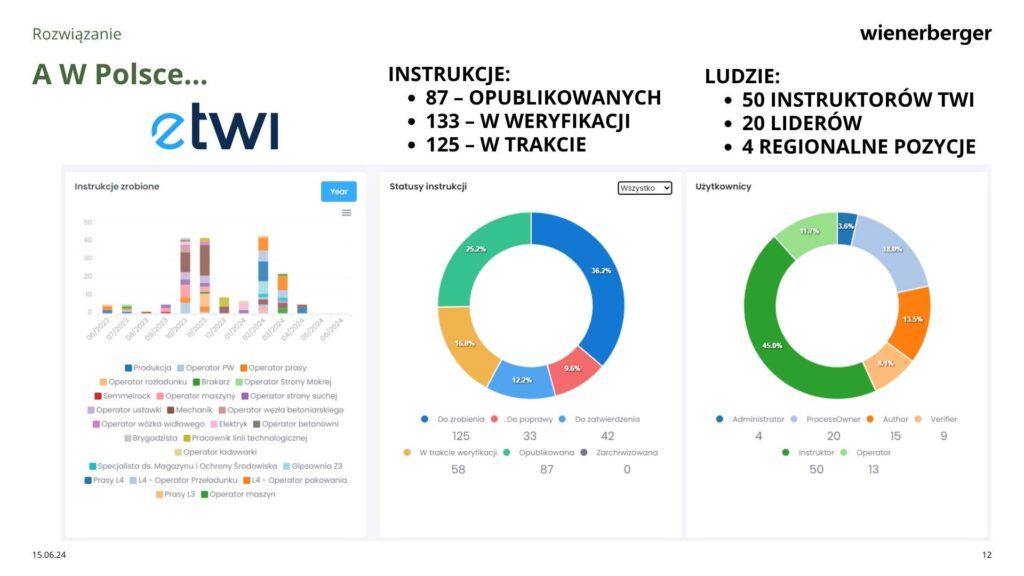
Wienerberger used the etwi system to digitise TWI work instructions.
Developing TWI instructors
Over two years, the programme trained:
-
50 TWI instructors,
-
20 leaders,
-
and created four regional roles supporting standardisation.
The source reports more than 200 TWI instructions created and lists the following workflow figures:
-
87 published,
-
133 under review,
-
125 in development.
Results of TPM implementation at Wienerberger
The results were visible in both organisational culture and operational performance:
-
Operators became more aware of their role and influence on equipment effectiveness.
-
The number of improvement suggestions and preventive activities increased.
-
Standardisation shortened changeovers.
-
Process stability and OEE (Overall Equipment Effectiveness) improved.
-
The programme established a foundation for further TPM and Lean development across the organisation.
Next steps for TPM at Wienerberger
The Wienerberger team continues to develop its TPM and TWI system through:
-
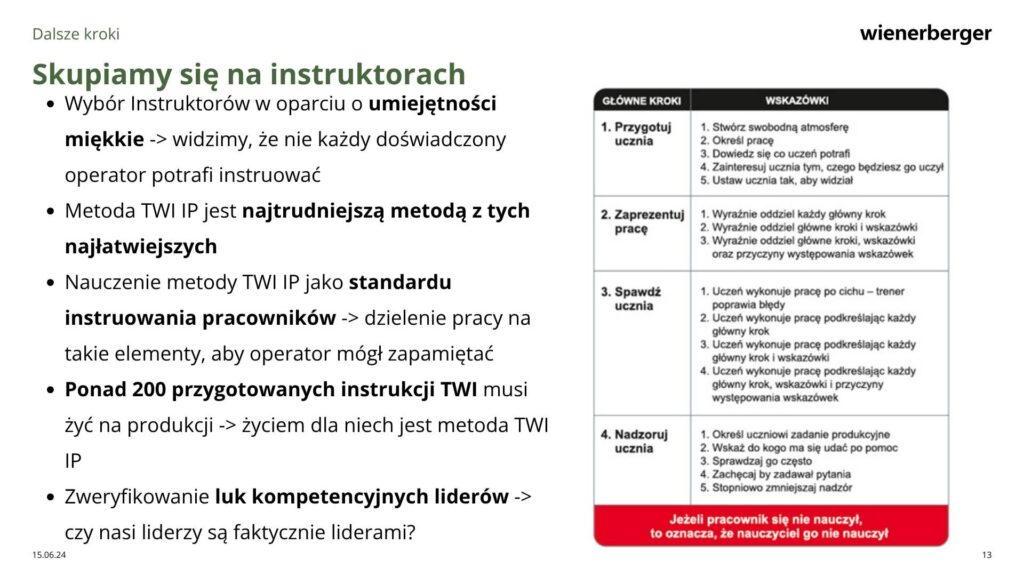
selecting instructors with suitable interpersonal skills,
-
improving TWI Job Instruction as the teaching standard,
-
periodically reviewing leaders’ skills gaps,
-
keeping instructions active on the production floor through everyday use.
The project authors describe TWI Job Instruction as the most demanding of the simple methods: it requires a real understanding of people as well as the process.
Summary: TPM at Wienerberger
The Wienerberger case demonstrates how combining Training Within Industry with Total Productive Maintenance connects people and machines more effectively.
Standardisation, operator involvement and skills development became the basis for better OEE and a culture of continuous improvement.
For the LeanTrix team, it demonstrates that Lean transformation starts with people, with TWI and TPM providing practical methods for making it happen.

Dorota Draus is a specialist in Lean Management who currently serves as the Head of Lean for Poland at Wienerberger Ceramika Budowlana. She has extensive experience in coordinating the implementation of Lean methodologies across multiple factories throughout Poland.
Her career at Wienerberger has spanned over 12 years, beginning in an entry-level position and progressing through a series of promotions to increasingly senior roles. Dorota Draus places particular emphasis on Total Productive Maintenance (TPM), which has significantly contributed to improving the efficiency of production processes at Wienerberger. Her work plays a crucial role in maximizing the effectiveness and reliability of machinery, essential for maintaining production continuity and quality.
Bartłomiej Chodubski serves as the Continuous Improvement Manager at Wienerberger AG. As a Continuous Improvement Manager for Europe, Bartek supports over 200 Wienerberger sites across the continent, focusing primarily on work standardization within the framework of Total Productive Maintenance (TPM) and leveraging the Training Within Industry (TWI) program.
Bartek began his journey at Wienerberger in March 2021 as a Lean Manager at WBS Poland. In this role, he was responsible for developing and implementing the Continuous Improvement strategy for WBS PL, as well as building and training a CI team that supported plant management teams in promoting and sustaining a Lean culture across 13 locations (22 production lines) in WBS PL.
He identified cost-saving initiatives exceeding €2 million and co-developed WBS PIP+ and Maintenance standards in the areas of shop floor management, problem solving, standardized work, and TPM.

I am a promoter of Lean Management and the Training Within Industry program. I am a practitioner. I co-create many startups. Since 2015, I have been the CEO of Leantrix - a leading Lean consulting company in Poland, which, starting from 2024, organizes one of the largest conferences dedicated to lean management in Poland - the Lean TWI Summit. Since 2019, I have been the CEO of Do Lean IT OU, a company registered in Estonia that creates the software etwi.io, used by dozens of manufacturing and service companies in Europe and the USA.