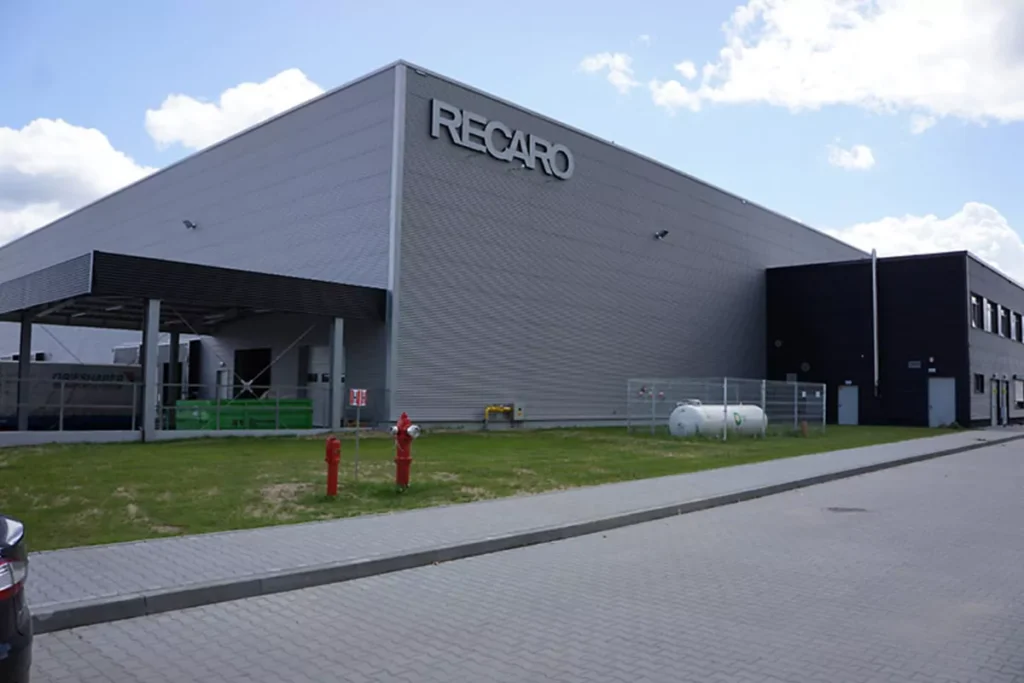
Improving resource utilisation does not have to mean making people work faster, buying more machines or building another factory hall. The case of RECARO Aircraft Seating Polska shows another route: consistently removing waste from material flow, workstation organisation and plant layout.
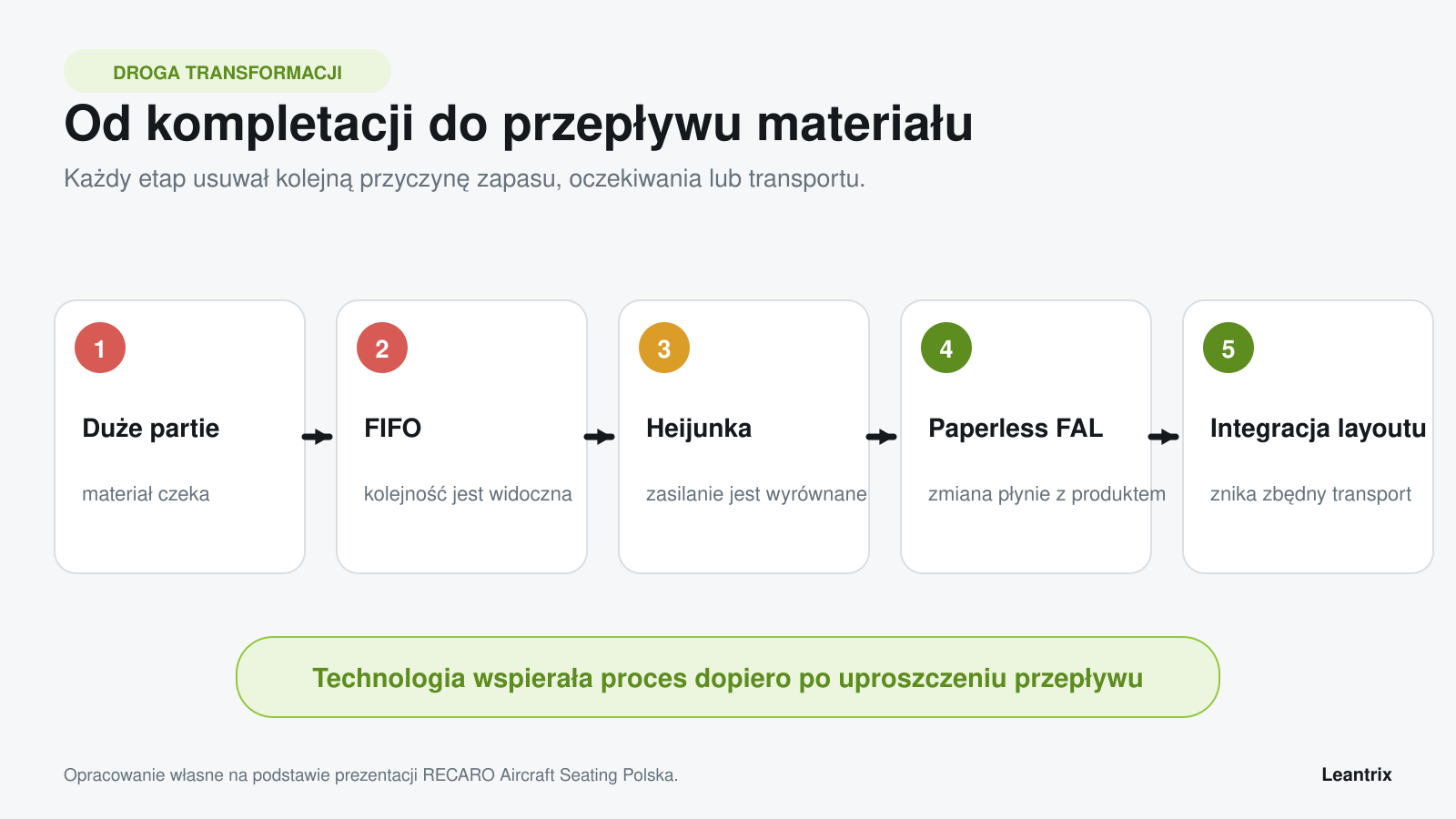
Initially, large batches, material kitting, extensive inventories and long transport routes consumed space and organisational capacity. Successive changes—FIFO, Heijunka, eliminating kitting, digitalising flow and connecting the warehouse with assembly—gradually released resources already available within the existing infrastructure.
This is the story of a transformation over many years. Bartosz Masny’s presentation also shows a temporary setback during the pandemic. That makes the case particularly valuable: flow needs to be redesigned as products, volumes, technology and operating conditions change.
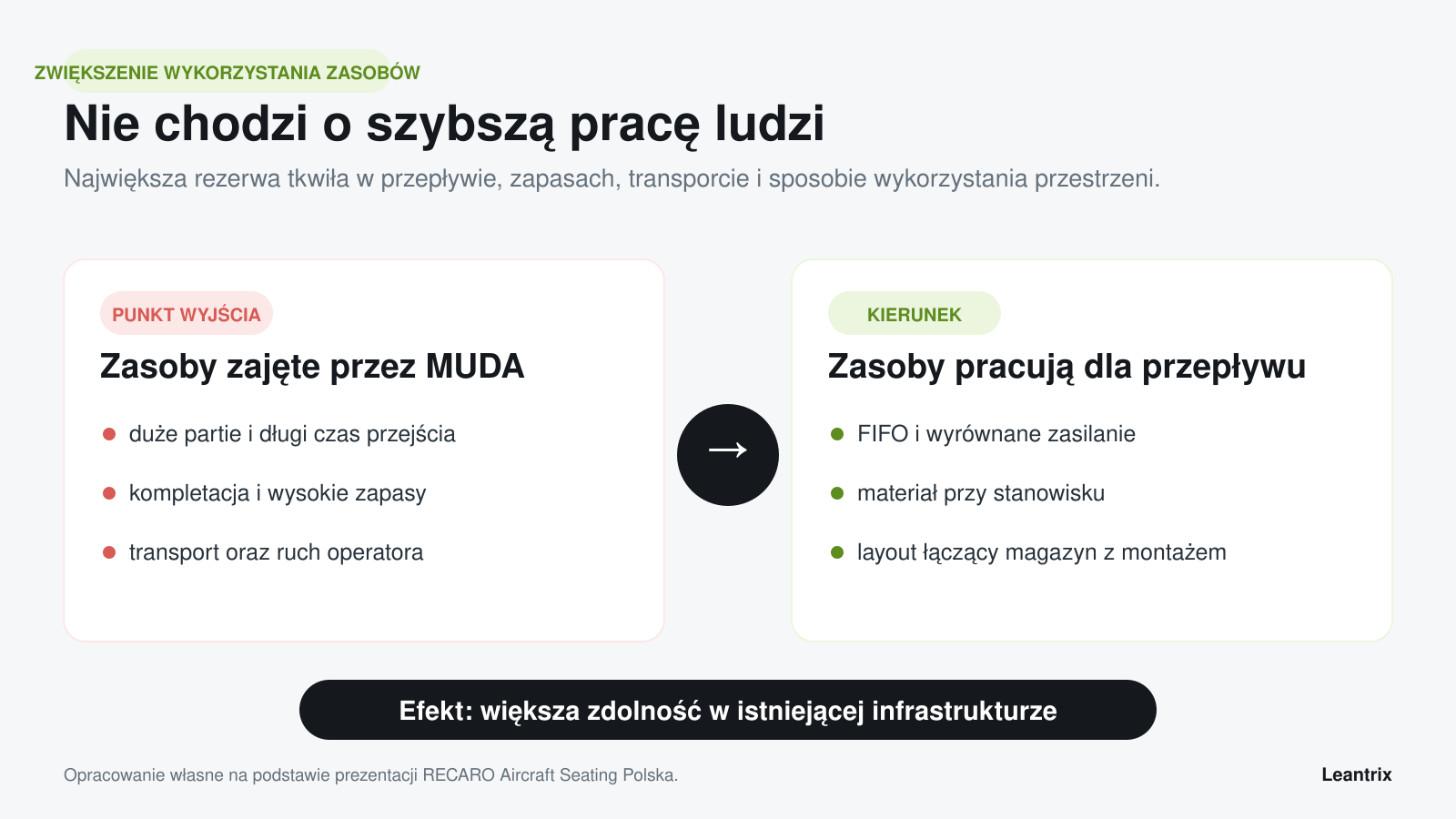
Improving resource utilisation means more than working faster
In a conventional approach, insufficient production capacity quickly raises questions about additional space, equipment and headcount. Lean reverses the sequence. It first examines how much available time, space and equipment is consumed by activities for which customers are unwilling to pay.
A resource can be busy and still be poorly utilised. A forklift travels a long route, an operator searches for material, a component waits in a queue and floor space holds inventory. Each activity looks like work without increasing product value. The objective is smooth flow across the entire value stream, rather than maximum loading of every workstation.
The largest capacity reserve is often hidden in transport, waiting, inventory, motion and rework within the existing building.
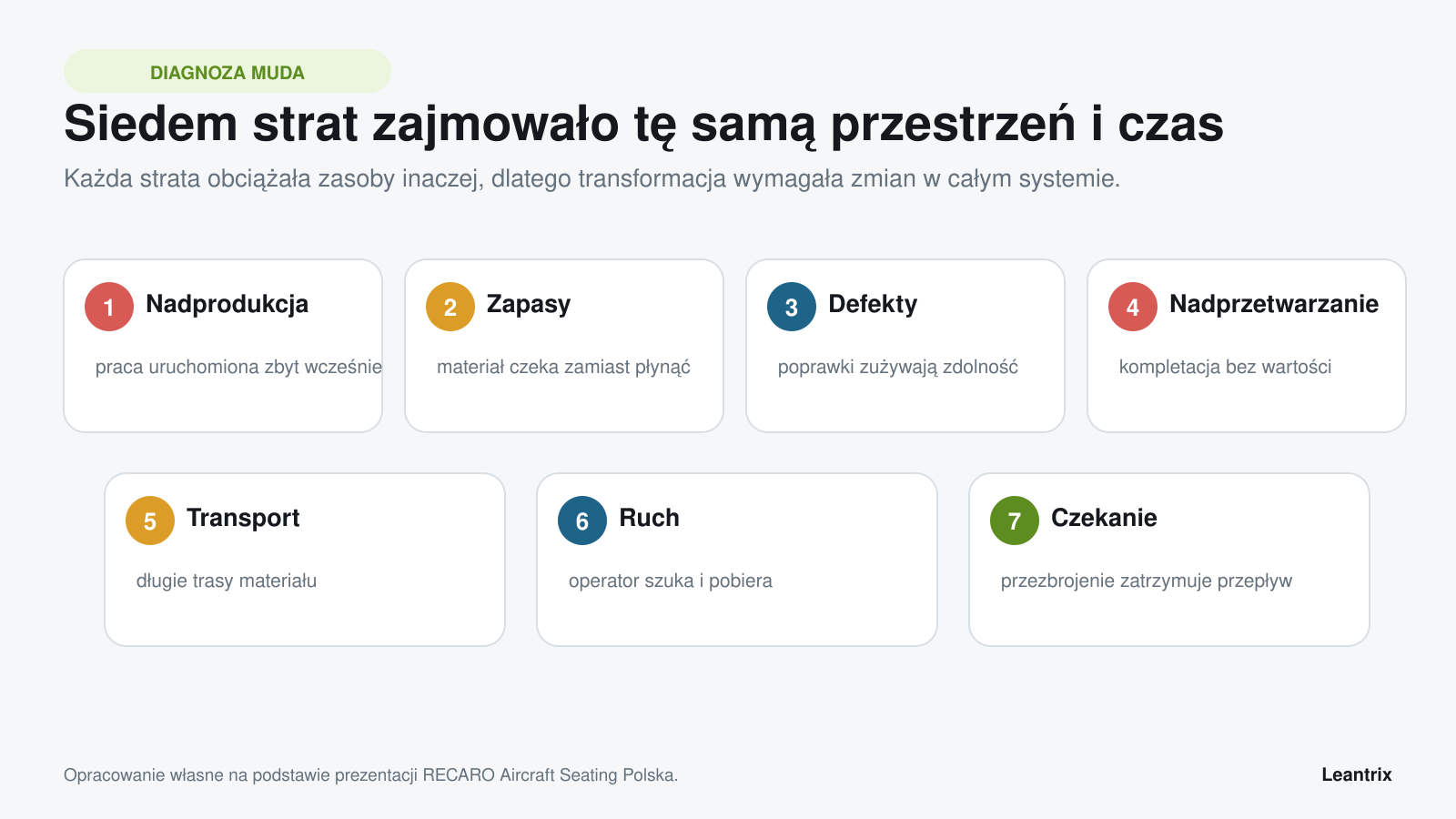
The starting point: seven types of MUDA in one flow
In the initial model, materials arrived in large batches and subassemblies were kitted before assembly. A substantial part of the hall served as storage. This appeared advantageous because each order received its own kit. In practice, kitting added another handover, waiting location and opportunity for error.
The presentation identified all the classic types of waste:
- Overproduction: starting work before the next process required it.
- Inventory: raw materials, components and prepared kits.
- Defects: consuming people’s and workstations’ capacity in rework.
- Overprocessing: including kitting that added no value.
- Transport: long routes between areas.
- Unnecessary motion: operators collecting materials and tools.
- Waiting: associated with product changes and uneven process replenishment, among other causes.
Define workstation principles before the detailed layout
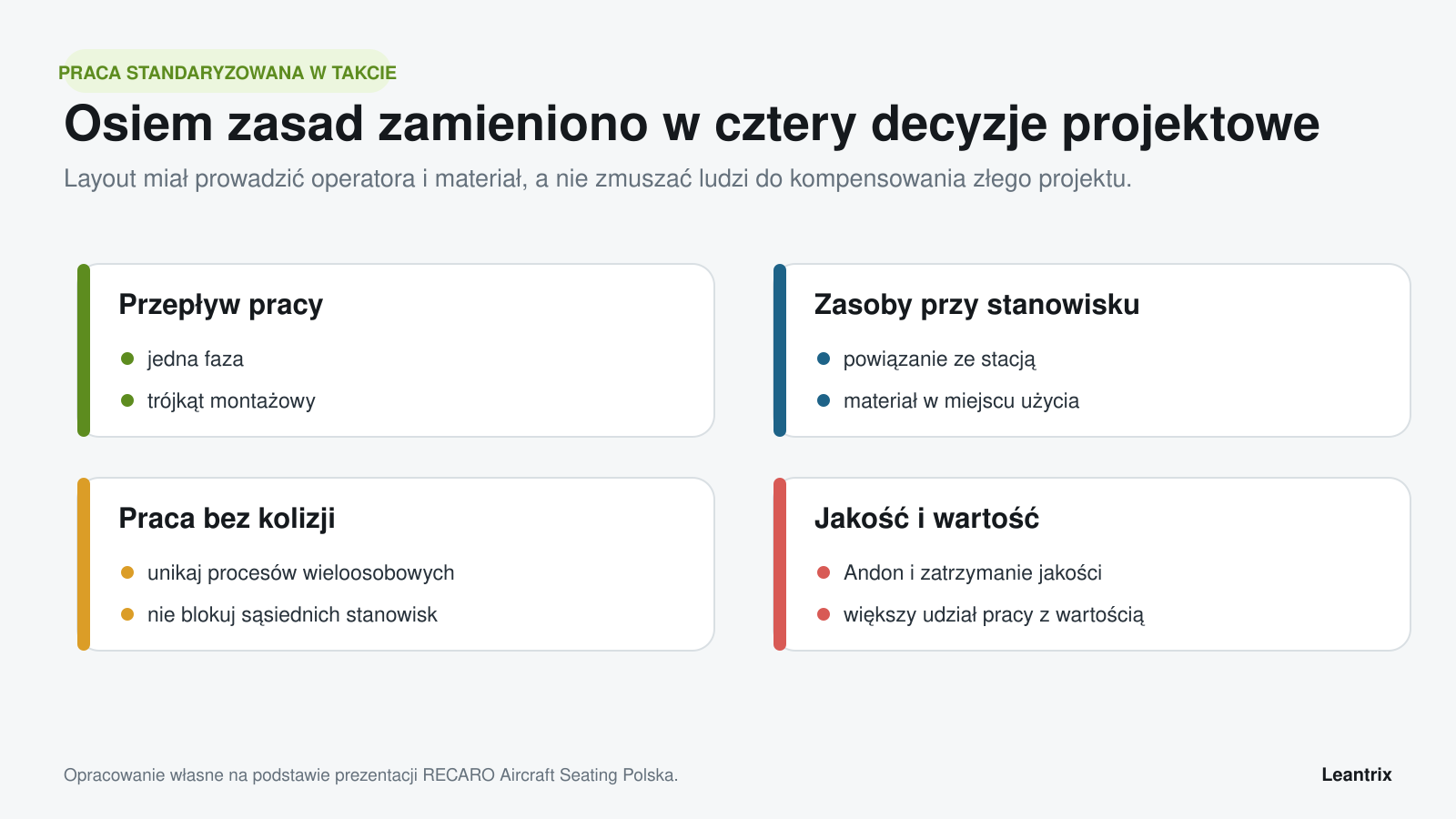
RECARO began by defining workstation design principles for standardised work to takt. The presentation lists eight rules, which can be organised into four design decisions.
| Design decision | Practical question | Expected effect |
|---|---|---|
| Work flow | Does the workstation perform one clearly defined phase, and does the arrangement shorten the product’s route? | Fewer handovers, less waiting and fewer changes in flow direction. |
| Resources at the workstation | Are materials and equipment linked to the operation and available at the point of use? | Less operator motion and less need for kitting. |
| Work without interference | Can people perform the standard without blocking one another? | More stable takt, improved safety and easier balancing. |
| Quality and value | Are deviations visible within the process, and does the workstation support quality at source? | Faster response and a greater share of value-creating work. |
Improving resource utilisation: stage one
The first significant change concerned material control. FIFO—first in, first out—establishes sequence, prevents older orders from being bypassed and reveals blockages. It is a flow rule, not simply a rack type: the item entering a controlled queue first should also leave first.
Switching to FIFO does not automatically eliminate excess inventory. Queue boundaries must be visible, capacity limited and replenishment linked to actual consumption. Only then does an overflowing area become a signal of a problem rather than normal practice.
Improving resource utilisation: stage two
The next step eliminated subassembly kitting. Material was supplied closer to its point of use, and Heijunka helped organise replenishment. Levelling distributes product mix and workload over time so the preceding process does not need to produce large batches “just in case”.
The sequence matters. Simply accelerating kitting optimises an activity that may be unnecessary. RECARO questioned the need for the step itself. Eliminating an entire operation frees more resources than improving its local productivity.
Technology supports the process after simplification
The transformation also introduced Paperless FAL, first as a pilot and later more widely. Digital support could follow the product and facilitate work with frequent variant changes. Digitalisation complemented the organisation of materials and workstations.
If a process contains unnecessary handovers, digitalisation may only move information faster between unnecessary steps. A useful sequence is therefore to observe flow, remove obvious MUDA, establish a standard and then apply technology where it helps sustain quality and flexibility.
Integrating warehouse and assembly: material reaches the point of value creation
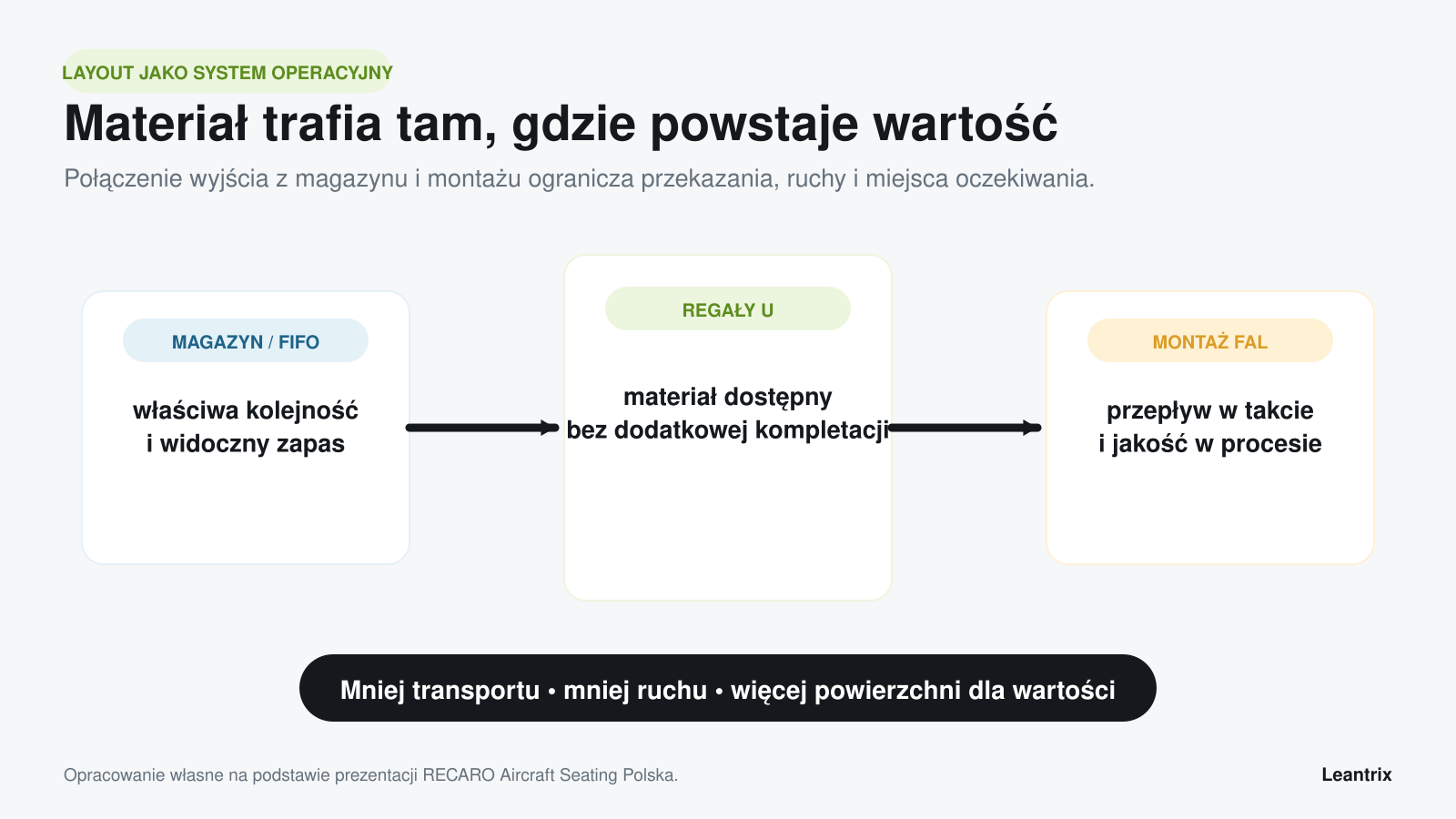
The most mature layout connected the warehouse exit to assembly. Material in FIFO racks was available without additional kitting, and assembly workstations were built directly beside the replenishment system. This reduced handovers, transport routes and waiting locations.
The change went beyond reducing warehouse size. Space ceased to act as a buffer for flow problems and could be allocated to value-creating activity. In this sense, layout became an operating system: it enforced material sequence, exposed deviations and supported work to takt.
The pandemic interrupted the trend, while transformation continued
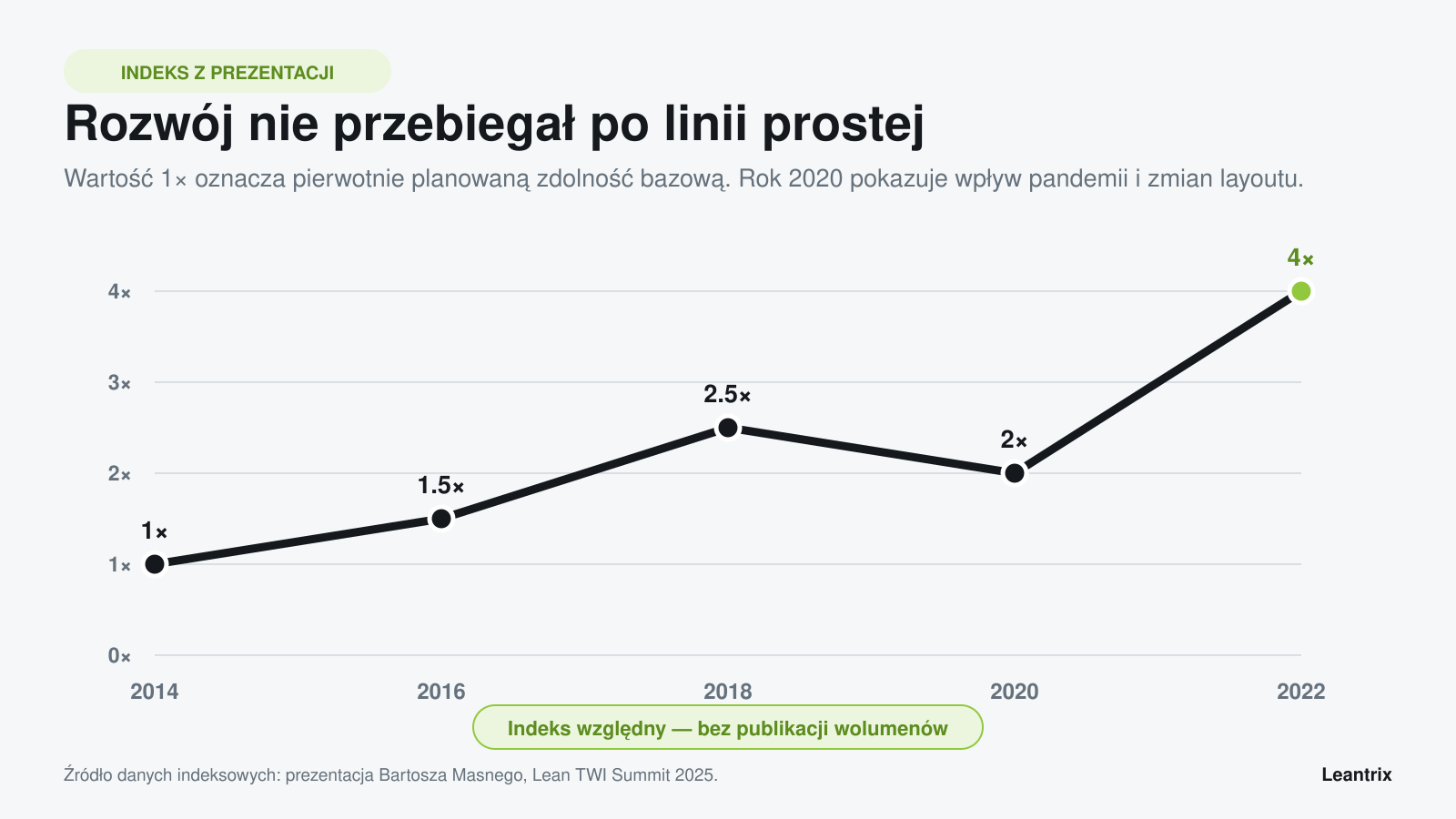
In 2020, the relative index presented by RECARO fell. Parts of the layout had to adapt to pandemic conditions, and the organisation relocated selected processes in response to new cost and operating constraints. This part of the story avoids an unrealistically perfect picture of Lean.
Transformation is not linear. External events can change demand, staffing, safety requirements and the validity of earlier assumptions. Resilience means being able to redesign the system while retaining principles: flow, visibility, quality at source and eliminating unnecessary work.
The result: a fourfold index within existing infrastructure
The presentation shows a relative capacity index developing from a baseline of 1× in 2014, through 1.5× in 2016 and 2.5× in 2018, to 2× in the pandemic year and 4× in 2022. These figures describe the relationship to originally planned capacity, rather than disclosed production volumes.
The chart should not be interpreted as proof that a single layout project independently caused the entire result. It is RECARO’s reported outcome of a multi-year journey involving many connected changes. The central lesson is clear: the organisation expanded capacity without investing in a new building by consistently releasing space, time and flow.
What actually released resources?
Capacity grew through the combined effects of decisions, each removing a specific loss:
- FIFO established sequence and limited the concealment of problems in queues.
- Eliminating kitting removed an activity, additional space requirements and error risk.
- Heijunka stabilised replenishment despite variant changes.
- Point-of-use material reduced walking and component collection.
- Paperless FAL supported information and flexibility after flow had been simplified.
- Warehouse and assembly integration shortened transport and handovers.
- Standardised work provided a shared reference for further changes.
The common factor was questioning the process. If operators repeatedly walk to collect material, workstation replenishment needs redesigning; their pace is not the root issue.
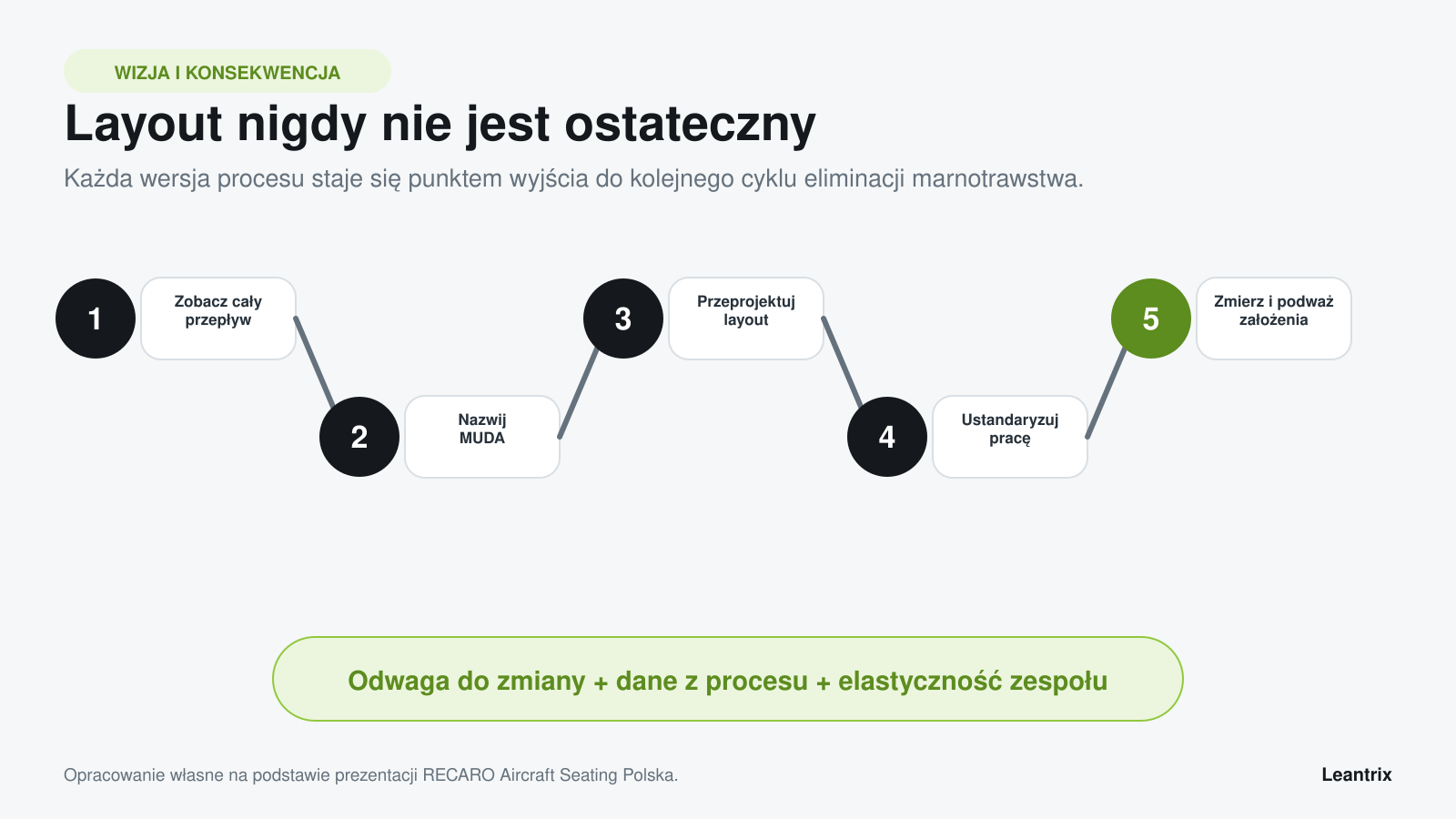
A layout is never final
The next-generation plant vision included further reductions in forklift traffic, improved safety and better use of natural light. This shows a broader understanding of resources. Well-designed space supports capacity, ergonomics, safety and potentially lower energy use.
Even a good layout is only today’s best-known version. A new product, a different mix, technology changes or newly revealed MUDA may justify another iteration. Standards stabilise work so deviations become visible and the next improvement can be introduced safely.
How should resource utilisation improvements be measured?
One measure cannot show the whole effect. Output can rise at the expense of inventory, overtime or quality. Outcome indicators should therefore be combined with process measures.
| Area | Example measure | What does it reveal? |
|---|---|---|
| Flow | Lead time and time between operations | Waiting hidden between activities. |
| Material | WIP, inventory level and number of handovers | Capacity occupied by queues and buffers that conceal problems. |
| Space | Share of floor space used for value creation | How much space serves the process versus storage and transport. |
| Motion and transport | Distance travelled by products, materials and operators | Loss resulting from the positioning of resources. |
| Quality | First pass yield, rework and stoppages | Capacity consumed by repeating work. |
| Outcome | Output per unit of floor space or available time | Whether changes improve the capacity of the whole system. |
Indicators should be analysed together. A shorter distance is no success if it increases quality risk. Higher local productivity does not help if the next operation cannot receive the product. Lean directs attention to the entire value stream and guards against such local optimisation.
Practical guidance for improving resource utilisation
- Go to the process. Observe the actual routes of materials, products, information and operators.
- Identify MUDA. Separate value creation from transport, motion, waiting, inventory and rework.
- Establish a baseline. Measure distances, WIP, lead time, floor space and quality before changes.
- Set design principles. Define takt, sequence, replenishment, quality standards and buffer limits.
- Remove unnecessary steps. Eliminate activities first, then automate or accelerate what remains.
- Test at low cost. Use mock-ups, markings and pilots before permanent reconstruction.
- Check the whole system. Assess flow, quality, ergonomics and safety alongside workstation productivity.
- Update the standard. Establish the better method, measure its performance and begin another observation cycle.
Common mistakes when improving resource utilisation
- Designing from the office without observing real routes, exceptions and product variation.
- Moving inventory elsewhere instead of removing its cause.
- Automating MUDA before questioning whether a step is necessary.
- Optimising one workstation at the expense of the next operation or overall flow.
- Failing to standardise after a change, allowing earlier habits to return.
- Treating layout as a one-off project despite changes in products, mix and demand.
Key lessons from the RECARO case study
First, storage and transport space often indicates a broken connection between processes. Second, eliminating kitting may release more capacity than accelerating it. Third, digitalisation delivers the greatest value when it supports a flow that is already simpler and visible.
Fourth, a temporary decline in performance tests the organisation’s ability to learn and adapt; it does not invalidate the transformation. Fifth, improving resource utilisation requires layout, material control, standardised work and in-process quality to work together.
This case complements LeanTrix’s earlier article on standardised work at RECARO. That article focuses on TWI and standard development. This one examines flow, space and eliminating MUDA across the entire production system.
FAQ: improving resource utilisation
Does better resource utilisation require new investment?
Not always. First measure the capacity consumed by waiting, inventory, transport, motion and rework. RECARO achieved substantial growth in its relative index through successive flow and layout changes without a new factory hall. Investment may be needed later, but decisions improve when MUDA elimination comes first.
What is the difference between resource utilisation and loading?
Loading tells us whether a resource is busy. Utilisation should also consider whether its work creates value and supports overall flow. A machine producing for inventory can be heavily loaded while worsening value-stream performance.
Where should a layout change begin?
Start with process observation and a baseline. Then define takt, work sequence, material replenishment, quality control points and inventory limits. Design workstation positioning on that basis.
Does Heijunka work with high product variability?
Levelling can be particularly useful under variability, but requires demand, capacity and changeover data. Heijunka helps distribute variation in a way that reduces large batches and uneven loading of subsequent processes.
About the presenter
Bartosz Masny was Operations Director at RECARO Aircraft Seating Polska at the time of the presentation. He specialises in Lean Management, production control, material flow, continuous-flow design and layout optimisation. He combines production and logistics improvement with short-, medium- and long-term operational strategy. At Lean TWI Summit 2025, he presented the Świebodzin plant’s multi-year journey from large batches and kitting to an integrated flow making better use of existing infrastructure.
This article is based on materials presented by Bartosz Masny at Lean TWI Summit 2025 in Wrocław on 10–11 June 2025. To protect confidential information, absolute volumes, inventory levels, quality indicators and detailed plant plans have been omitted. The infographics are original LeanTrix illustrations and do not reproduce RECARO’s internal layouts.

Bartosz Masny is a managing executive, Lean expert and executive coach. At the time of the case study, he served as Operations Director at RECARO Aircraft Seating Poland. He specializes in production control, material flow, continuous-flow design and layout optimization. In the case study, he presented the Świebodzin plant’s long-term journey from large batches and kitting to an integrated flow that uses existing resources more effectively.