Implementing a Dojo at the ZF Electronics Plant in Częstochowa addressed a very specific business problem: rapid factory growth, recruitment averaging 25 people a month and a lack of local candidates experienced in advanced electronics manufacturing. Rather than limiting onboarding to presentations, instructions and observing a more experienced colleague, the organisation created a Production Training Area. It combined practical experience, adult learning, HoloLens technology, the 70:20:10 model, Kolb’s learning cycle and TWI Job Instruction.
This case study shows that a DOJO is more than a room containing training stations. It is a knowledge management system designed to prepare people for safe, high-quality, repeatable work before pressure from the actual process makes learning difficult. ZF designed this system for the automotive industry, where an error in electronics manufacturing can affect the quality of components supporting vehicle safety.
Dojo implementation at ZF Group: the business context
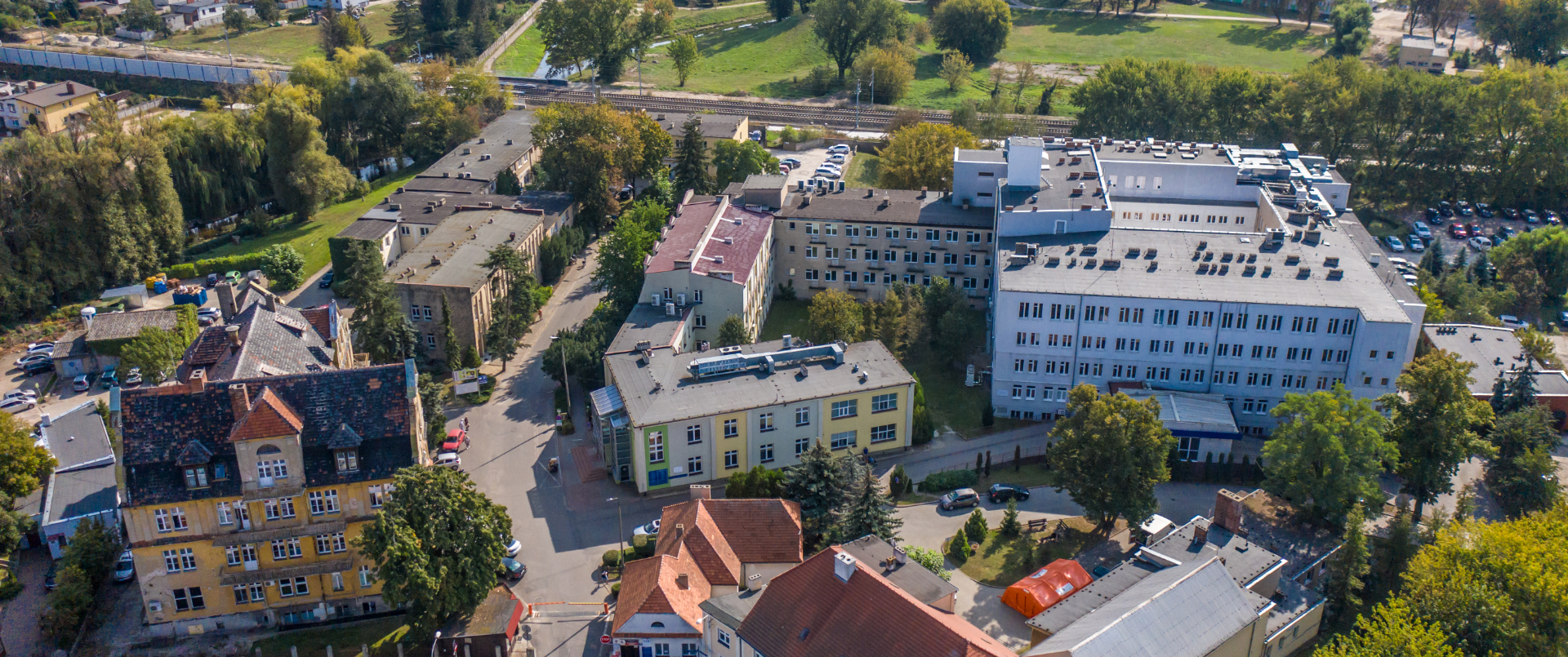
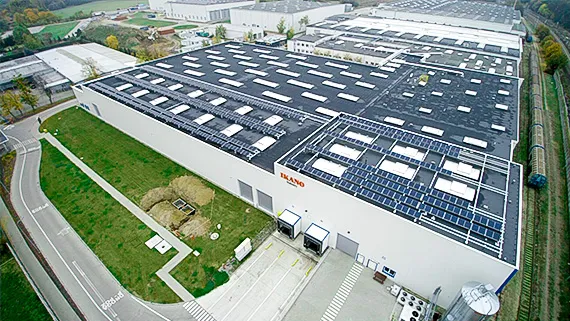
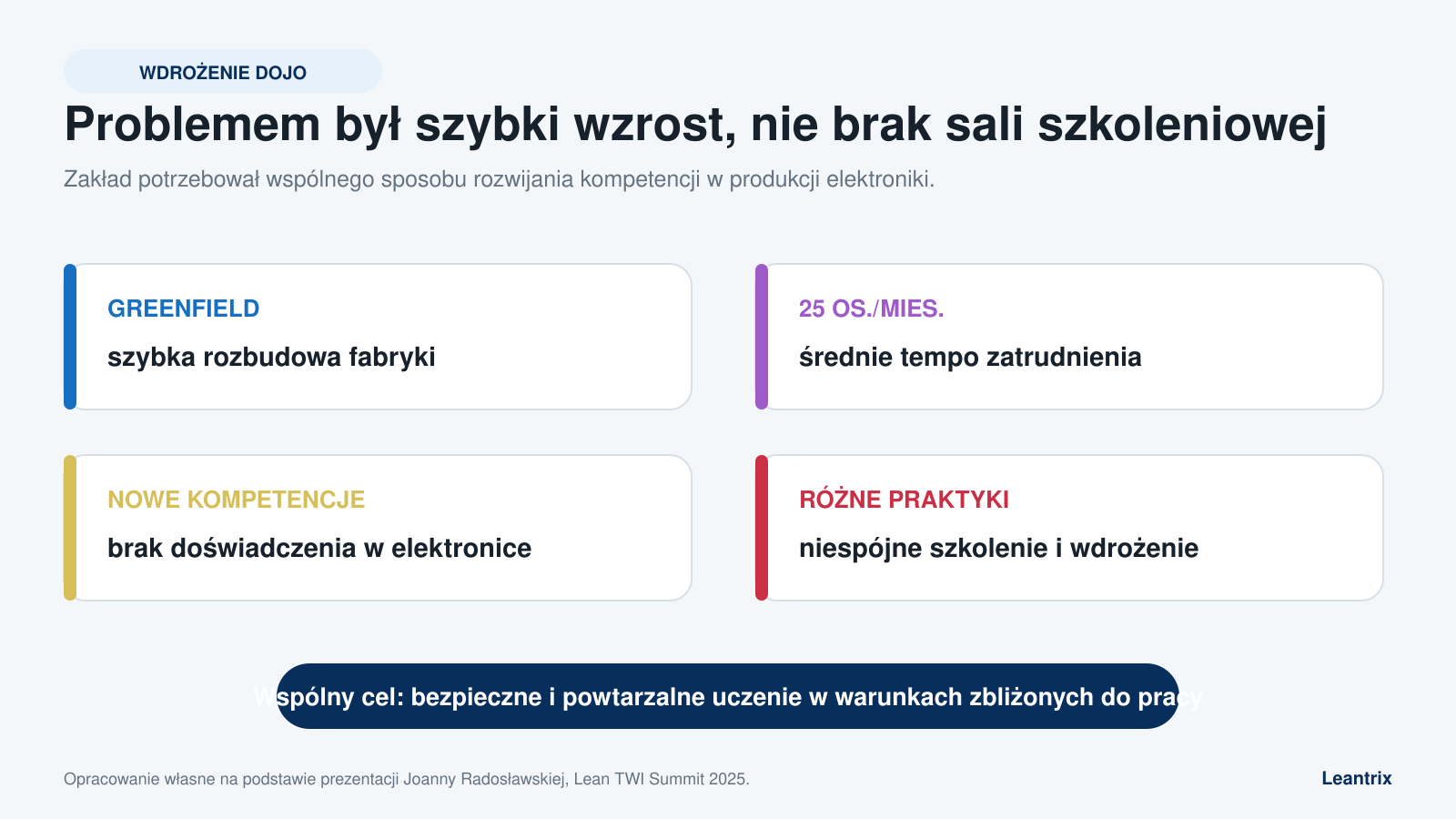
The ZF Electronics Plant in Częstochowa was established as a greenfield investment and expanded rapidly. Joanna Radosławska’s presentation reported average recruitment of 25 people a month. At the same time, there were no similar factories in the region, so many new employees had no previous experience of electronics manufacturing.
This context matters. The company could not base growth solely on recruiting ready-made specialists. It needed its own scalable approach to developing skills. A common approach to training new and existing employees was necessary because previous onboarding practices were not fully consistent.
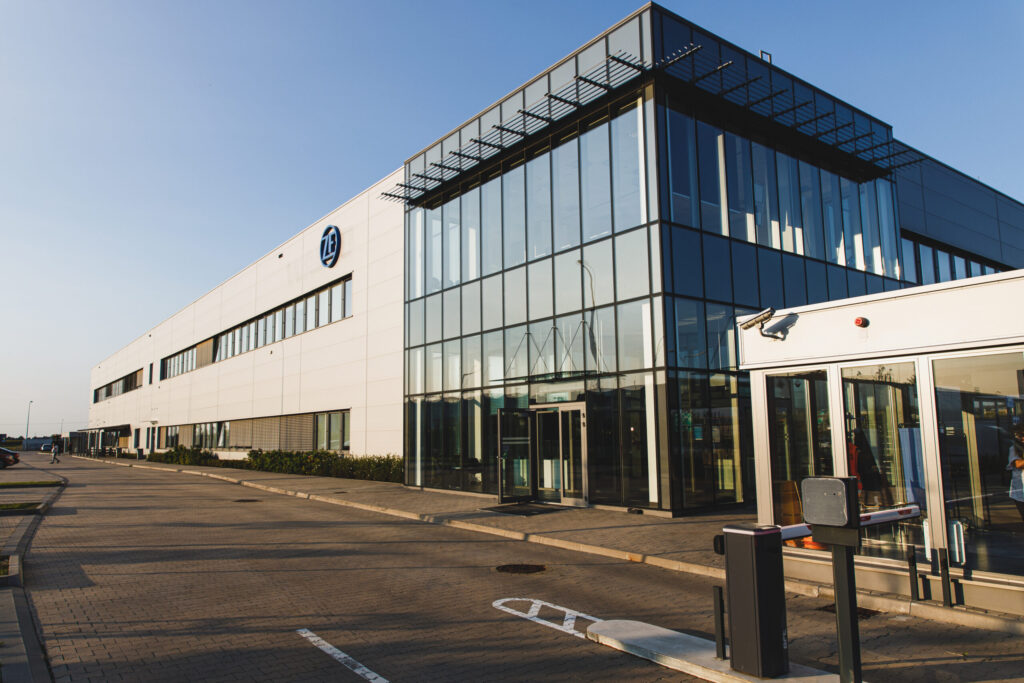
ZF’s official description confirms the technological nature of the Częstochowa plant. It manufactures electronic components for driver assistance systems, including cameras, radars and supercomputers. More information about its products and role is available in the ZF Group press centre (Polish).
What is a Production Training Area?
In the ZF project, DOJO referred to a Production Training Area: a dedicated space where employees can explore phenomena, practise tasks and make controlled mistakes outside the pace of normal production. Conditions should be sufficiently close to real work for the skills acquired to transfer to the workstation.
The difference between a DOJO and a conventional training room lies in their purpose. A classroom helps communicate information. A DOJO should enable work to be performed to standard. Participants do more than hear what an electronic component is: they can see its function, practise correct assembly, understand quality risks and receive feedback.
The most important output of a DOJO is an employee who understands the key points of the job, can perform them and knows why they matter.
Implementing a Dojo step by step
1. Define standards and skill requirements
The first task was to agree what to teach and how. ZF developed the concept and training standards and translated specialist electronics and automotive terminology into language understandable to people without industry experience.
This offers a practical lesson for other organisations: unless concepts, important steps and criteria for correct performance are clear, even an attractive training station will remain a collection of teaching aids. First establish the expected way of working and the key skills.
2. Provide dedicated space for safe practice
The next step was to prepare a dedicated room, specialist tools and practical stations. Employees could concentrate on learning without simultaneously trying to keep up with production takt. A safe training environment reduces uncertainty during the first days, but must remain connected to real operating conditions.
3. Develop internal instructors and trainers
The implementation relied on people who knew the process from within. An internal instructor combines technical knowledge with the ability to observe a learner. Their role includes demonstrating the task, checking independent performance, identifying misunderstandings and providing feedback.
Five foundations of knowledge management
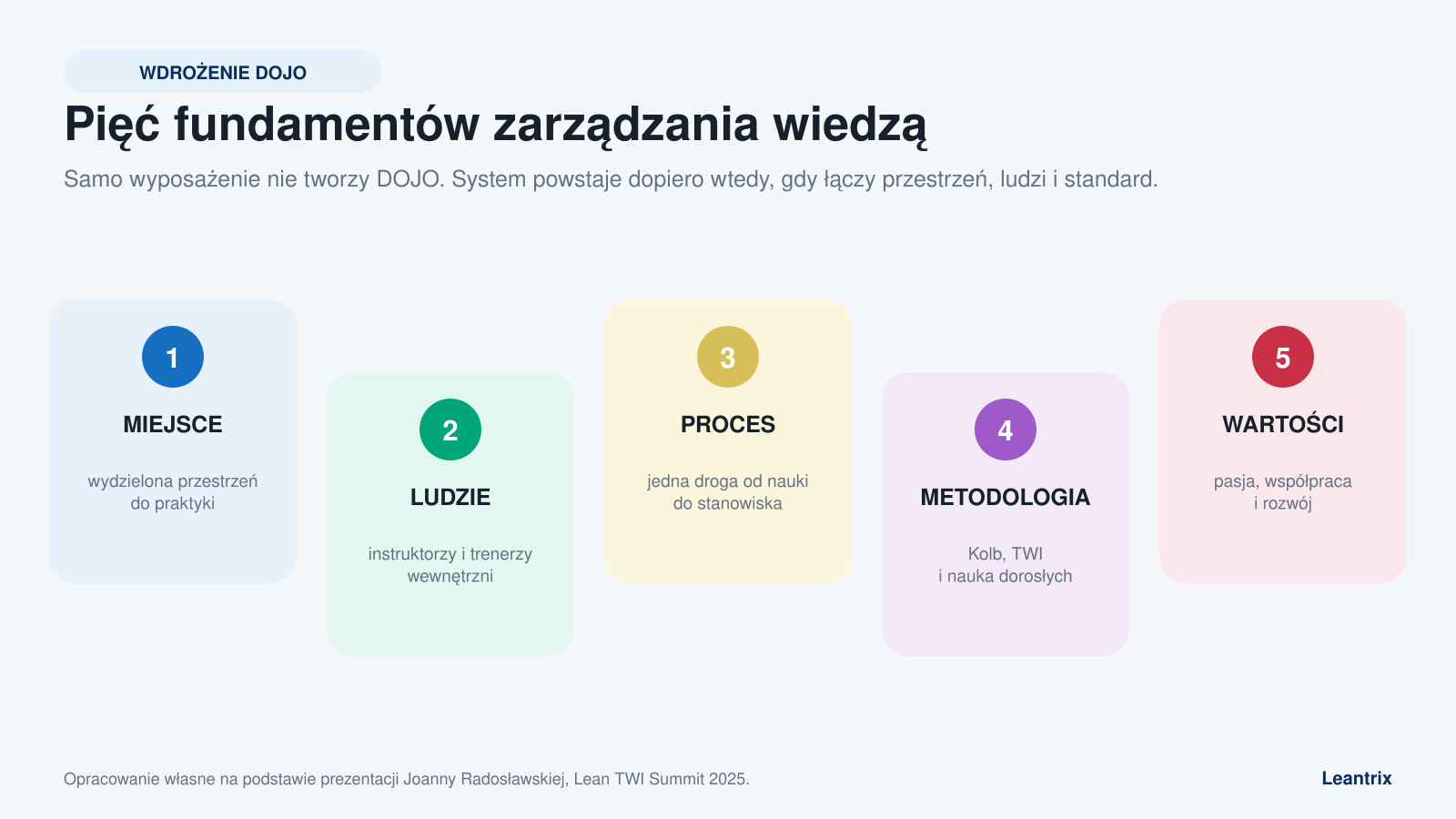
The ZF presentation organises the system around five elements, each with a distinct role:
- Place provides space for practice and limits the consequences of mistakes while learning.
- People contribute process knowledge, instruction skills and feedback.
- Process connects training with qualification for a specific job and subsequent observation at the workstation.
- Methodology structures how skills are taught, practised and checked.
- Values create an atmosphere in which questions, attempts and development are a natural part of work.
Omitting any foundation weakens the whole. Space without an instructor does not build competence. An instructor without a standard passes on personal habits. Training disconnected from qualification may be completed without changing behaviour at the workstation.
How was the learning architecture built?
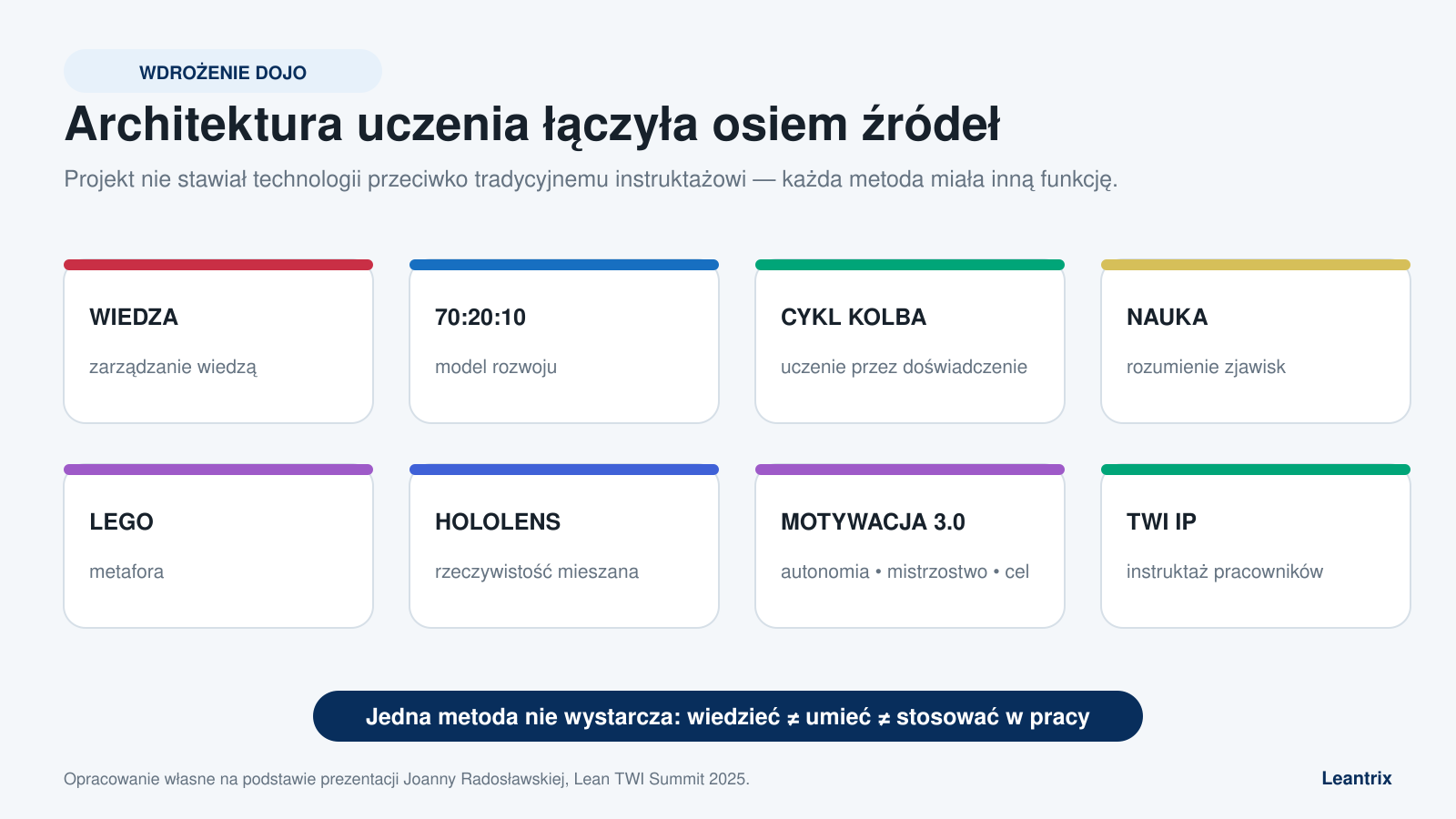
Dojo implementation at ZF drew on several methods. The project combined knowledge management, the 70:20:10 development model, Kolb’s cycle, scientific demonstrations, LEGO metaphors, mixed reality, Motivation 3.0 and TWI Job Instruction. Each element addressed a different aspect of learning.
The 70:20:10 model
The 70:20:10 model reminds us that development continues beyond formal training. Most learning occurs through tasks and experience; relationships and feedback also play a significant role, while formal education provides the foundations. In practice, this means planning the transition from the DOJO to the workstation and ongoing support from a leader or instructor.
Kolb’s cycle: from experience to deliberate practice
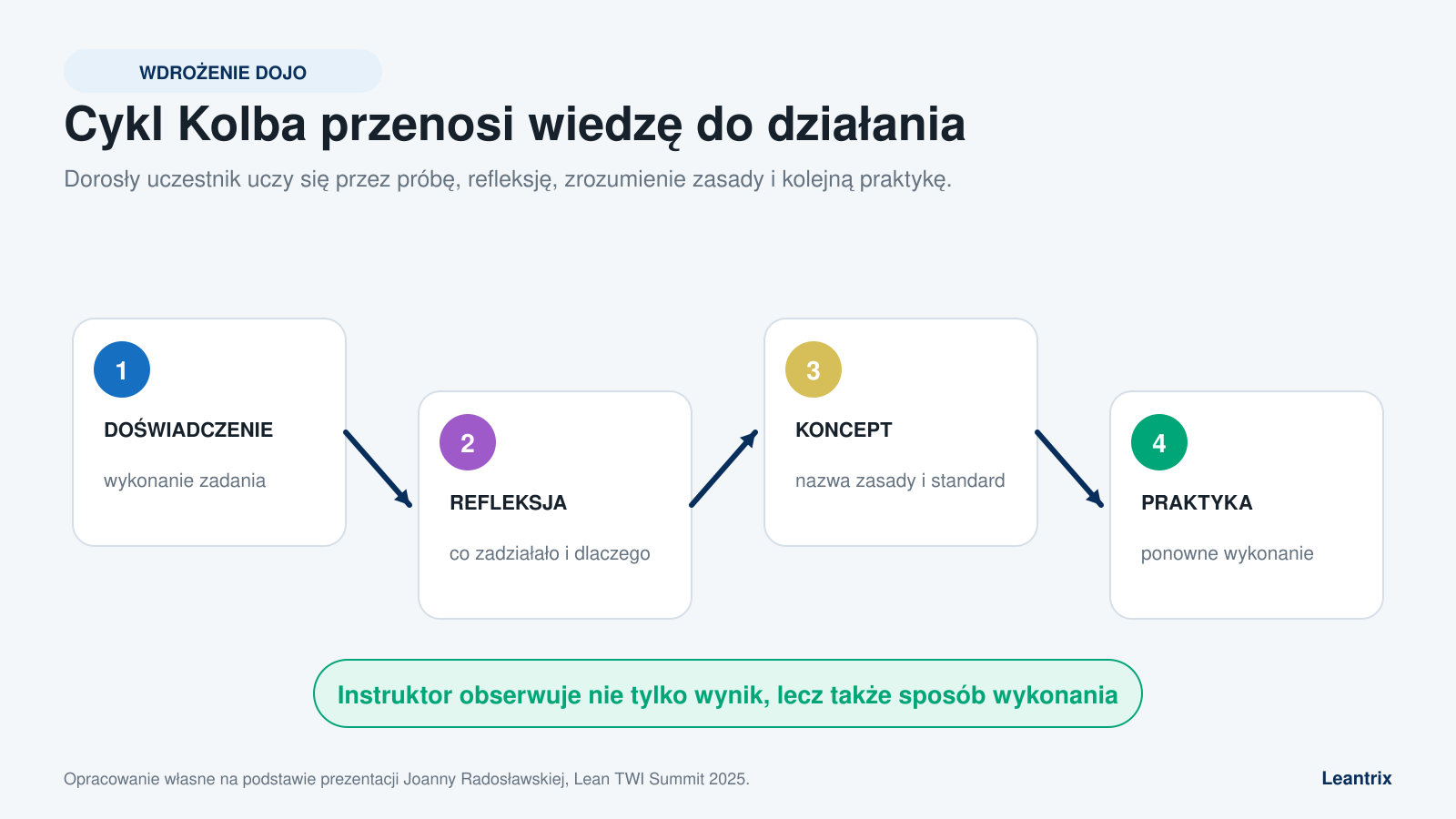
Kolb’s cycle takes participants through experience, reflection, understanding a principle and applying it again. In a DOJO, employees can perform a task, discuss the result, identify the key principle and try again. This sequence is particularly important for adults who want to see the link between knowledge and a real problem.
Scientific demonstrations and metaphors give definitions context
Training used experiments to explain phenomena employees encounter in electronics. A Tesla plasma ball and a coil producing an electric arc made visible something that would remain abstract in a conventional presentation. LEGO served as a metaphor, simplifying discussion of complex relationships and helping build a shared language.
Dojo implementation and HoloLens technology
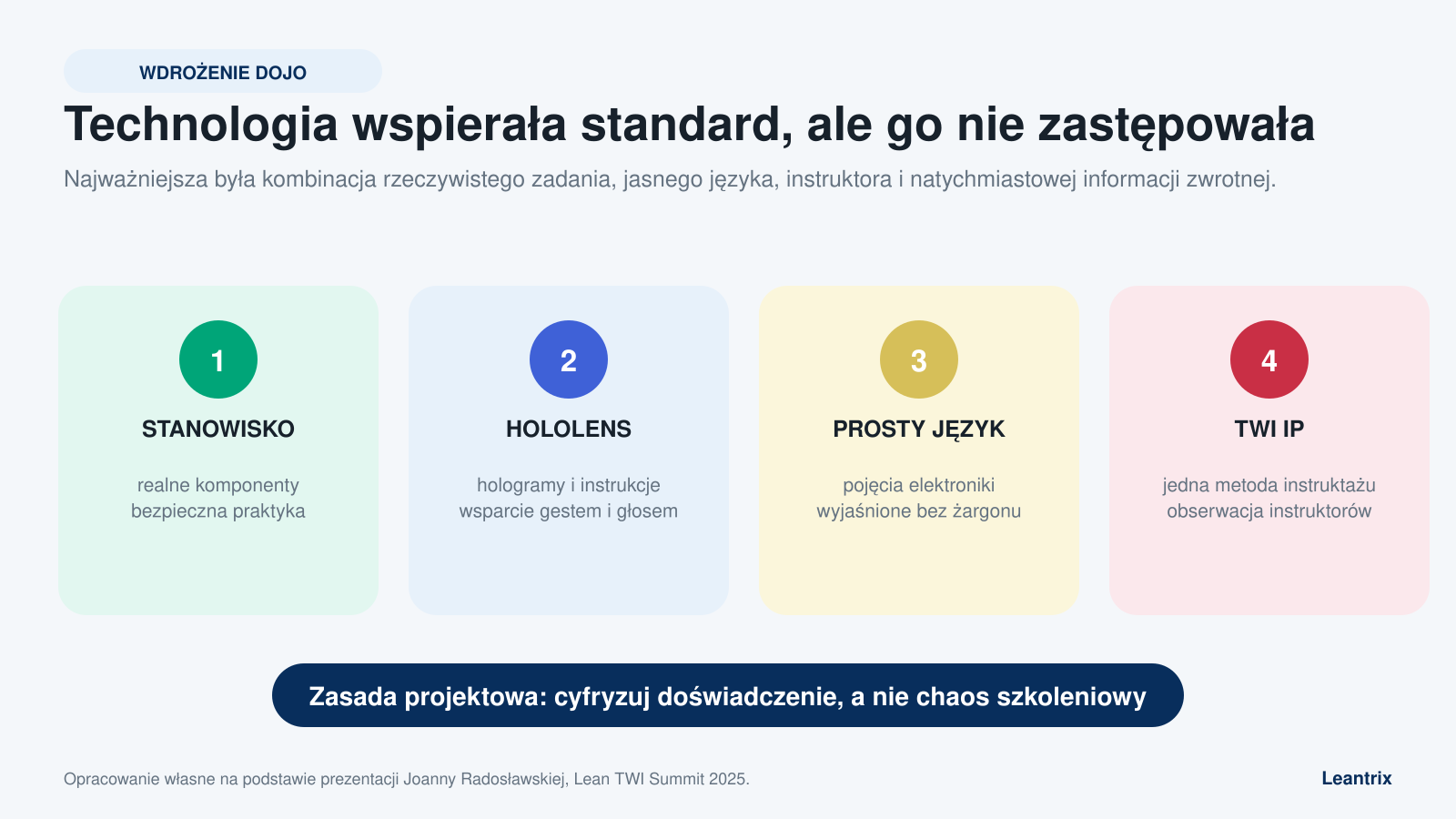
The project used HoloLens, a mixed reality device in which holograms can respond to the user’s gaze, gestures and voice. It was incorporated into training for a demanding workstation, supplementing physical practice with digital guidance within the participant’s field of view.
The key lesson is that technology makes sense when it supports a defined standard and removes a specific learning barrier. Ambiguous content remains ambiguous in digital form. ZF therefore combined HoloLens with conventional methods, video and photographic materials and practice under an instructor’s supervision.
Dojo implementation and TWI Job Instruction
TWI Job Instruction turns expert knowledge into a repeatable approach to teaching work. The instructor prepares the learner, presents the task with its important steps, key points and reasons, then allows the participant to perform the work independently and gradually transfers responsibility.
In a DOJO, TWI Job Instruction can bring different teaching aids together within one standard. A video, training station, hologram or scientific demonstration becomes valuable when employees know what they are learning, can perform the activity and understand its key points. Read more about Training Within Industry at LeanTrix.
Instructor consistency is especially important when scaling. If everyone teaches differently, the DOJO simply moves variability from production to the training area. Developing instructors and observing instruction quality should therefore form part of system maintenance.
Motivation 3.0: autonomy, mastery and purpose
The project also drew on three drivers of intrinsic motivation: autonomy, mastery and purpose. Autonomy means active participation in learning rather than passively following orders. Mastery means visible skill development. Purpose explains why assembly accuracy and adherence to standards matter to the customer, quality and safety.
In automotive manufacturing, “do it this way because the instruction says so” is insufficient. Employees should understand the reason for a key point. This increases the likelihood that they will follow the standard even when the instructor is absent.
How can the effects of Dojo implementation be measured?
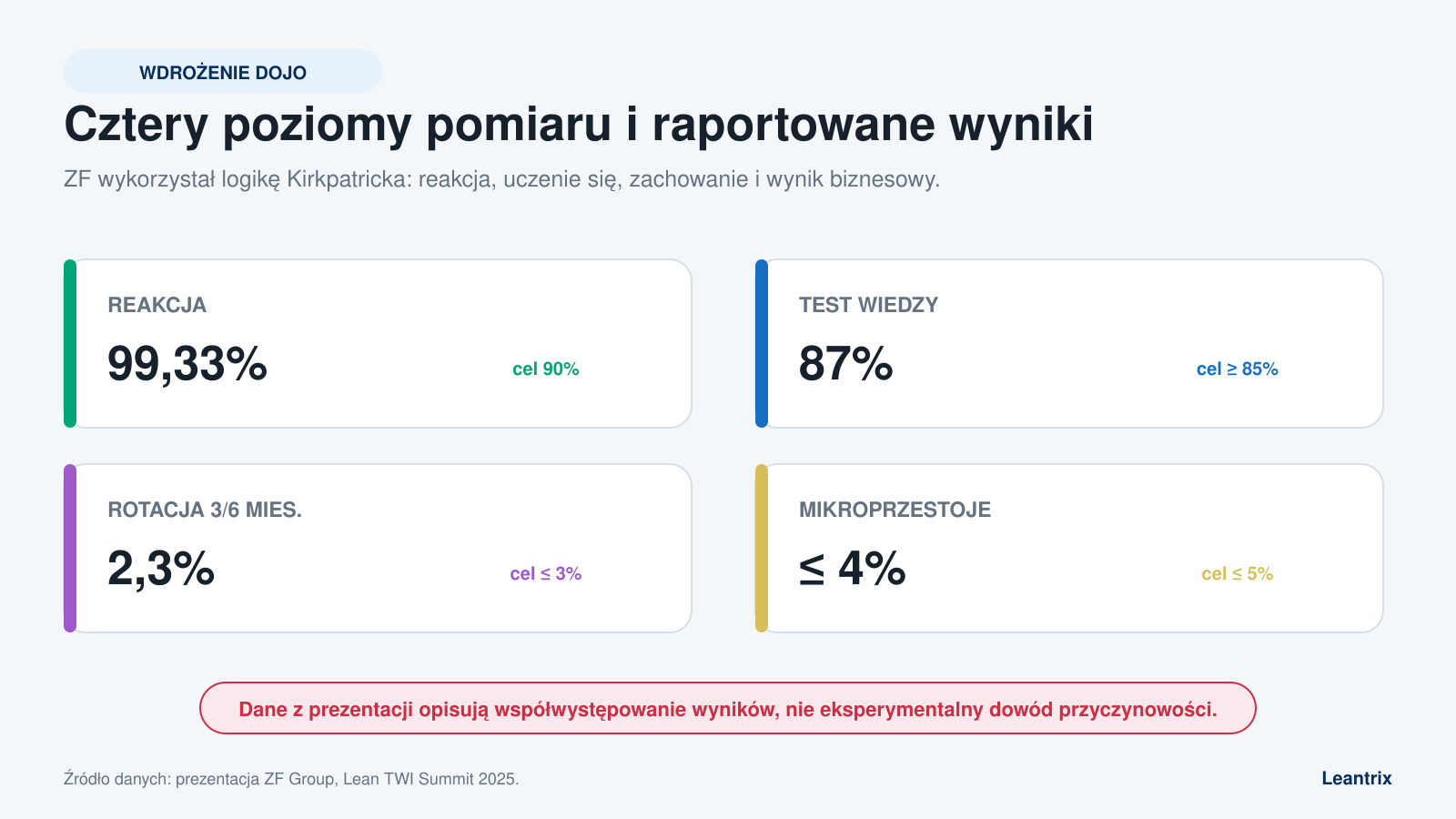
ZF structured evaluation around the four levels of Kirkpatrick’s model: reaction, learning, behaviour and business results. This offers a much fuller picture than participant numbers or an average training rating.
| Level | Evaluation method | Value presented in the case study |
|---|---|---|
| 1. Reaction | Participant evaluation | 99.33%, against a 90% target |
| 2. Learning | Knowledge test, TWI and instructor observation | 87% in the knowledge test, against a target of at least 85% |
| 3. Behaviour | Workstation observation sheet and training pace | Assessment of skill transfer to work |
| 4. Results | Employee turnover and human-factor microstoppages | Turnover over 3/6 months: 2.3%, against a maximum 3% target; microstoppages up to 4%, against a maximum 5% target |
The project was also nominated for the ZF Excellence Award 2023 in Operational Excellence and identified as a benchmark for the Electronics Division. These facts demonstrate internal recognition of the solution while complementing analysis of the process and results.
How should the results be interpreted?
The figures in this case study are values reported with the project. They do not constitute experimental proof that every indicator changed solely because of the DOJO. Turnover and microstoppages are also affected by management practices, labour market conditions, process stability, production load and other initiatives.
A mature evaluation should therefore combine several types of evidence. Reaction shows how participants experienced training. Tests check knowledge. Observation reveals application of skills. Process indicators show whether the organisation is moving towards its business objective. No single result tells the whole story.
A practical Dojo implementation checklist
- Define the business problem. Establish whether it concerns time to independence, quality, safety, turnover, new technologies or a shortage of skills in the labour market.
- Select a pilot job. It should be important, observable and stable enough to define a standard.
- Agree the important steps and key points. Separate knowledge essential to doing the work from supplementary information.
- Design the transition to the workstation. Specify who confirms readiness, how they do so and when post-training observation takes place.
- Prepare instructors. Process expertise does not automatically translate into effective teaching.
- Match aids to the learning barrier. Use video, models, experiments or mixed reality when they solve a specific learning problem.
- Measure all four levels. Reaction, knowledge, behaviour and results require different measurement tools.
- Update the DOJO when standards change. Product or process changes must trigger a review of training content.
This sequence protects against a common mistake: designing an impressive space before identifying the skill gap to close. Effective Dojo implementation begins with the process and the person, then selects the tools.
Key lessons from the ZF Group Dojo case study
- The DOJO addressed a real barrier to plant growth: a lack of readily available electronics skills in the local labour market.
- The project combined a practice environment, internal instructors, a training standard and subsequent workstation observation.
- HoloLens complemented learning without replacing the standard or the instructor.
- Kolb’s cycle, the 70:20:10 model and TWI Job Instruction served different, complementary purposes.
- Evaluation used four levels, extending beyond participant satisfaction.
- The reported results reflect the whole system and organisational context; they are not an automatic promise for every implementation.
FAQ: Dojo implementation in automotive manufacturing
Is a DOJO useful only for large-scale recruitment?
No. High recruitment volumes improve the business case, but a DOJO can also help when launching a product, changing technology, developing multiskilling or preparing people for work with high quality risks.
Can a DOJO replace on-the-job training?
It should not. A training area prepares employees and limits the risk of early attempts, but final competence must be confirmed in the real process. Designing the transition between the two environments is crucial.
Does Dojo implementation require HoloLens?
No. Mixed reality was one of the tools ZF used. Organisations should first identify the learning barrier, then choose the simplest solution that helps remove it.
How can a DOJO be combined with TWI Job Instruction?
A DOJO provides the place and practice aids; TWI Job Instruction structures instruction. The Job Breakdown Sheet defines important steps, key points and reasons. The four-step method helps prepare the employee, present the job, check performance and transfer responsibility.
Which indicators should be tracked?
Alongside training evaluations, measure test or skill demonstration results, adherence to the workstation standard, time to independence, quality, safety, microstoppages and turnover over a clearly defined period. KPI selection should follow the business problem.
This article is based on materials presented by Joanna Radosławska at Lean TWI Summit 2025 in Wrocław on 10–11 June 2025 and the public description of the ZF Group project. Numerical values come from the case study presentation and are reported in aggregate form.
About the case study presenter
Joanna Radosławska is a strategic HR partner, business trainer, project manager, coach and mentor with EIA & IPMA EMCC credentials. During the project and at Lean TWI Summit 2025, she represented ZF Group as HR Lead, presenting the Production Training Area implementation at the Electronics Plant in Częstochowa.