Implementing 5S and TPM in a brewery may begin with maps, labels and checklists, but tools alone will not sustain it. The Asahi Group case, presented through Lech Browary Wielkopolski, illustrates a more important change: moving from responsibility held by a few nominated people to everyday engagement across entire teams.
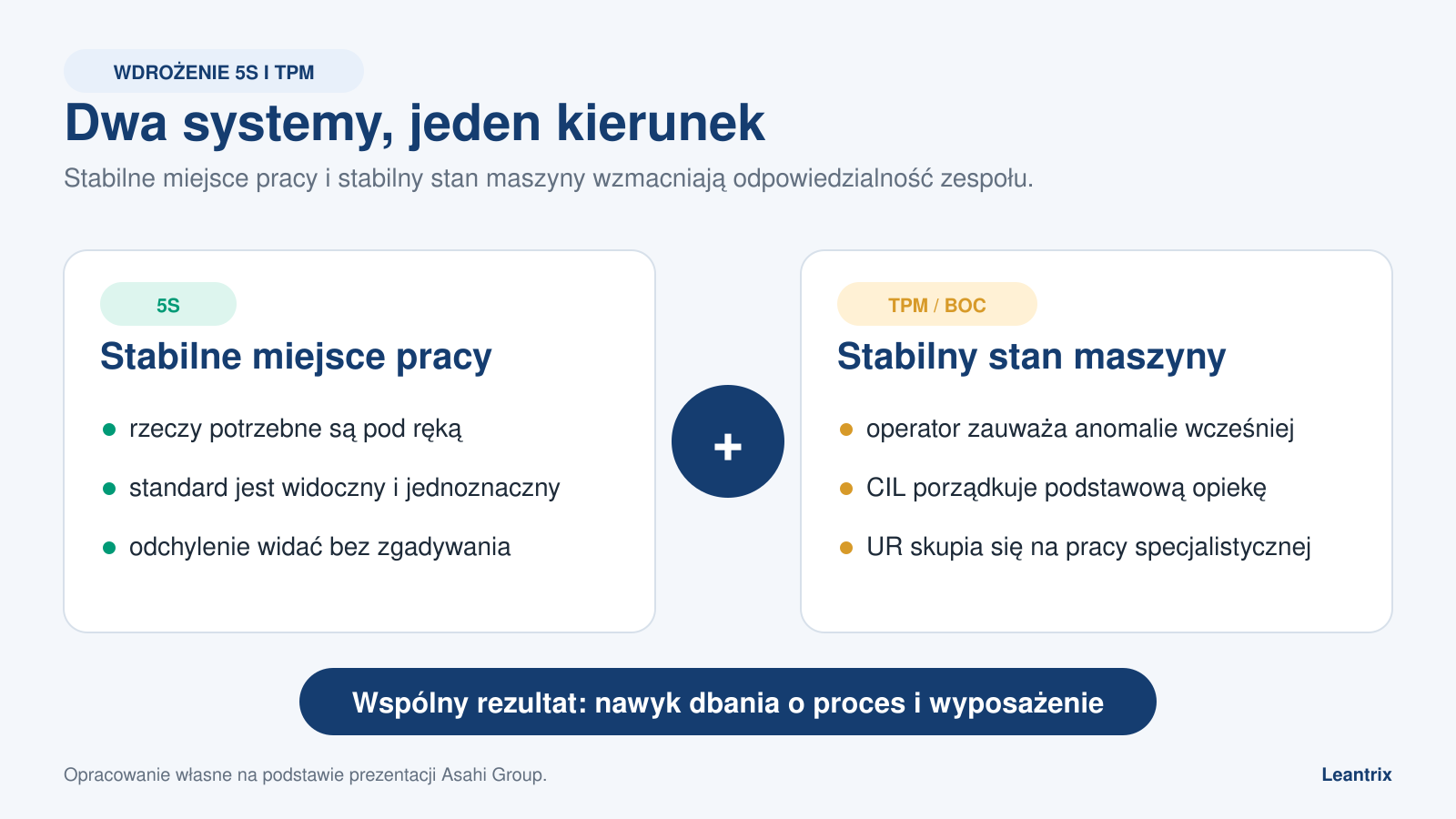
Here, 5S organises the workplace, information flow and visual standards. TPM—developed within autonomous maintenance as Basic Operator Care (BOC)—helps restore and maintain equipment’s basic condition. Both systems teach people to notice deviations, respond and avoid waiting until a small issue becomes a breakdown, hazard or accepted part of daily life.
The organisation already used 5S and autonomous maintenance activities. The new approach refreshed their purpose, changed how people learned, clarified standards and deliberately connected team development with process development.
Why did 5S and TPM need a fresh start?
Many companies measure a tool’s maturity by its age: if 5S has been running for years, the subject is considered complete. Joanna Hering and Aneta Kozińska’s presentation reveals the trap. A method can be formally present yet gradually become cleaning before audits, maintaining maps nobody uses and obtaining high scores that fail to reveal real improvement opportunities.
Autonomous maintenance faced a similar problem. Earlier practice concentrated mainly on checklists and inspections. It lacked the full journey from restoring basic machine condition, through eliminating sources of problems, to maintaining standards and confirming that they worked in practice.
A mature implementation asks how 5S and TPM change people’s daily decisions, as well as whether the systems formally exist.
5S and TPM: two systems moving in one direction
The 5S system (Polish) stabilises the working environment. It establishes what is needed, where it belongs, how to recognise the correct condition and who maintains it. TPM (Polish) extends this logic to equipment, engaging production and maintenance in a shared commitment to machine effectiveness and reliability.
At Lech Browary Wielkopolski, autonomous maintenance developed under the name BOC—Basic Operator Care. BOC is one part of TPM: an approach to organising basic operator care of equipment. Operators perform clearly defined tasks, observe machine condition and report anomalies. Maintenance specialists retain responsibility for diagnosis and repairs requiring technical expertise.
Team maturity provided the foundation
Before teams began developing further standards, leaders assessed their development stage and adapted how they led change. The presentation described this through situational management. A team just discovering a method’s purpose needs different support from a group able to identify and solve problems independently.
Four elements proved particularly important:
- Communication: clearly explaining the purpose of 5S and BOC, showing examples and presenting the implementation path.
- Leadership: visible support, help during difficulties and motivation without doing the team’s work for them.
- Collaboration: preparing leaders and internal trainers to work with people in their areas.
- Problem solving: progressing from correcting symptoms to removing root causes.
The implementation became a programme for developing the skills needed to maintain and improve standards independently.
Train the Trainer and TWI: building the ability to teach
Initially, 5S coordination was concentrated in one place. That model is difficult to scale: an expert can create standards and deliver training but cannot support every area every day. A Train the Trainer programme developed internal trainers in response.
The training plan used Job Breakdown Sheets from TWI Job Instruction. Breaking down a job helps trainers identify important steps, the key points determining correct performance and the reasons for them. Training then follows a shared structure rather than depending solely on an experienced person’s account.
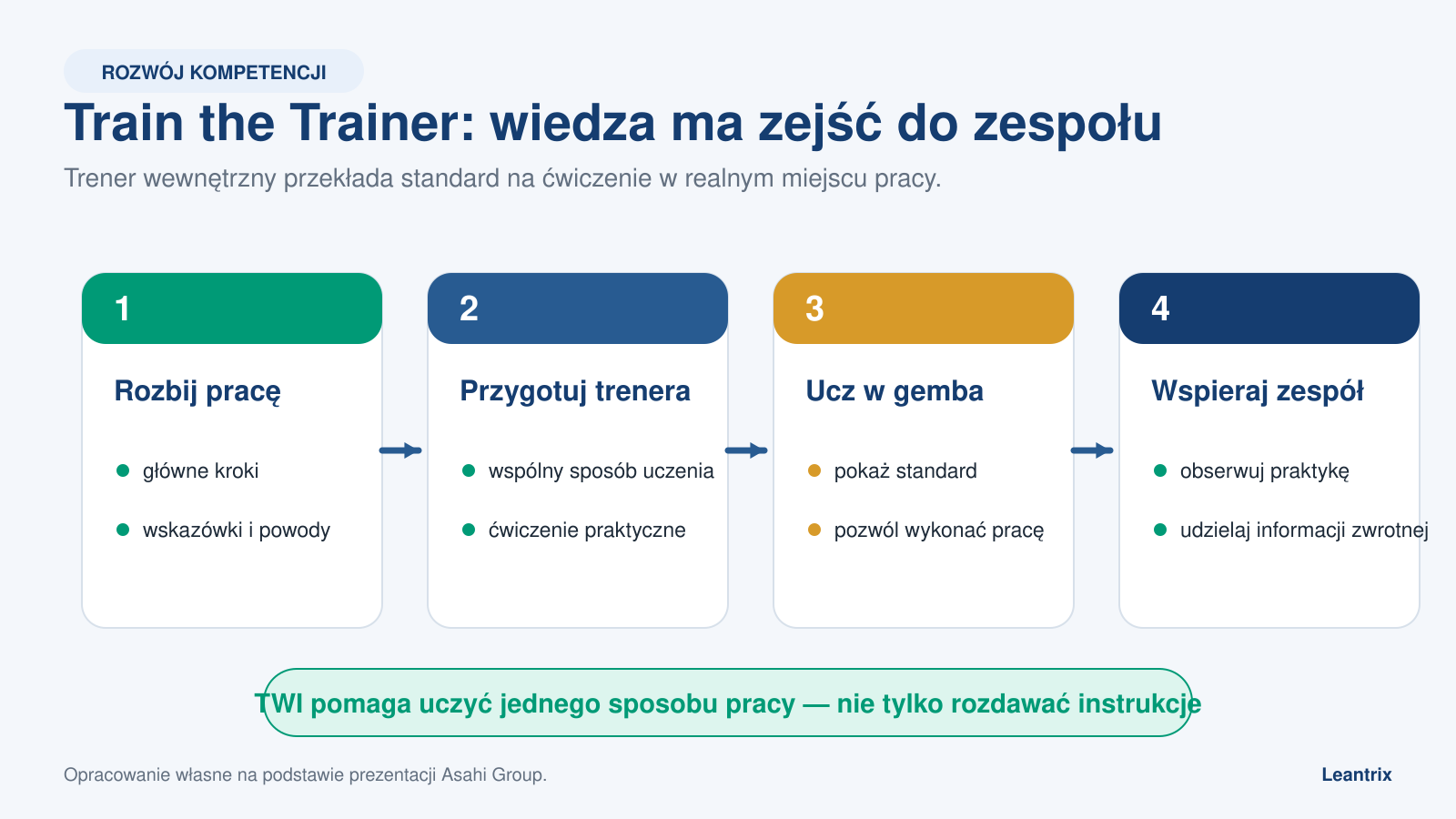
BOC used a different model. Line teams implemented successive elements step by step. An expert regularly verified practices and supported teams until they reached the agreed level. Both approaches shared one principle: handing over a document must be accompanied by building the ability to act correctly.
5S renewed: the whole workforce takes ownership
A crucial change concerned process ownership. Previously, 5S had been the domain of a few designated people. The new approach spread responsibility across the team. The Bottling Laboratory demonstrated the change in everyday work, safety and ergonomics.
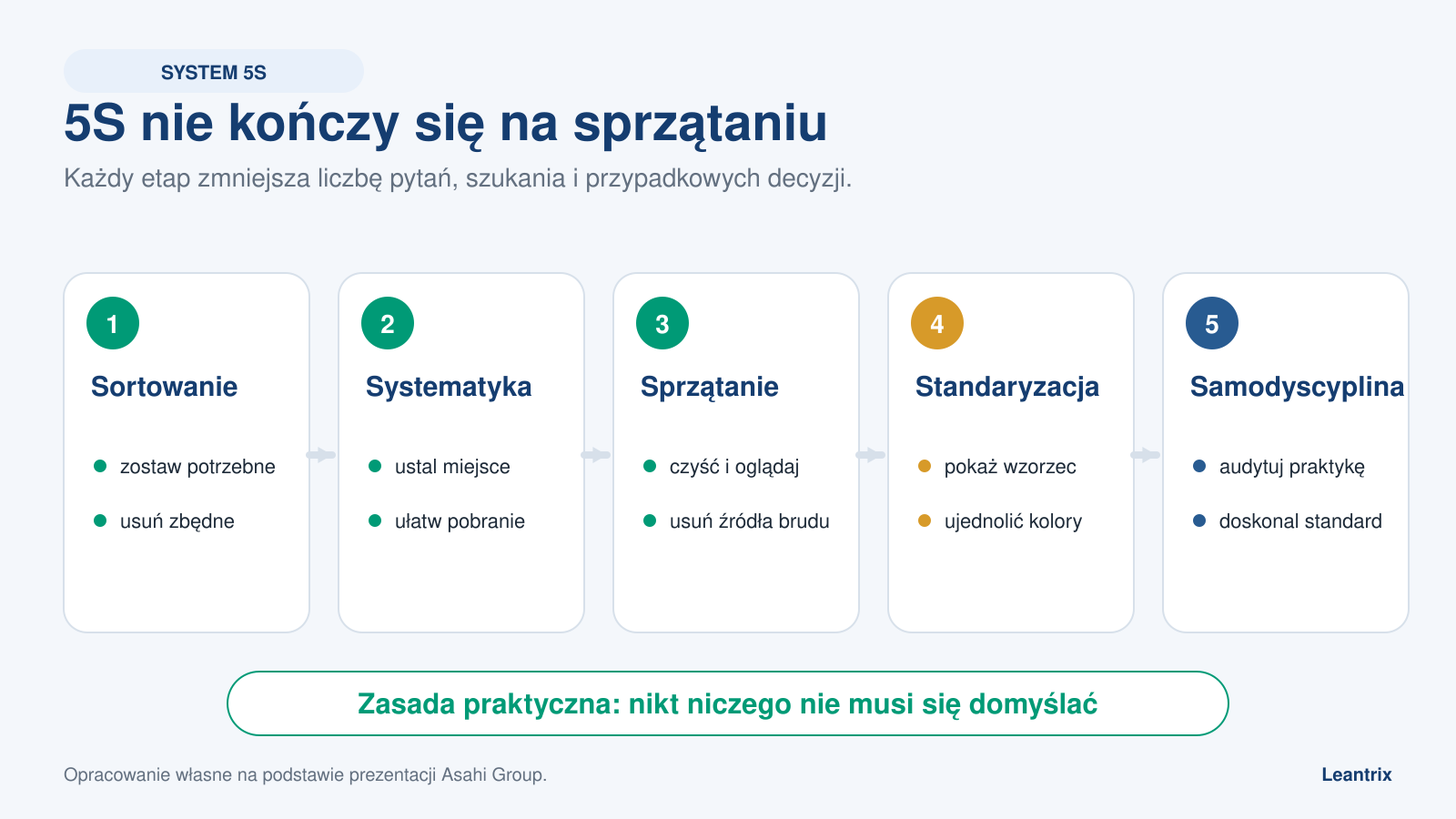
1S: sorting and difficult decisions about “just in case” items
Deciding what was truly necessary took the longest. Items kept “just in case” occupy space, complicate stock control and obscure the desired condition. Sorting therefore requires physical work and agreed criteria: how often an item is used, how much should be available and who decides to remove it.
2S: maps, zones and ergonomics
Area maps alone were insufficient. Zone maps and responsibilities were needed at the level where the team actually worked. Setting in order meant asking whether people could find and collect a needed item quickly, safely and ergonomically.
3S: cleaning as observation and prevention
Cleanliness ceased to be the sole proof of good 5S. A clear schedule helped each shift understand its responsibilities, but the more important question was how to clean less or more easily. Simple design and organisational changes can reduce effort. Eliminating contamination sources turns cleaning into improvement.
4S and 5S: standardisation and self-discipline
Standards needed to be easy to understand and remember. A common colour language, clear markings, reference photographs and specified inventory levels reduce questions. Self-discipline means maintaining the current standard and improving it when the team discovers a better approach.
“Nobody has to guess”: a practical test of a standard
The implementation motto was “Nobody has to guess”. It offers a simple test of a visual system. If employees need to ask where to return a tool, how much material belongs in a zone, who performs an activity or how to leave the workstation after a shift, the standard needs greater clarity.
This also matters when training new employees. A visual standard supports instruction and, after proper training, becomes a reference point. It recalls key requirements, helps identify deviations faster and reduces differences between shifts.
A 5S audit creates an opportunity to improve
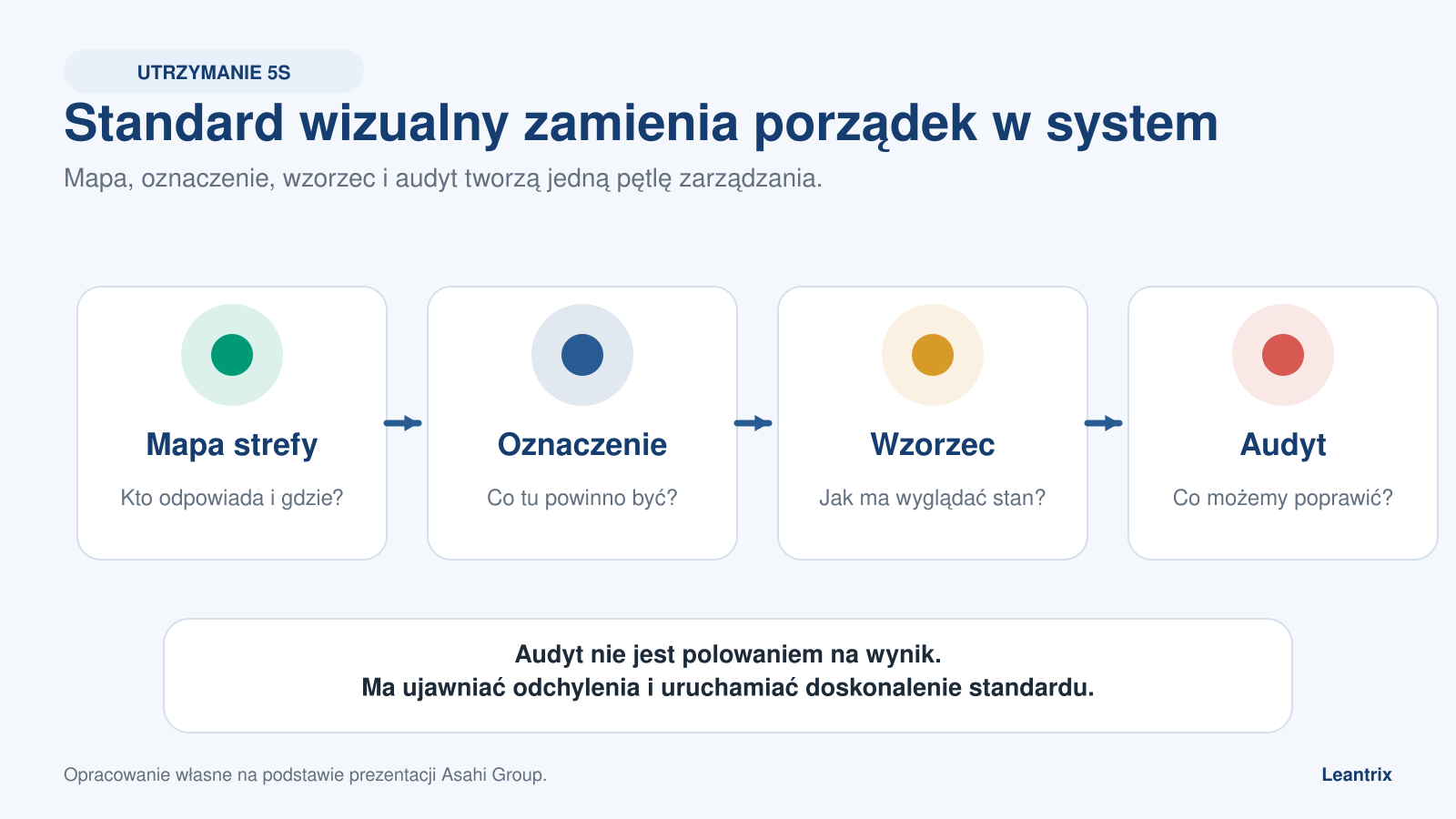
A high audit score can reassure people without indicating a mature system. If auditors look only for compliance, reports can stay green while standards stop evolving. Asahi Group changed its understanding of auditing: the aim was to examine the process critically and initiate improvement.
Auditors were prepared and validated using a TWI approach. In practice, the audit created a cycle: observe the actual condition, compare it with the standard, discuss the deviation with the team, agree action and update the standard when the solution is better.
From autonomous maintenance checklists to Basic Operator Care
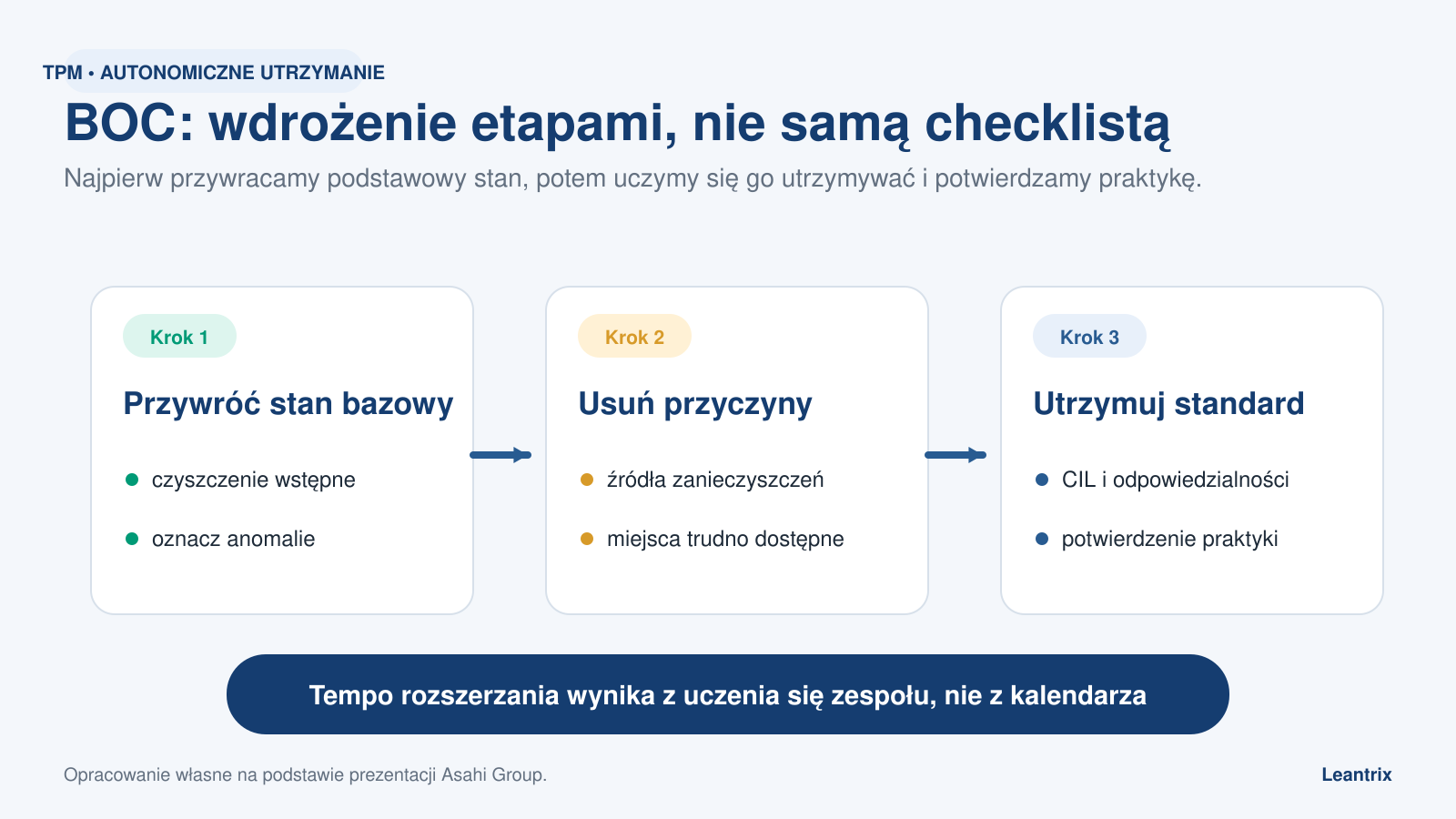
The second part of the case concerned autonomous maintenance. Earlier practice was based largely on inspections. BOC aimed to restore a step-by-step logic: establish basic machine condition, remove causes of deterioration and maintain the agreed standard.
Pilot machines were selected using breakdown analysis. Implementation expanded deliberately, line by line. The pace followed team readiness and confirmation of successive practices. Autonomous maintenance changes skills and habits, so a date in a schedule alone cannot accelerate it effectively.
Tagging anomalies: make the problem visible and give it an owner
Reporting anomalies and defects became a foundation of BOC. A tag or digital report records an observation, helps classify it and initiates information flow between production and maintenance. The issue still needs to be resolved.
A good tagging system identifies the location and nature of the problem, who can safely act, its priority and how the reporter receives feedback. Without closure, tags become another backlog. With feedback, they reinforce the belief that noticing abnormalities matters.
The CIL standard: Clean, Inspect, Lubricate
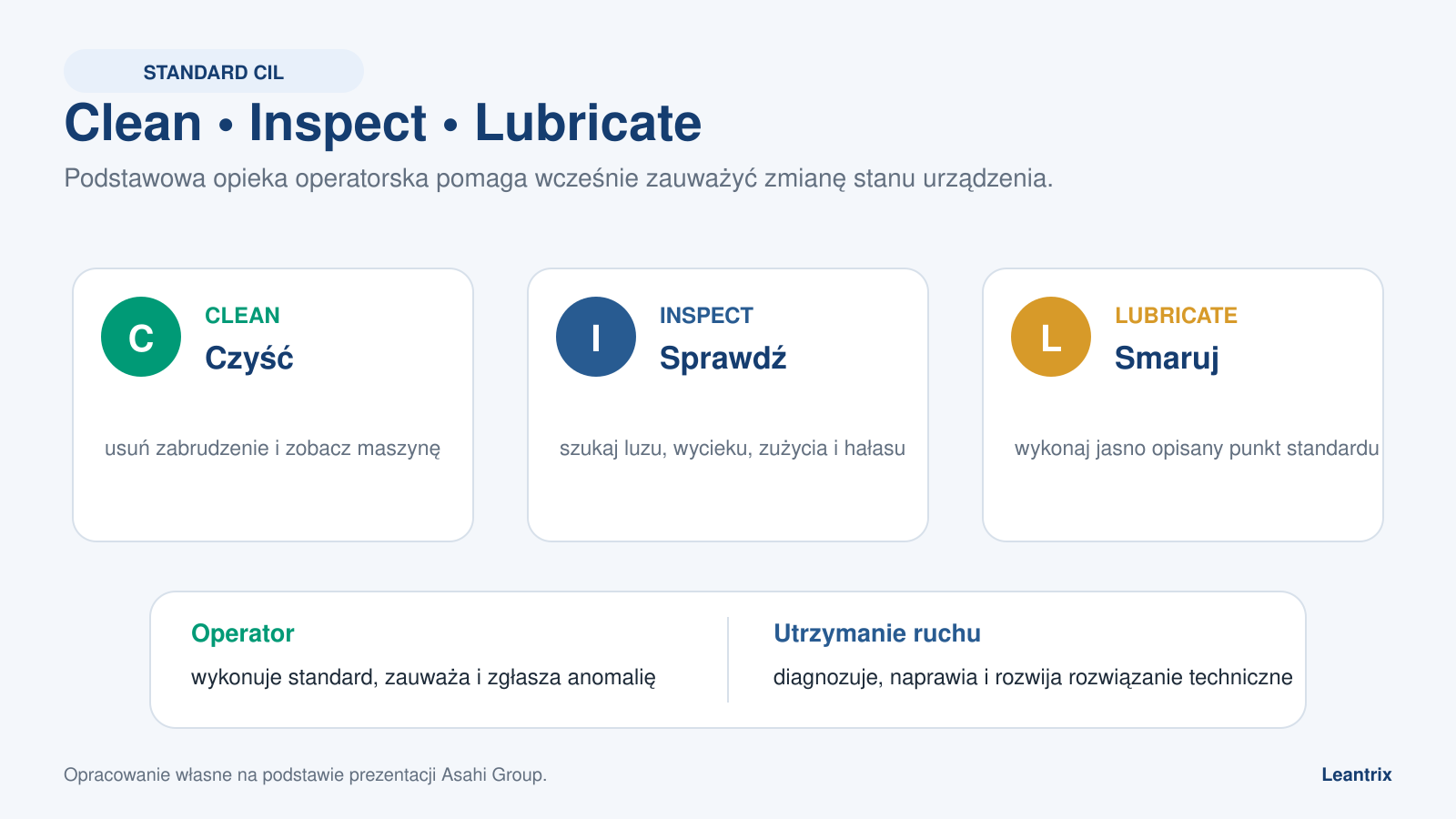
Autonomous maintenance used CIL standards: Clean, Inspect, Lubricate. They specify what to clean, inspect or lubricate, how, when and by whom. A standard should also identify safety conditions, the expected state and the response to deviations.
| CIL element | Practical question | Value for the process |
|---|---|---|
| Clean | Does cleaning make the component’s condition easy to see? | Removal of dirt and earlier detection of abnormalities. |
| Inspect | How can leaks, looseness, wear, unusual sound or temperature be recognised? | Faster response before an anomaly develops into a breakdown. |
| Lubricate | Which point, lubricant, quantity and frequency does the standard specify? | Repeatable basic care and reduced deterioration. |
Eliminating contamination sources and hard-to-access areas
5S and BOC also connect through eliminating contamination sources and inaccessible locations. If the team cleans the same leak every shift or struggles to reach an inspection point, the standard perpetuates waste.
The next level requires root cause analysis. Solutions might include a guard, rerouted cable or hose, better access, a different container or revised task frequency. Action should address the identified cause rather than simply improve appearance before an audit.
BOC audits confirm milestones
In 5S, audits can provide a regular maintenance and improvement loop. In BOC, they confirmed completion of each implementation stage. Each step had its own criteria and measures, and progression required evidence that the practice worked.
The presentation identified measurement directions involving breakdown reduction, closure of detected defects and reduced workload. It did not provide a complete, comparable set of before-and-after results. The supported conclusion is that the organisation established a measurement system and developed the programme in stages; final business effects should not be invented.
What connects 5S and TPM implementation?
The common factor is changing habits. In 5S, teams organise the workplace so the correct condition is easy to recognise and maintain. In BOC, they maintain equipment’s basic condition and respond to early signs of deterioration.
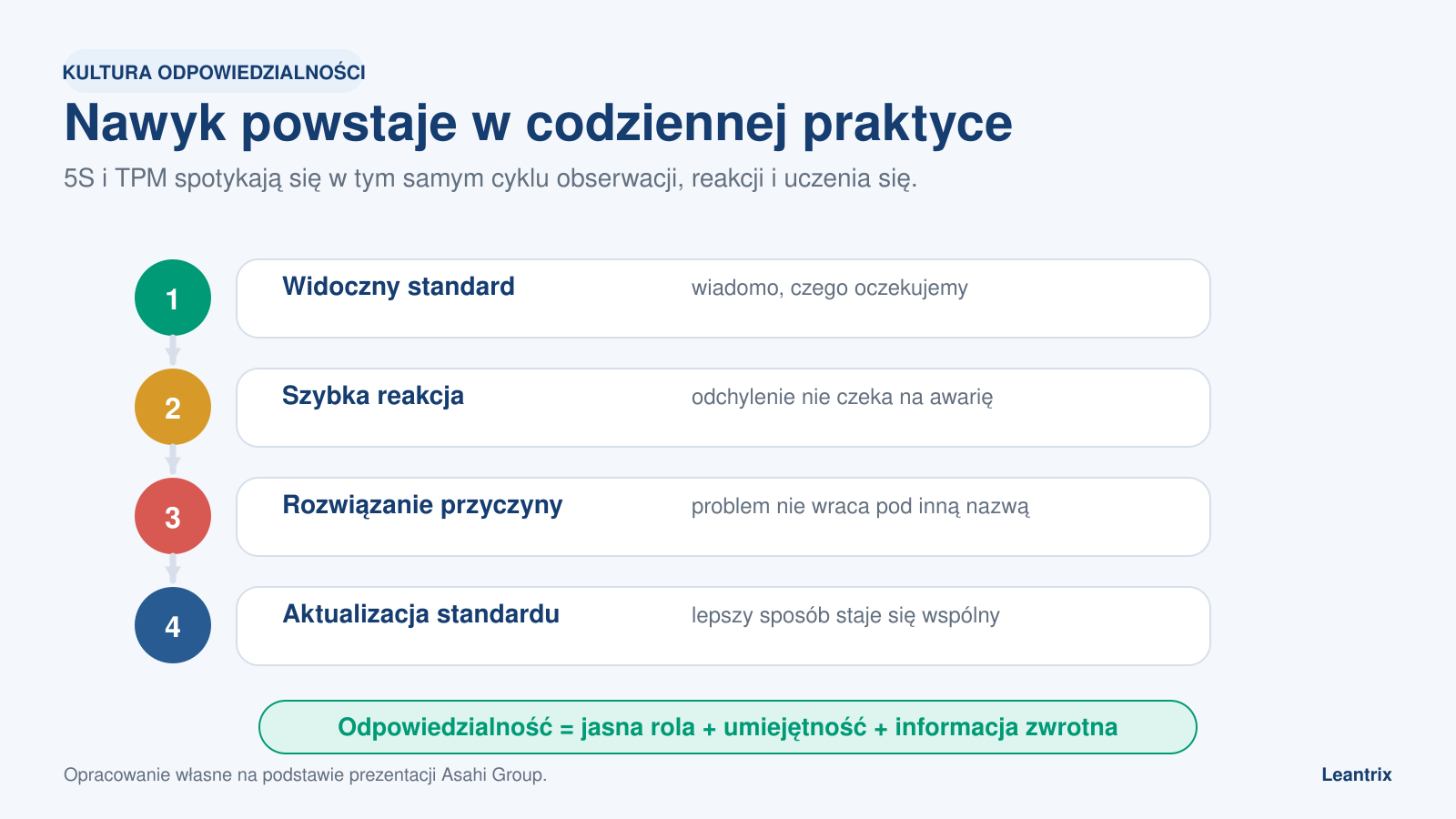
Both systems use the same cycle:
- Establish a visible standard so everyone understands the expected condition.
- Notice a deviation before it becomes accepted as normal.
- Respond and remove its cause rather than repeatedly correcting symptoms.
- Update the standard when the team finds a better method.
- Teach others so improvement becomes the team’s new practice.
Key lessons from 5S and TPM implementation in brewing
| Lesson | Practical significance |
|---|---|
| Check the maturity of long-established tools | Examine whether they change behaviour and outcomes as well as generate reports. |
| Develop internal trainers | An expert cannot scale implementation alone; teams need local support. |
| Build standards with their users | People doing the work know real constraints, risks and opportunities for simplification. |
| Separate operator and maintenance roles | Autonomy requires clear boundaries, competence and safe escalation. |
| Audit to learn | Evaluation should reveal problems and lead to action. |
| Expand according to readiness | Pilots and confirmed steps reduce the risk of a superficial rollout. |
The Asahi Group case shows that 5S and TPM implementation is primarily about developing people. Maps, CIL standards, anomaly tags and audits become effective when teams understand their purpose, can use them and influence their improvement.
How to begin a similar 5S and TPM implementation
An organisation combining 5S and autonomous maintenance can start with one area and one pilot machine. Agree the business problem and expected behaviours before selecting tools.
- Choose an area where deviations are visible and matter to safety, quality or machine availability.
- Assess team maturity and prepare communication suited to its needs.
- Build local teaching capability: select trainers and prepare a training standard.
- Carry out 5S with full participation from people working in the area.
- Restore basic machine condition and define a safe scope for basic operator care.
- Establish how anomalies are reported, assigned and closed.
- Confirm practice in the gemba before extending the programme.
Read more about implementation difficulties in LeanTrix’s “Standardised work in TPM AM” (Polish) and practical 5S implementation in “How to implement 5S: theory versus practice” (Polish).
FAQ: 5S and TPM implementation
How does 5S differ from TPM?
5S organises and stabilises the workplace: items, information, responsibilities and visual standards. TPM is a broader system engaging the organisation in equipment effectiveness and reliability. They overlap in cleaning as inspection, visible deviations and maintaining standards.
Does BOC mean operators replace maintenance specialists?
No. Basic Operator Care structures basic care within a clearly defined, safe scope. Operators perform standard tasks, observe equipment and report anomalies. Maintenance handles specialist diagnosis, repairs and development of technical solutions.
What does CIL mean?
CIL means Clean, Inspect, Lubricate. A CIL standard defines points, methods, frequency, responsibility, safety requirements and responses to deviations.
What role does TWI play in 5S and TPM implementation?
TWI Job Instruction prepares trainers and helps teach one agreed method. A Job Breakdown Sheet organises important steps, key points and reasons, enabling consistent instruction where work is performed.
About the case study presenters
Joanna Hering
At the time of the presentation, Joanna Hering was Brewery Development Manager at Lech Browary Wielkopolski. She presented the refreshed approach to 5S and autonomous maintenance, the Train the Trainer model and staged implementation of Basic Operator Care. Her perspective connected team skill development with a system for maintaining and improving standards in everyday work.
Aneta Kozińska
At the time of the presentation, Aneta Kozińska was Shift Leader in the Bottling Laboratory at Lech Browary Wielkopolski and an internal 5S trainer. She shared the team’s practical experience: difficult sorting decisions, zone organisation and inventory management, clear cleaning rules, ergonomics and audits supporting improvement.
This article is based on materials presented by Joanna Hering and Aneta Kozińska at Lean TWI Summit 2025, held in Wrocław on 10–11 June 2025. Their presentation, “The perfect duo: 5S and TPM as foundations for a culture of responsibility in breweries”, took place on 11 June 2025.

Joanna Hering is a Lean expert and Lean Six Sigma Black Belt. At the time of the case study, she served as Brewery Development Manager at Lech Browary Wielkopolski. She specializes in people development, gemba coaching and process optimization. In the 5S and TPM implementation case study, she presented the Train the Trainer model, the staged development of Basic Operator Care and a way to combine team capability with ownership of standards.