
OEE measures how effectively equipment is used. This is a key challenge for manufacturing companies and a major factor in their competitiveness. Today, every manufacturing company uses machines in its processes, and every machine stoppage is a serious problem. This is why many tools and methods for improving work organisation focus on increasing equipment availability. These include Total Productive Maintenance (TPM), a system developed to achieve three main goals:
- Zero breakdowns
- Zero errors
- Zero defects
In TPM, these principles represent a goal that companies should pursue, but one that is difficult to sustain over the long term. Implementing TPM therefore never ends, because there is always something to improve. TPM focuses on prevention: preventing breakdowns, errors and defects. These problems do occur in manufacturing practice, which makes monitoring indicators and observing trends so important when implementing TPM. One of the main indicators used in TPM is Overall Equipment Effectiveness (OEE).
Introduction to OEE
OEE was developed to help identify losses in machine operation. Seiichi Nakajima, the creator of TPM, identified six such losses, which he called the six big losses:
- Breakdowns
- Excessive changeover times
- Idling and minor stoppages, usually up to five minutes
- Reduced operating speed
- Defects
- Production losses during start-up
OEE makes it possible to allocate these losses to the appropriate areas, making it clear which countermeasures should be taken to minimise them.
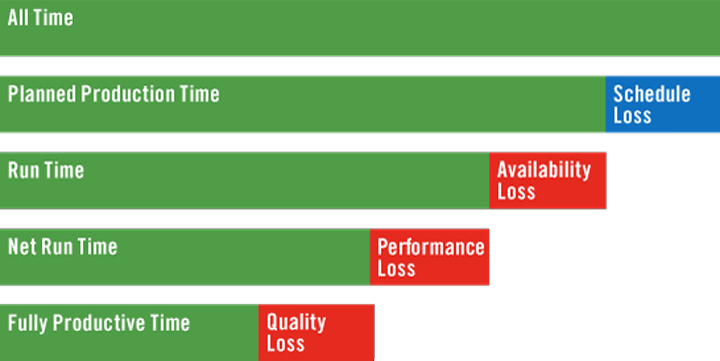
Calculating OEE
OEE consists of three elements:
- Availability — how much time the machine actually ran compared with the planned time.
- Performance — how quickly production took place compared with the maximum theoretical speed.
- Quality — the percentage of products that were good, without defects.
To calculate OEE, simply multiply these three values:
OEE = Availability × Performance × Quality
Example:
| Parameter | Value |
|---|---|
| Planned time | 480 min |
| Downtime | 60 min |
| Total units produced | 800 |
| Ideal cycle time | 0.5 min |
| Defects | 40 units |
Calculations:
- Availability = 420 / 480 = 0.875
- Performance = (800 × 0.5) / 420 = 0.952
- Quality = (800 − 40) / 800 = 0.95
- OEE = 0.875 × 0.952 × 0.95 = 0.792 ≈ 79.2%
How should you interpret the OEE result?
- 85–100% — a “World Class” level
- 60–85% — a good level, with room for improvement
- Below 60% — significant losses and a need for improvement actions
Why measure OEE?
- You identify the largest sources of loss: downtime, speed and quality.
- You can monitor the effects of improvements, for example after implementing TWI, SMED or TPM.
- You see how effectively equipment is actually used, rather than only its availability.
Practical guidance for using OEE
In this article, I present four tips that should help you if you want to use OEE in your organisation. Hundreds of articles have already been written about how to calculate OEE, so I will leave that discussion aside and move on to the practical details.
Calculate OEE using the detailed method, never the simplified method
This may seem counterintuitive. We all try to make our lives easier. When calculating OEE, however, the opposite applies. The simplified method expresses the ratio of the time needed to produce good units to the available machine time. The result ranges from 0% to 100% and shows how effectively a machine operated during a given period. What if OEE is 60%? This means that losses account for 40% of the available machine time. What prevented the machine from operating at 100% effectiveness? You do not know. Calculating OEE using the simplified method gives you a bare result. It is certainly useful when comparing selected machines, areas or manufacturing plants. However, it is insufficient when you want to improve the way a machine operates. Why? Because it does not tell you where to focus your improvement efforts.
It is therefore much more valuable to use the detailed method, calculating the following separately:
- Machine availability
- Machine performance
- The quality of the products made on the machine
The percentage values of these three OEE components are multiplied to obtain the OEE result. Naturally, the result is identical to that obtained using the simplified method. Why, then, divide OEE into three components? Because doing so allows you to categorise the individual losses in machine operation (Table 1).
Table 1. Equipment losses allocated to the three OEE components
| OEE component | Equipment losses |
|---|---|
| Availability | Breakdowns |
| Excessive changeover times | |
| Performance | Idling and minor stoppages, usually up to five minutes |
| Reduced operating speed | |
| Quality | Defects |
| Production losses during start-up |
Knowing the values of the individual OEE components allows you to take appropriate corrective action. Whenever I work as a consultant in manufacturing companies, I communicate one message: first start measuring Overall Equipment Effectiveness (OEE), and only then implement Lean tools. OEE is like a good diagnostician who can identify what is wrong with a machine. Lean tools are the treatment. Before starting treatment, however, you first need to identify the condition. Table 2 shows examples of the Lean tools that can be used depending on the problems affecting machine operation.
Table 2. Lean tools focused on eliminating the six big equipment losses
| Six big equipment losses | Examples of Lean tools for eliminating the loss |
|---|---|
| Breakdowns |
|
| Excessive changeover times |
|
| Idling and minor stoppages, usually up to five minutes |
|
| Reduced operating speed |
|
| Defects |
|
| Production losses during start-up |
|
Treat changeovers as unplanned downtime
In TPM, the loss is not the changeover itself, but its excessive duration. During a changeover, the machine usually has to stop, creating an availability loss. Even in Formula 1, changing the tyres requires the car to stop, although the changeover takes very little time. In many factories I have worked with, changeover time is treated as a planned break. After all, changeovers are planned. What is the consequence? Changeover time is not deducted from the available machine time. In that situation, if a changeover takes longer for some reason, OEE remains unchanged, because it compares the number of good products made within the available machine time.
We need to recognise that OEE was not developed simply to report machine effectiveness results. OEE exists to reveal problems in machine operation. The result itself is only a measure, not an end in itself. I always encourage companies to treat changeovers as unplanned downtime that reduces machine availability. If a machine is undergoing a changeover, it is not available: it is not running. This is quite logical. OEE can then reveal problems, particularly when changeover times increase.
For many companies, this change is too radical. I therefore sometimes recommend a compromise. Almost all companies standardise their changeovers; this is part of the SMED method. In this situation, I recommend treating the standard changeover time as a planned break, and any time beyond that standard as unplanned downtime. However, my preference is to treat the entire changeover as unplanned downtime. Why? Because this gives you a reason to apply SMED, which allows you to reduce changeover time. Otherwise, when the duration of a standard changeover does not affect OEE, there is no motivation to address and improve it.
Do not treat World Class OEE as an absolute benchmark
World Class OEE is the target OEE level adopted by Seiichi Nakajima. It is 85%. Everyone implementing TPM knows this figure. Not everyone knows where it came from, however. Nakajima once said that, in his view, machine availability should be 90%, machine performance during the available time should be 95%, and the quality of the products made during that time should be 99%. Multiplying these three OEE components gives a result of approximately 85% (Table 3).
Table 3. Component values for World Class OEE
| World Class OEE | Availability | Performance | Quality |
|---|---|---|---|
| 85% | 90% | 95% | 99% |
This is certainly a logical analysis by Nakajima and an interesting point of reference. Unfortunately, many companies have treated World Class OEE as an overriding standard. As a result, I often hear companies say that they maintain OEE at 90% without difficulty. The people saying this feel that they have already done everything possible in terms of improvement. After all, they are five percentage points above Nakajima’s benchmark. When I ask about the type of production in such cases, the answer is usually continuous processing. These processes are automated, continuous and geared towards large batches. A line is often dedicated to one product. In practice, changeovers are rare and there are almost no performance losses. Breakdowns and defects do occur, resulting in OEE of 90%.
Can this type of production be compared with discrete, small-batch manufacturing, where changeovers are a normal part of every working day? Certainly not. I have seen many companies with OEE of 60% whose production work was organised far better than in companies boasting OEE of 90%. Every company should set its own targets for OEE and, especially, for each of its components separately. A large number of changeovers is, after all, the essence of small-batch production. It does reduce OEE, but it also reduces the worst type of waste: inventory.
Do not focus on World Class OEE. Set your own Company Class OEE, tailored to the specific characteristics of your company and encouraging employees to look for improvements in machine operation.
Do not base employee bonuses on OEE
Making employee bonuses dependent on OEE is one of the worst approaches a company can adopt. I always oppose this solution. OEE measures the effectiveness of equipment, not people. In different companies, I have repeatedly seen statements such as:
A 5% bonus if the machine’s OEE is between 80% and 85%.
I understand the managers’ intention: to encourage employees to produce more good-quality products. That makes sense, of course. On the other hand, how much influence do employees have over the company’s decision to accept small orders and carry out frequent changeovers? None. Do frequent changeovers reduce OEE? Absolutely. Human errors can, of course, affect each of the six big losses and thus lower OEE. However, OEE primarily measures machine operation. If you want to reward employees, identify the elements within OEE over which they have a real influence.
Conclusion
OEE is one of the most popular key performance indicators (KPIs) used in companies. It is widely applied in Polish industry. However, remember that the result is the least important part of OEE. It is much more important to track trends for each of its three components separately. They tell us about the actual problems in machine operation and whether our actions are producing the expected results. It is particularly important to define your own targets for availability, performance and quality. World Class OEE can be an inspiration, but it is certainly not a ready-made solution for every company. Remember that OEE was developed not only to measure, but to diagnose problems so that corrective action can be based on that diagnosis.

I am a promoter of Lean Management and the Training Within Industry program. I am a practitioner. I co-create many startups. Since 2015, I have been the CEO of Leantrix - a leading Lean consulting company in Poland, which, starting from 2024, organizes one of the largest conferences dedicated to lean management in Poland - the Lean TWI Summit. Since 2019, I have been the CEO of Do Lean IT OU, a company registered in Estonia that creates the software etwi.io, used by dozens of manufacturing and service companies in Europe and the USA.