Standardising MRI examinations across a distributed network may look like a documentation project: agree protocols, approve them and send them to teams. The Affidea case shows that the real challenge begins afterwards. A shared standard must support diagnostic quality, accommodate differences between scanners, structure cooperation between doctors and radiographers and withstand established local habits.
The starting point was a troubling paradox: an examination can take a long time and include additional sequences yet still fail to deliver the expected diagnostic value. More activity does not always produce a better outcome. When every centre performs examinations differently, comparing images, managing teleradiology and defining a correctly performed examination become difficult.
Paweł Kokorczak’s presentation at Lean TWI Summit 2026 describes a transition from three unsuccessful attempts to a model in which the people performing the work co-create standards, implementation proceeds in batches and results are monitored across the organisation.
Standardising MRI examinations: where was the real problem?
Affidea (Polish website) operates a distributed network of diagnostic centres using different scanner models, configurations and local team experience. This diversity offers knowledge, but without a common core it quickly generates multiple variants of the same work.
The problem extended beyond examination duration. The presentation identified four connected risks:
- Lack of comparability between a patient’s examinations when successive scans follow different protocols.
- No shared reference point for determining whether an examination meets the expected standard.
- Additional sequences that may extend scanner time and subsequent reporting time.
- A distributed reporting process: according to the materials, approximately one third of examinations were reported through internal teleradiology.
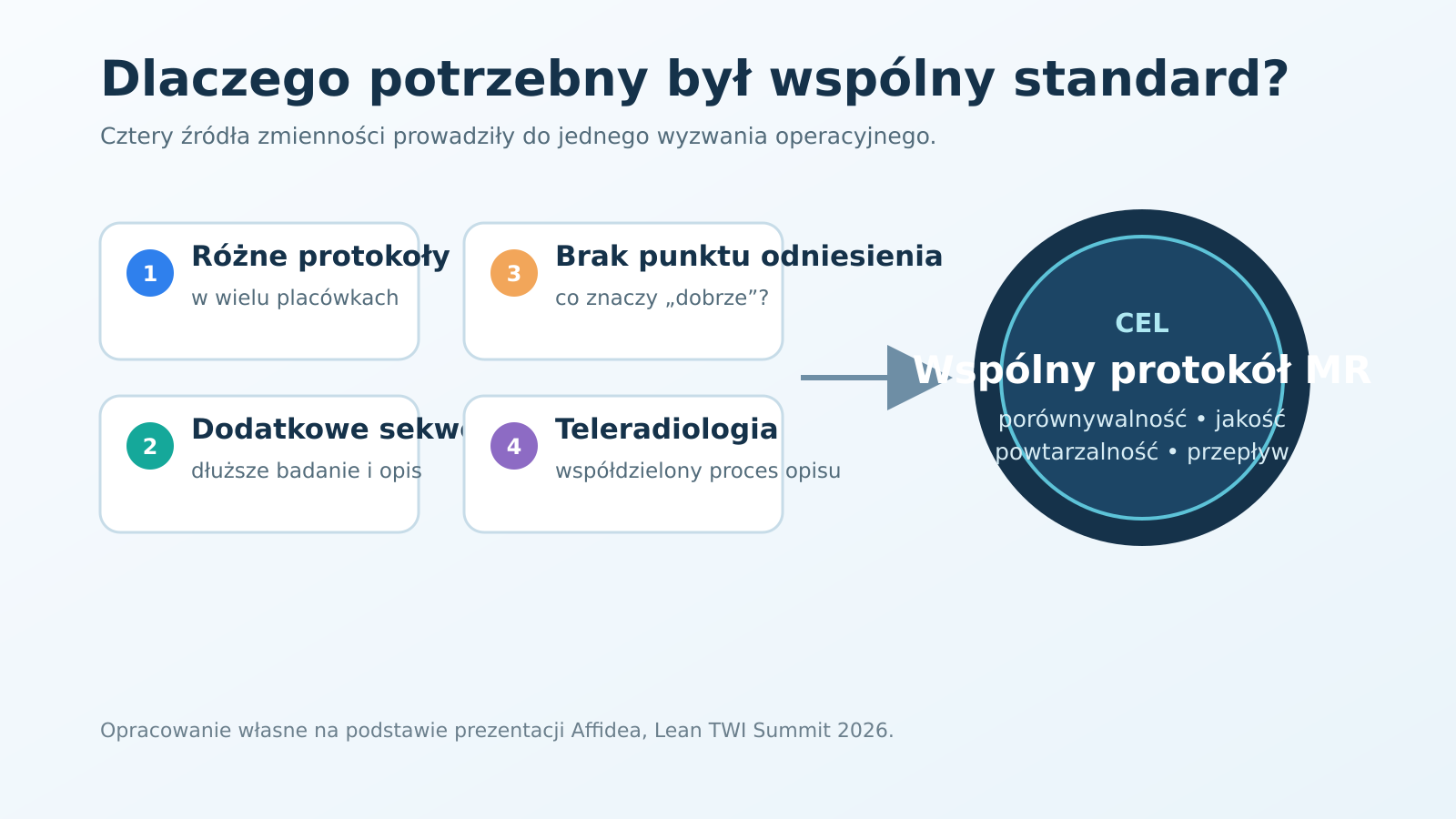
The organisation did not yet have a single accepted way of working that combined clinical requirements with the technical realities of many centres. The issue therefore went beyond staff knowing a procedure.
Why do more sequences not always mean a better examination?
In medical processes, additional activity can easily be equated with additional safety. Every imaging sequence, however, consumes scanner time, extends the patient’s time in the department and increases the material to analyse. Without a justified clinical need, it can increase workload without a proportional gain in value.
The standard was intended to define a shared, best-known starting point and organise justified exceptions while preserving medical decisions. A managed standard distinguishes a common core from situations requiring a doctor’s judgement.
A good standard supports clinical knowledge by reducing unjustified variation and making departures a conscious decision rather than a local habit.
Three standardisation attempts failed to deliver lasting results
One of the strongest aspects of this case is that three earlier standardisation attempts produced no lasting outcome. The presentation does not detail each attempt, so specific causes should not be invented. The fact of three failures is itself a significant lesson.
A technically sound document may still leave daily work unchanged. Standards developed away from the process can feel imposed. Teams may question their fit with a scanner, local conditions, doctors’ expectations or patient characteristics. Discussion then shifts from repeatable quality towards why head office is dictating local work.
The breakthrough came from changing how the standard was created rather than selecting another problem-solving tool.
The breakthrough: the people doing the work create the standard
The project involved doctors and radiographers representing different regions and teleradiology. They jointly developed the content. Paweł Kokorczak led the project, which also included project and medical sponsorship.
The team’s composition addressed several problems:
- Doctors contributed diagnostic quality criteria and the perspective of those reporting examinations.
- Radiographers contributed knowledge of actual examination practice, scanner capabilities and execution difficulties.
- Regional representatives revealed local differences before these became sources of resistance.
- The medical sponsor gave clinical decisions appropriate authority.
- The project leader connected technical work, communication, formalisation and measurement.
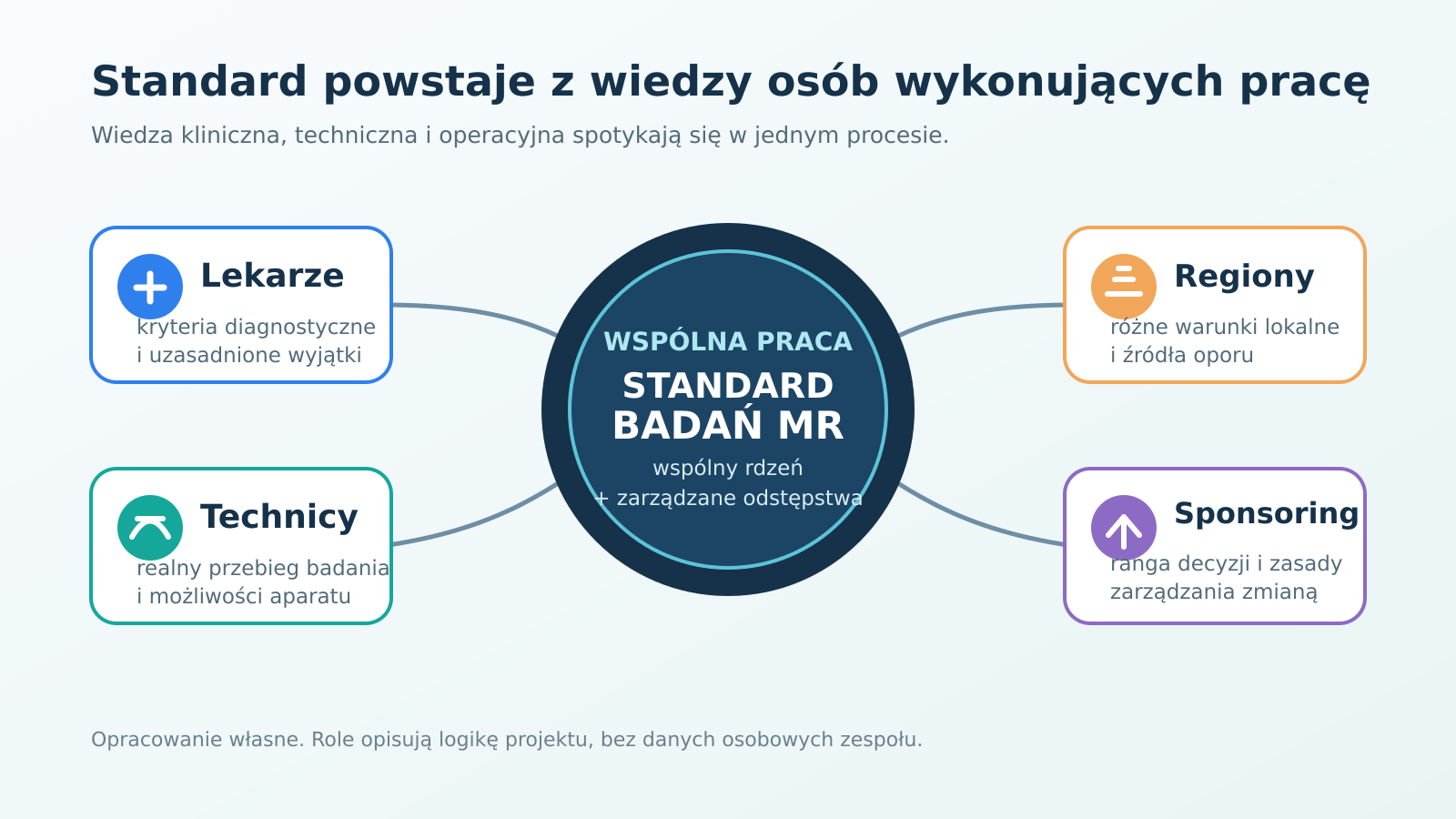
The presentation’s central rule was clear: standards must be created with the people who perform the work. This does not automatically validate every local practice. It means building the best common approach on process facts rather than assumptions made far from the gemba.
MRI standardisation: implementation in three batches
The project divided work into three batches instead of covering every protocol at once. Teams could learn from the first group, refine cooperation and then move into further areas.
Batch implementation is particularly valuable in a distributed organisation because it enables:
- Limiting simultaneous changes.
- Testing standards on different scanner types and under different conditions.
- Identifying naming and reporting problems quickly.
- Preparing materials for radiographers and patients based on real questions.
- Developing an initial group able to support further centres.
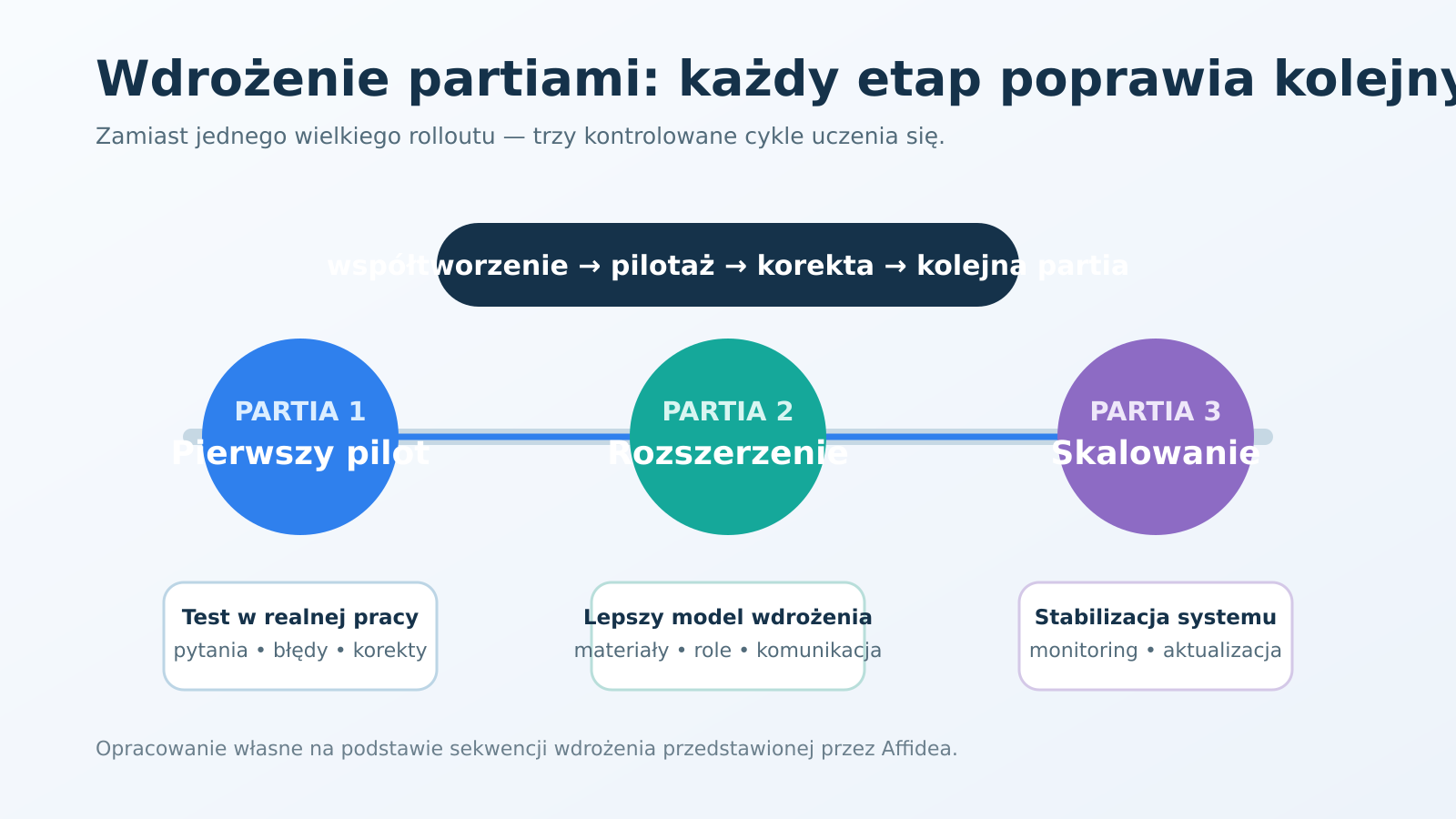
This follows an experimental logic: implement the best current hypothesis, observe deviations, learn and update practice. The standard becomes a baseline for controlled improvement.
MRI standardisation is a system
A sequence list alone is insufficient. Affidea built supporting elements around shared protocols to enable daily work and sustain the standard.
| System element | Role |
|---|---|
| Shared examination protocol | Defines the agreed core method of performing the examination. |
| Radiographer’s handbook | Translates the standard into practice and explains execution. |
| Patient preparation and referral materials | Organise information needed before the patient enters the examination room. |
| Management procedure | Defines roles, responsibilities, updates, monitoring and local adaptations. |
| One digital source | Provides access to the current version and reduces use of outdated files. |
| Reporting | Reveals adoption and directs attention to deviations. |
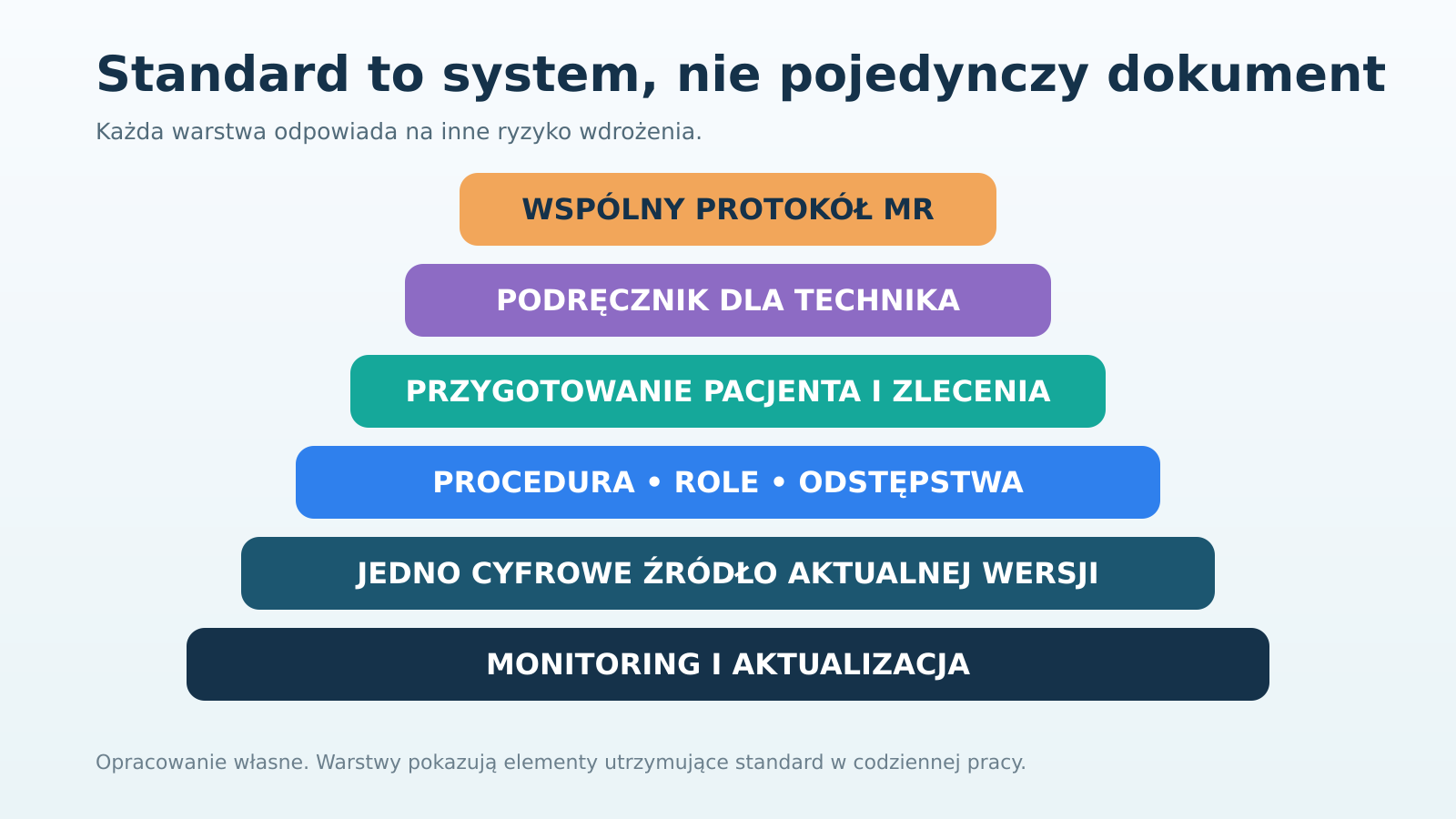
This architecture protects against announcing a standard without creating the conditions to use it. If radiographers cannot locate the current version, doctors do not know how to request a change and centres receive no feedback on deviations, even an excellent document quickly loses relevance.
Change management began before the standard went live
MRI standardisation touches professional autonomy, local experience and relationships between specialist groups. Resistance is therefore understandable information about a change in established decision-making.
Where did concerns arise?
- “Our scanners and configurations are different.”
- “Doctors in our region expect additional sequences.”
- “The central standard overlooks local conditions.”
- “A longer examination meets the recipient’s expectations but places pressure on the schedule.”
- “Who resolves a conflict between the protocol and an individual recommendation?”
These tensions required a communication plan, direct conversations, site visits, explanation of purpose and a clear route for feedback. Implementation materials explained why the project was needed and acknowledged concerns. Recognising real worries came first, followed by showing how the standard addressed them.
The change plan mattered as much as protocol content
Paweł Kokorczak summarised this part through four principles: resistance will occur, bigger changes generate stronger resistance, a plan is needed and the change must be carried out properly. Developing a standard and building acceptance must therefore be part of the same work.
Operational challenges continued after protocol publication
Implementation raised questions about additional sequences, local recommendations and responses to justified departures. This is natural: a standard becomes real when used under daily scheduling pressure, technical constraints and individual cases.
Alongside compliance, the organisation needs a mechanism for learning from deviations. Each exception should lead to one of three conclusions:
- The standard is appropriate, and the issue concerns understanding or execution.
- The departure is clinically justified and should remain a conscious exception.
- The standard needs updating because new evidence or repeated experience suggests a better approach.
Without this cycle, standards either become rigid and detached from reality, or each centre develops its own variant and standardisation gradually disappears.
The outcome: high adoption of shared protocols
After corrections to reporting scope, the presentation showed that shared protocols were used for the overwhelming majority of MRI examinations included in measurement. This is strong evidence of adoption across a distributed organisation.
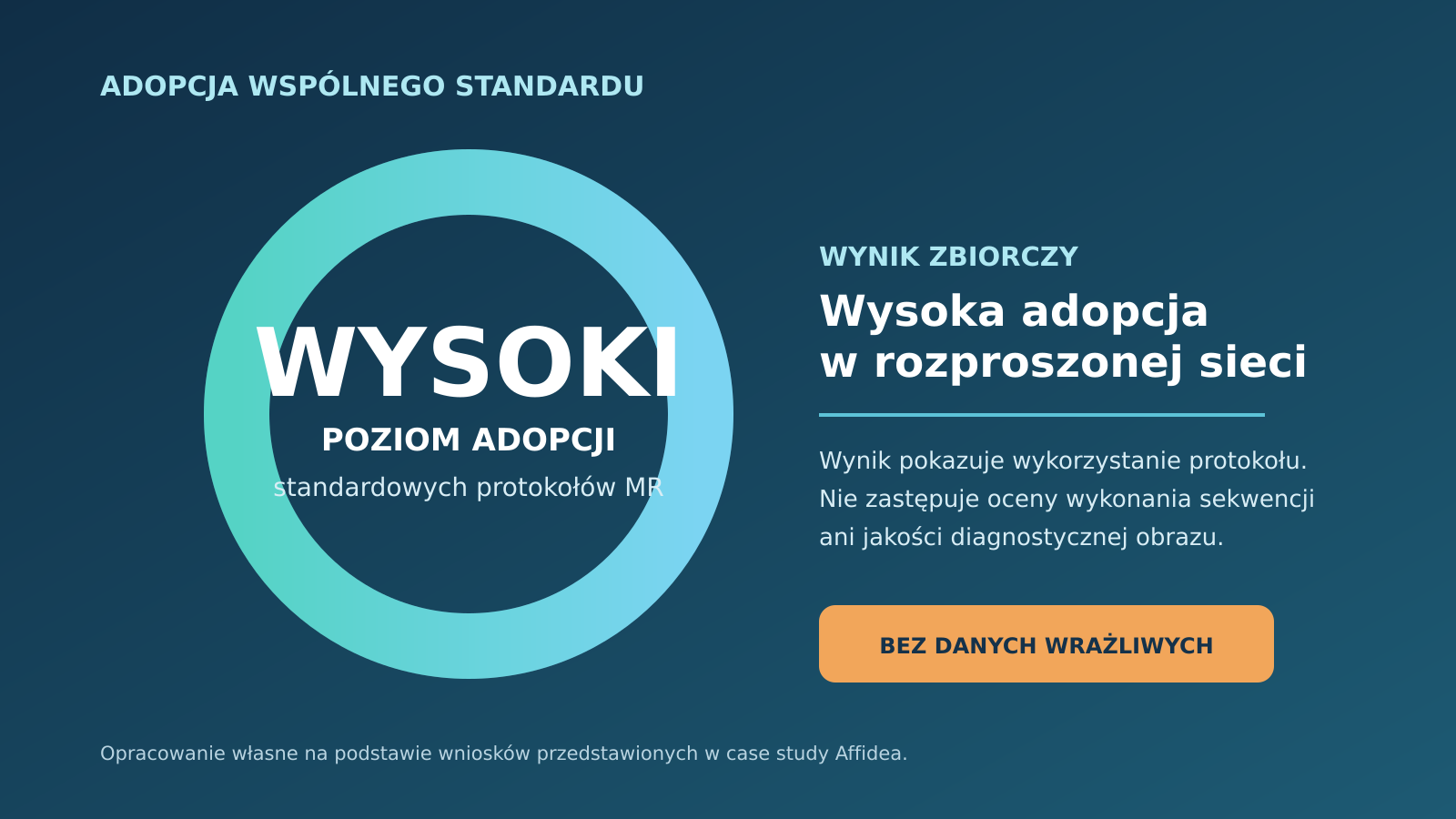
This demonstrates that protocols entered daily use. It does not automatically prove that every sequence was performed correctly or that every image met all diagnostic quality criteria.
Standard adoption and diagnostic quality require separate checks
The team went beyond a high compliance score. The presentation explicitly identified two further levels of verification:
- Selecting the correct protocol does not guarantee correct sequences were performed.
- Performing the sequences does not guarantee the quality of every sequence.
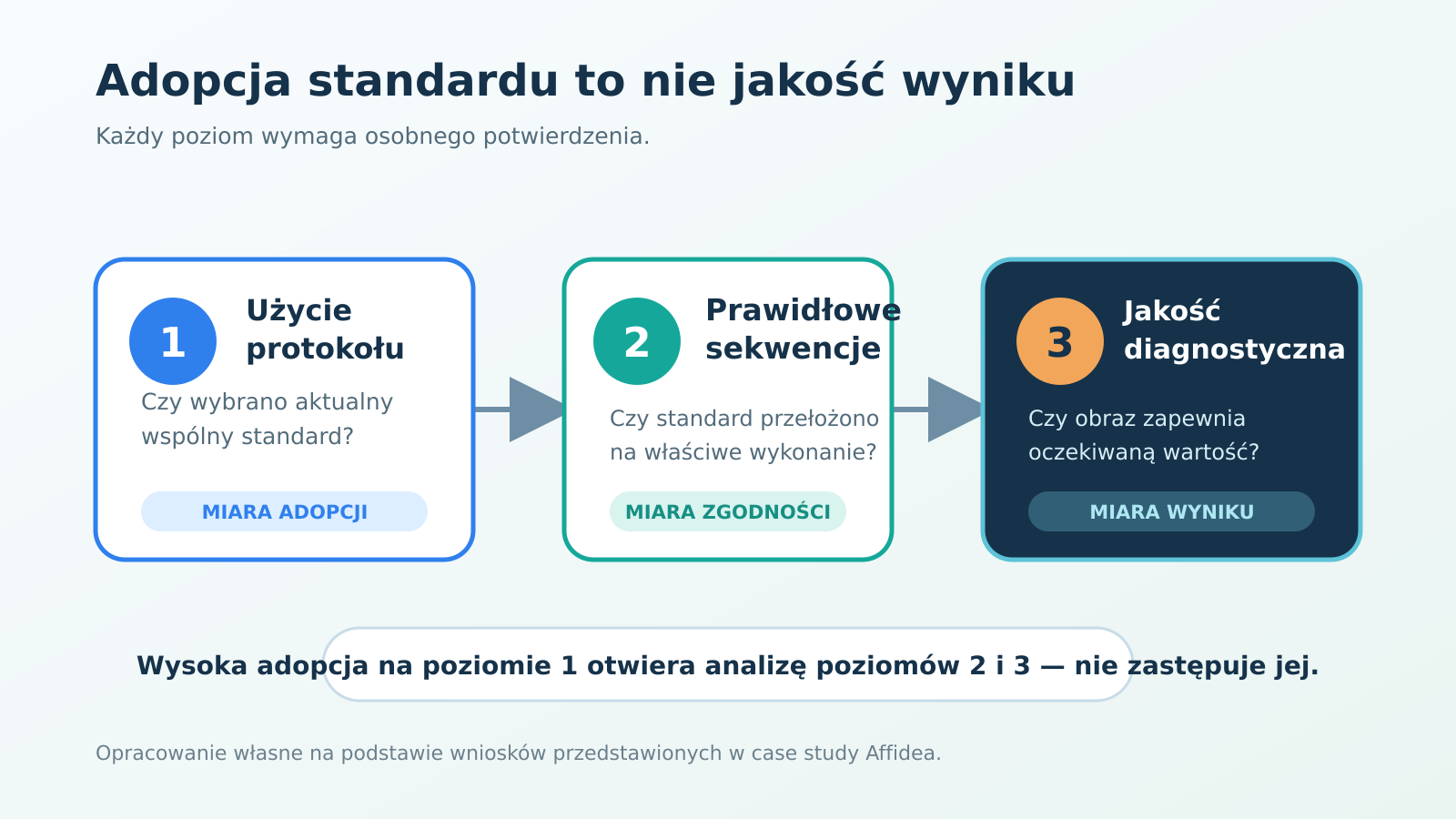
The next step therefore analysed sequences within protocols and assessed their quality in greater depth. This guards against a green indicator creating a sense of success without checking the outcome that matters to patients and doctors.
How can MRI standardisation be measured?
The Affidea case suggests a three-stage measurement logic. The table develops that logic into practical recommendations; these are not additional results reported in the presentation.
| Level | Example question | What does it show? |
|---|---|---|
| Adoption | Was the examination performed using the current protocol? | Whether the standard entered everyday work. |
| Execution compliance | Were required sequences and parameters performed to standard? | Whether documentation translated correctly into action. |
| Outcome quality | Does the image provide the expected diagnostic value? | Whether the process achieved its real purpose. |
| Flow | How did examination and reporting time and scanner utilisation change? | Whether the standard improves flow while maintaining quality. |
| Learning | How many deviations lead to adjustments in instruction, equipment or standards? | Whether the organisation can improve its solution. |
Measures must be read together. A shorter examination is no success if quality falls. A single high-quality scan is insufficient if work is inconsistent and queues grow. Protocol compliance cannot replace medical assessment.
Eight lessons from Affidea’s implementation
- Start with the problem. DMAIC, A3, 8D and Ishikawa help once the organisation understands what it needs to solve.
- A document becomes a standard through use. It must be known, feasible, applied and managed.
- Create standards with the people doing the work. Doctors and radiographers should co-create the solution.
- Separate the common core from justified exceptions. Reduce unnecessary variation while preserving clinical decisions.
- Implement in batches. Successive protocol groups allow refinement before scale increases.
- Plan for resistance. Concerns need ownership, time, communication and a clear response route.
- Build a maintenance system. Handbooks, patient materials, procedures, a repository and reporting matter as much as protocol content.
- Continue beyond adoption. A high usage percentage begins quality analysis.
What can another healthcare provider transfer?
Affidea’s protocols and examination parameters should not be copied without independent clinical and technical assessment. The implementation architecture can be transferred:
- A clearly defined challenge and target condition.
- A team connecting people doing the work with owners of quality and outcomes.
- Observation of the real process alongside documentation.
- A pilot and controlled implementation batches.
- Materials supporting employees and patients.
- One source of the current version.
- A mechanism for exceptions and updates.
- Measurement of adoption, execution and outcome quality.
This follows the broader logic of Lean in healthcare (Polish): see the process as it is, jointly design the best-known approach, then sustain and improve it using data.
Compare this case with the Penta Hospitals case study and the practical discussion of Lean in diagnostics (Polish).
FAQ: standardising MRI examinations
Does a standard replace a doctor’s decision?
No. A shared protocol defines an agreed starting point and reduces arbitrary variation. Clinical decisions may still require a conscious, justified departure managed through an agreed process.
Does high protocol compliance mean high quality?
Not automatically. Correct sequence execution must be confirmed, followed by assessment of diagnostic quality. Affidea treated adoption as another stage of work rather than final proof of quality.
Why is publishing one procedure insufficient?
A procedure alone cannot prepare a radiographer, explain patient preparation, resolve local exceptions or show usage. A full system of roles, materials, a repository, communication, monitoring and updates is needed.
Does this article provide MRI examination instructions?
No. It describes management of standardisation and organisational change. It contains no clinical parameters or diagnostic instructions and is not a medical document.
Paweł Kokorczak: the case study presenter
Paweł Kokorczak is a Lean Manager at Affidea Polska and a certified Six Sigma Black Belt. He has 15 years of experience improving processes in manufacturing, services, consulting and healthcare. He delivers training in Six Sigma, Lean, Kaizen and Nonviolent Communication (NVC). He is also academic programme lead for the postgraduate “Lean Manager in Healthcare” programme at Andrzej Frycz Modrzewski University in Kraków.
Bringing MRI standardisation into daily practice
The Affidea case shows that standardising MRI examinations combines clinical quality, technical realities, patient flow, teleradiology and change management across many locations.
Three previous attempts produced no lasting result. The breakthrough came when doctors and radiographers co-created standards, work was divided into batches and an implementation and maintenance system was built around the protocols. Aggregate results confirmed high adoption. The team also recognised that protocol compliance alone did not prove diagnostic quality and launched further analysis.
This article is based on Paweł Kokorczak’s materials presented at Lean TWI Summit 2026 in Wrocław on 9–10 June 2026. It describes the position presented at the conference. It contains no clinical instructions, full confidential protocols or exact values from Affidea’s internal reporting.

An expert in process optimisation and standardisation in healthcare and other industries. He combines a data-driven approach with operational practice. He gained experience in service and industrial environments, including AXA, Woodward and ArcelorMittal, delivering projects to reduce lead times, stabilise processes and build a Kaizen culture. In his presentation, he will explain how Affidea Polska uses analytical tools to improve operational processes.