Transforming manual processes through automation at DeLaval involved more than purchasing modern machines. The case follows a journey from an initial automation programme that exposed problems with flow, long batches and local optimisation to a second transformation designed around customer takt, the value stream, mock-ups, change management and standardised work. The key lesson is that technology stabilises a process when the organisation has first designed how materials, information and accountability will flow.
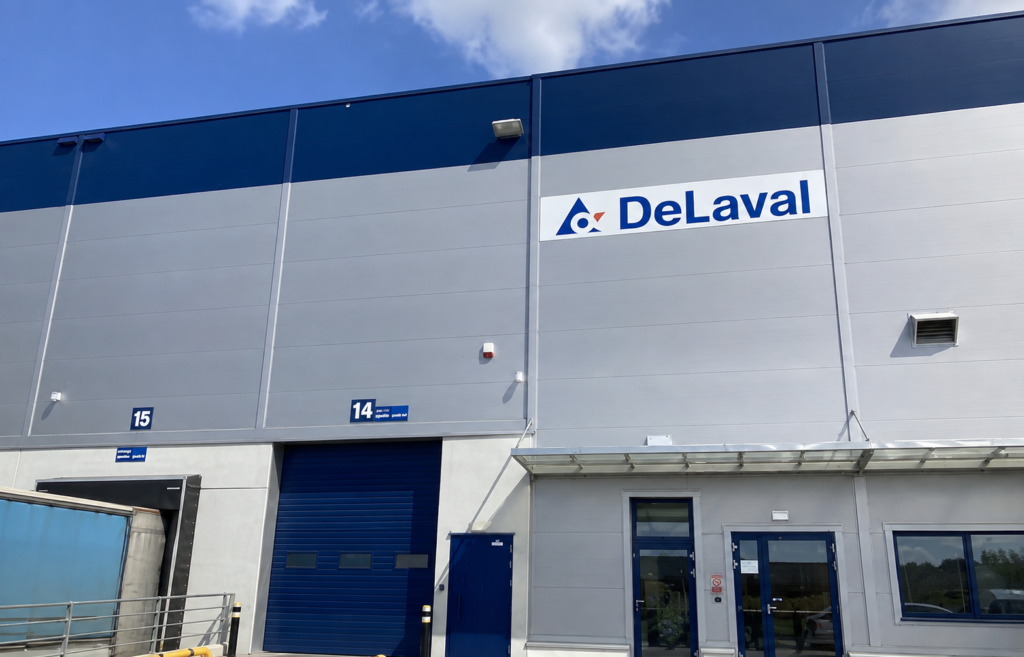
DeLaval develops solutions for sustainable food production and is part of Tetra Laval Group. The Lean TWI Summit 2025 presentation described an extensive factory and distribution-centre network and five production plants in Poland: four in Wrocław and one in Dobre Miasto. This project concerned two successive automation stages at the Robotnicza and Fabryczna street facilities in Wrocław.
Transforming manual processes through automation: the DeLaval context
The starting point was a need for greater process stability, repeatable quality, better safety and ergonomics, and lower manufacturing costs. Difficulty recruiting skilled welders was another important factor. Automation therefore addressed operational risks, quality requirements and labour-market constraints simultaneously.
However, automating an operation is different from transforming an entire value stream. A machine can perform a task faster and more consistently, but it will not automatically eliminate waiting between operations, excessive WIP, conflicting team objectives or planning problems. DeLaval experienced this during the first stage.
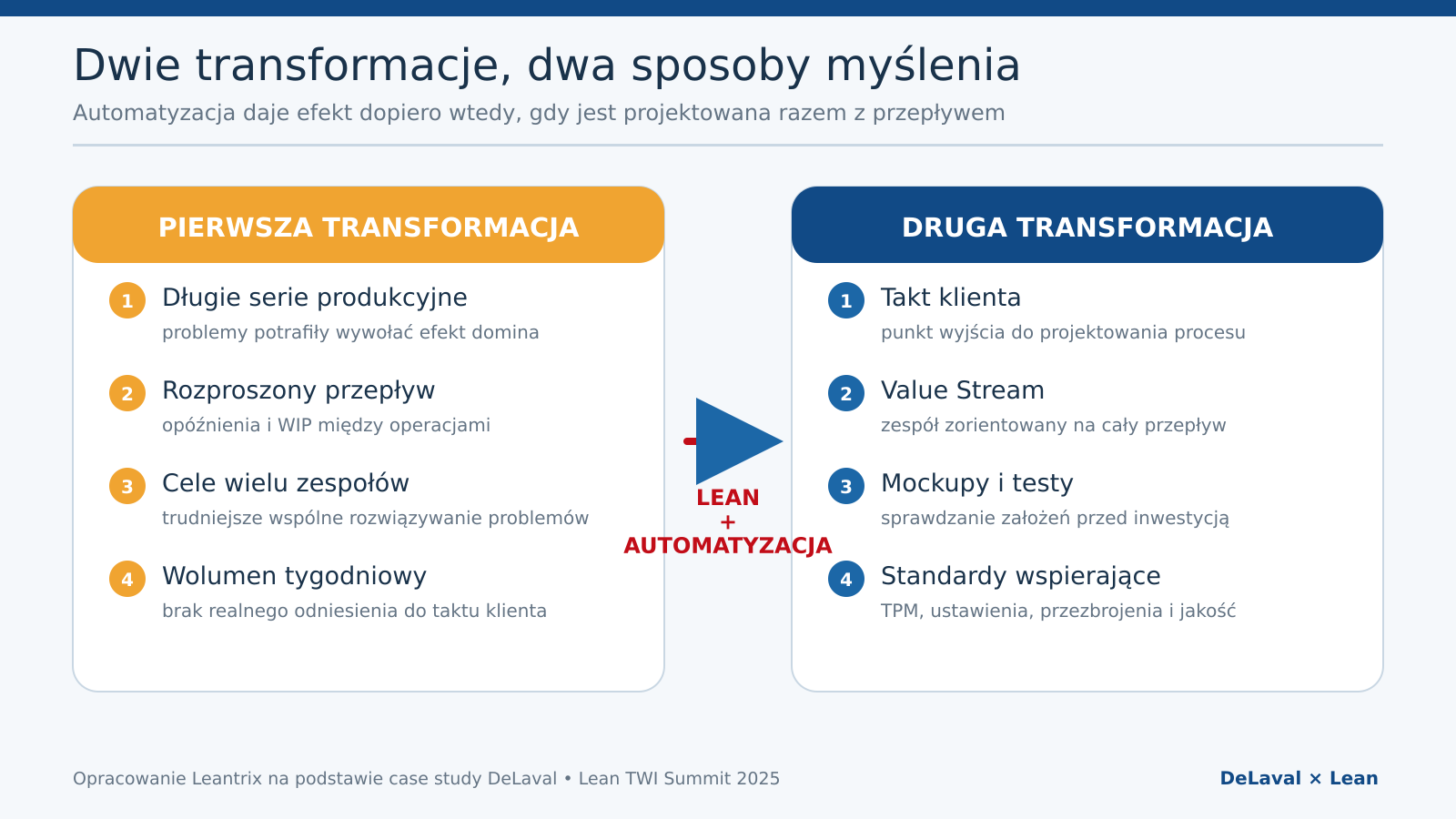
Transforming manual processes: machines alone did not create flow
During the first transformation, Lean activities focused on maintaining quality during launch, securing weekly production capacity, reorganising the layout, 5S and addressing bottlenecks. These were reasonable actions to stabilise the technological change. The project also produced valuable observations that shaped the next stage.
Long batches and the domino effect
Long production runs meant that a problem in one part of the process affected subsequent operations. Semi-finished products required temporary storage, and growing work in progress occupied shop-floor and warehouse space. Automating one operation therefore did not remove waiting costs or the difficulty of managing WIP.
Scattered machines and interrupted flow
The arrangement of machines and process stages hindered continuous flow. Material travelled between operations, increasing the risk of delays, misplaced semi-finished products and unclear priorities. This demonstrates why layout should follow the intended flow rather than available space or individual machines’ local needs alone.
Multiple teams and multiple local objectives
The same product passed through several teams. Their objectives were not always fully aligned, so agreeing a solution took longer. The organisation recognised that it needed a structure responsible for the entire value stream as well as connected machines.
Weekly volume without a meaningful link to takt
Production focused on achieving weekly volumes. Without a meaningful link to customer takt, it was harder to assess actual operational workload and required process capacity. The second transformation would begin at precisely this point: demand pace first, followed by technology and work organisation.
Seven principles for transforming manual processes through automation
The second project was built around seven connected principles. These were interrelated design decisions that reduced the risk of transferring old waste into new technology, rather than separate Lean tools.
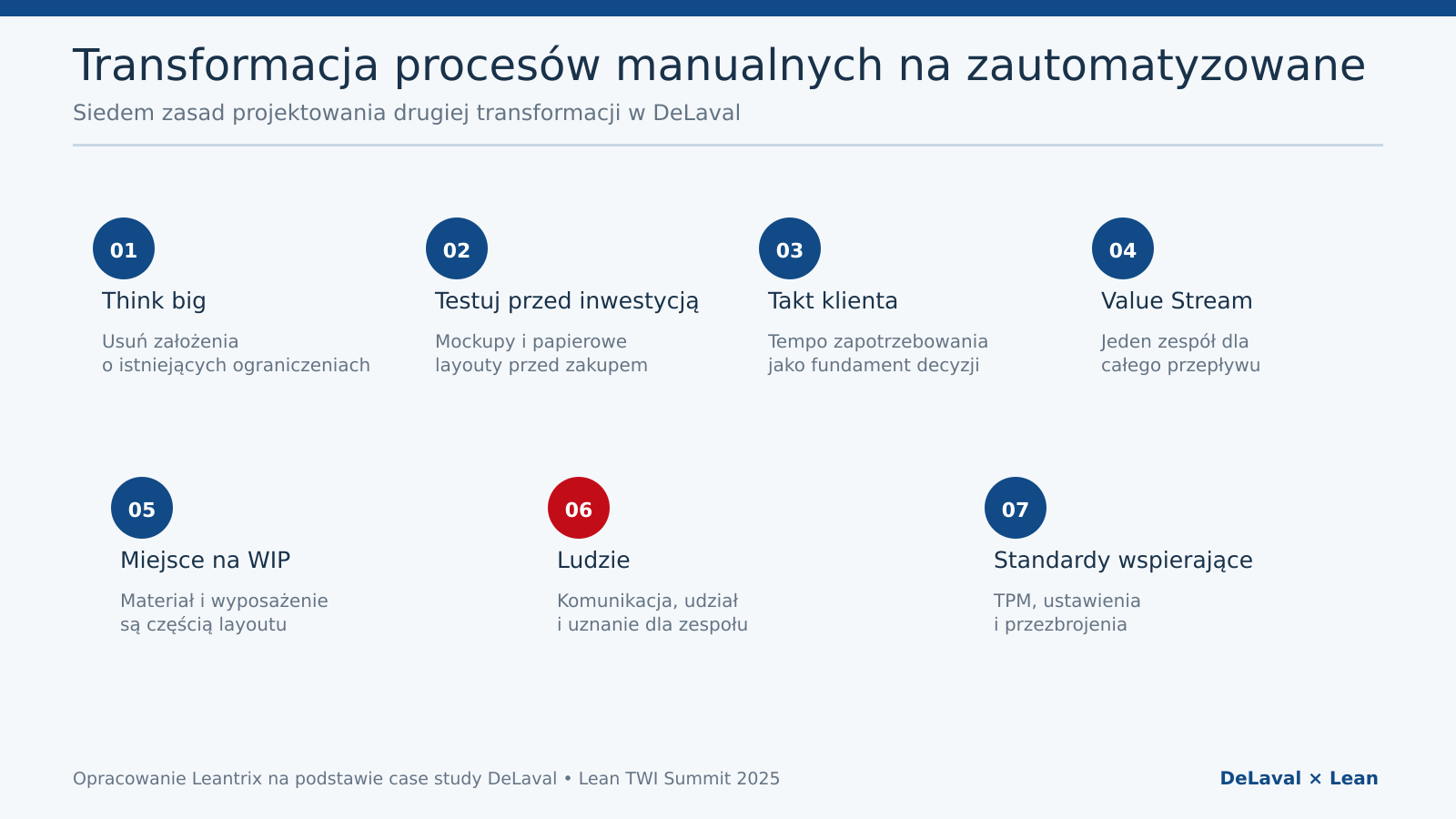
- Think big. Design began by simplifying the layout as far as possible and temporarily setting aside current-state constraints.
- Test before investing. Paper layouts and mock-ups enabled assumptions to be tested and errors corrected before they became embedded in machines and infrastructure.
- Customer takt as the foundation. Process workload and work-organisation options were analysed against the actual pace of demand.
- Value stream rather than local silos. The production team was organised around flow, allowing problems to be solved within one structure.
- Space for WIP. The layout included machines and planned space for material, equipment and buffers needed for stable operation.
- People deliver the change. The project included communication, employee preparation, change-management workshops and recognition of the team’s involvement.
- Standardising supporting processes. Continuous automated production required clear standards for TPM, settings, changeovers and quality checks.
Transforming manual processes through automation step by step
Planning used future-state VSM, workload analysis against takt, Muri, Yamazumi, PFMEA, layout workshops and multidisciplinary project work. The sequence mattered: the organisation first described its intended flow, then checked workload and risk, and only then embedded the solution in technology.
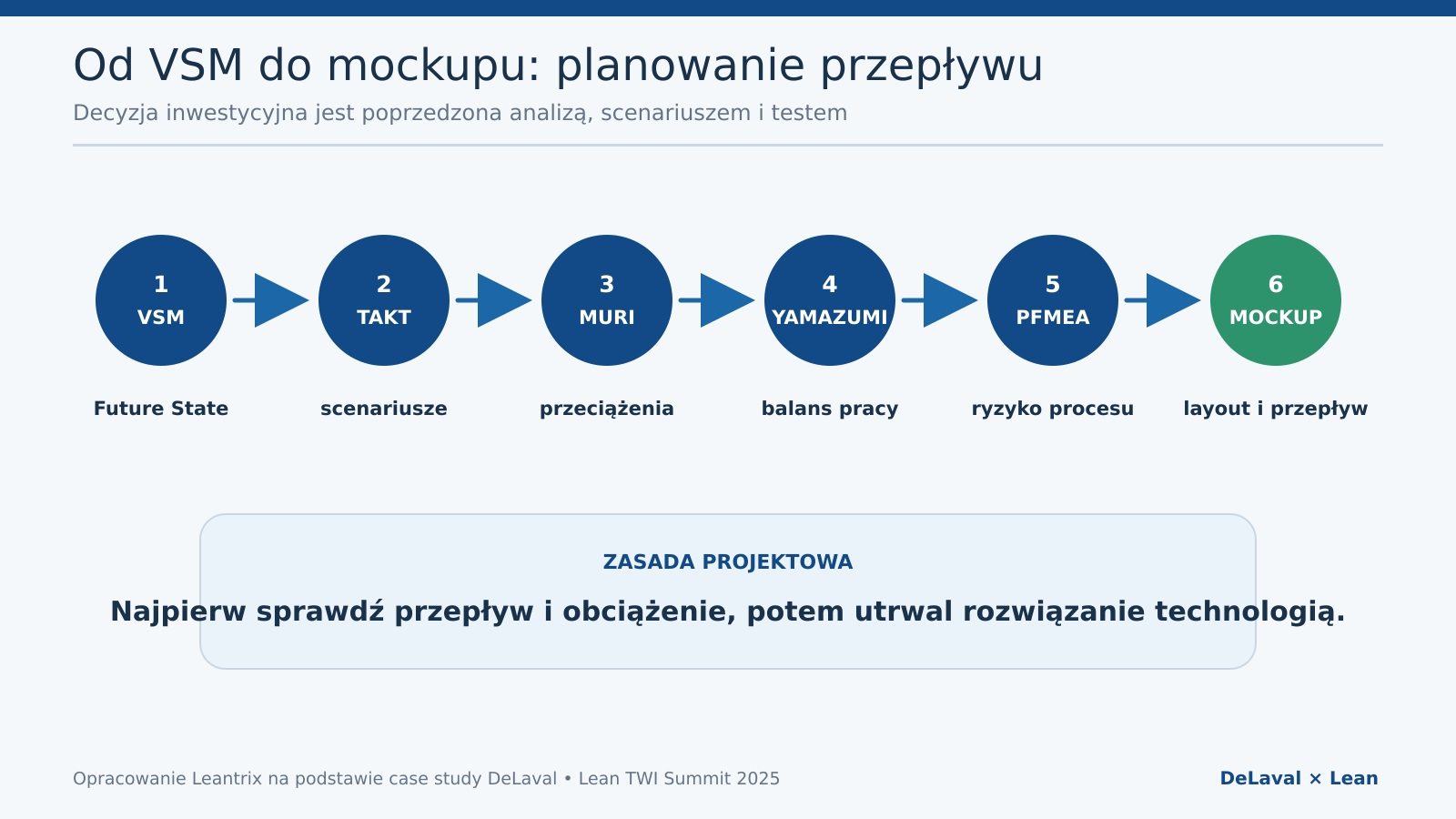
Future-state VSM and takt scenarios
The future value-stream map defined the intended material and information flow. Where takt was not yet clear, the team prepared several scenarios. The project therefore considered possible demand patterns instead of relying on one untested number.
Muri and Yamazumi: automation must not conceal overburden
Muri analysis helped identify overburden, while Yamazumi showed the distribution of manual, automated and parallel work. Comparing current and future states enabled the team to assess the balance of the entire process rather than the utilisation of a single machine.
PFMEA, ergonomics and mock-ups
PFMEA brought quality risks into the design phase. Ergonomic workstations, supermarkets, Kanban and TPM were elements of the future-state model rather than additions after launch. Mock-ups enabled rapid testing of reach distances, activity sequence, material space and operator working conditions.
Managing people and the project routine
The technical plan was supported by daily management routines. Teams held short stand-ups on the day’s plan and reviewed progress and bottlenecks weekly. Problems therefore surfaced before final acceptance of the installation.
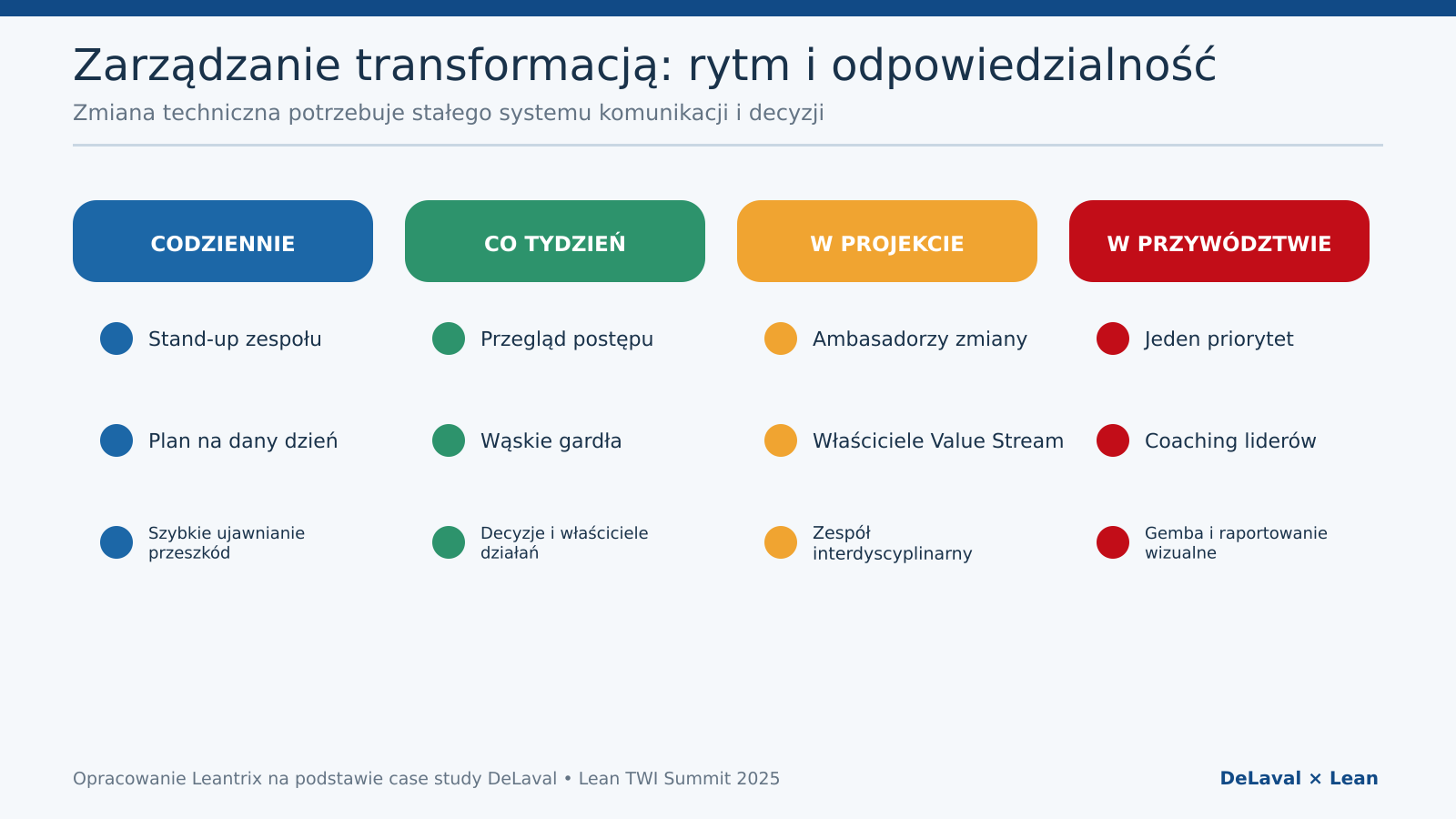
The “Change Ambassadors” programme and value-stream ownership strengthened accountability for the whole. The team also attended change-management workshops and communication training. Management maintained one priority, leadership coaching, Gemba Walks and visual reporting. This reduces the risk of automation remaining an engineering domain, with production receiving a finished solution only on launch day.
Automation changes the technology used to perform work. Transformation also changes flow, roles, decisions, capabilities and problem-solving.
Quality in the transformation of manual processes
Quality control was designed as a system rather than a single acceptance check. DeLaval used inspection instructions, FPY analysis, material sequencing, PFMEA, digital standardised work and TWI training. A pilot production run preceded full launch, with error analysis, a problem board and review meetings.
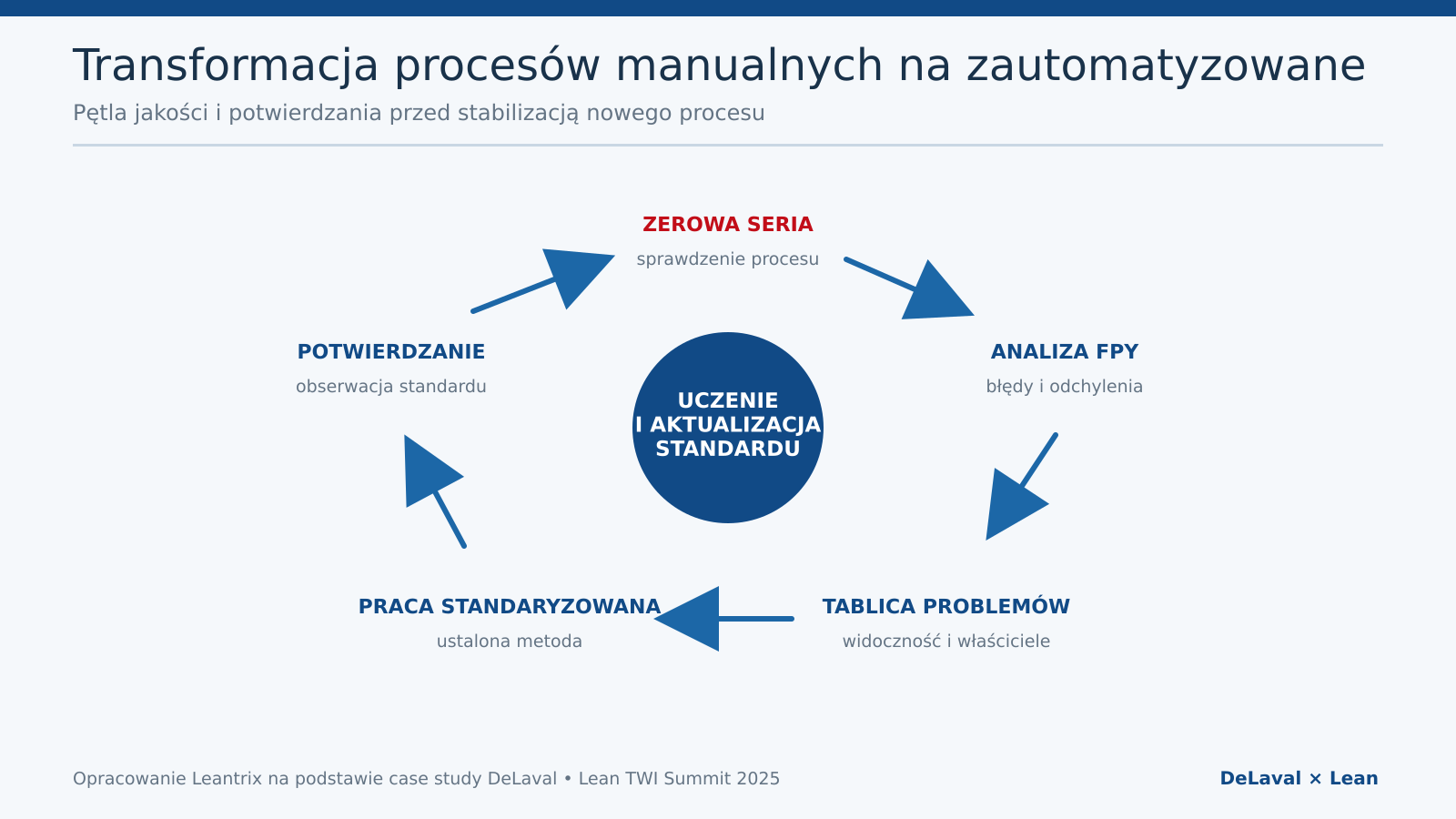
A technician responsible for the new press and robot processes played an important role. This provided practical support during transition: when a deviation occurs, the team needs someone who understands both technical assumptions and the operator’s actual work. A problem should not automatically be classified as human error before settings, material, method and process conditions have been checked.
Process confirmation: stabilising the new standards
Stabilisation began after launch. Process confirmation connected seven elements: 5S, the skills matrix, the Daily Control Board, problem-solving, VSM, standardised work and TPM. Their shared purpose was to check whether the designed working method was actually being followed and still produced the expected outcome.
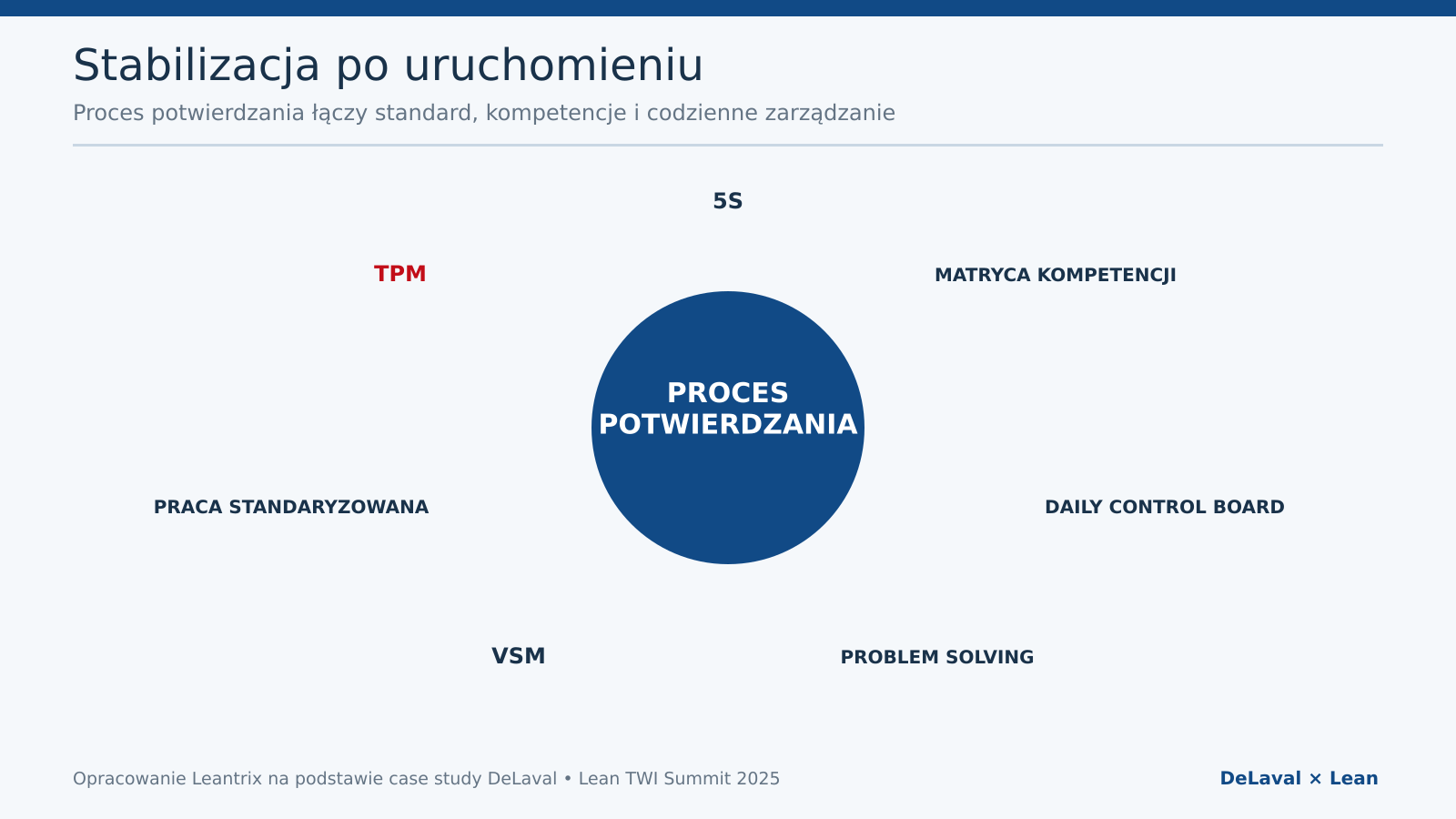
5S maintained the conditions needed for stable work. The skills matrix showed the team’s readiness to operate the new process. The Daily Control Board made deviations visible, while problem-solving structured responses. VSM protected the whole-flow perspective. Standardised work defined the best known method, and TPM protected equipment availability and basic operating conditions.
More about TPM and developing accountability can be found in the case study on implementing 5S and TPM at Asahi Group. The broader context of production-process improvement is available on Leantrix’s page about manufacturing (in Polish).
Where does TWI fit into the project?
The presentation identifies TWI as part of the advanced tools and training supporting digital standardised work. It is particularly relevant when moving from manual to automated processes. Operators must learn new activities as well as recognising normal conditions, responding to deviations, making settings and working with TPM and quality processes.
A work standard becomes useful when it supports effective employee training and observation of performance. TWI Job Instruction helps break work into important steps, key points and reasons. Read more about this approach on the Training Within Industry at Leantrix page.
What does the presentation not establish?
The conference material describes project delivery, methods and lessons from both transformations in detail. However, it does not present a complete set of comparable before-and-after indicators. We therefore do not attribute specific savings, productivity increases or FPY improvements to DeLaval that the presentation does not clearly report.
The case’s value lies in its decision structure: the organisation used lessons from the first stage to base the second on takt, flow, testing assumptions and preparing people. It provides a credible design lesson without needing a marketing promise about results.
Practical checklist: transforming manual processes through automation
- Define the business problem. Establish whether automation should improve stability, quality, safety, ergonomics, cost or access to capabilities.
- Establish takt and demand scenarios. Avoid designing capacity solely around historical batch sizes.
- Design the future state. Show the flow of material, information, WIP and accountability.
- Check Muri and work balance. Distinguish operator work, automated work and activities that can run in parallel.
- Build a mock-up. Verify ergonomics, reach, work sequence and material access before investing.
- Carry out PFMEA. Quality risk should influence process design as well as the later control plan.
- Prepare people. Plan communication, roles, instruction, a skills matrix and transition support.
- Run a pilot production batch. Collect problems, analyse FPY and update the standard before confirming the process.
- Design stabilisation. Connect 5S, the Daily Control Board, problem-solving, standardised work and TPM.
- Celebrate and benchmark. DeLaval closed the project with internal benchmarking and recognition of the team, enabling knowledge to transfer to other areas.
Key lessons from transforming manual processes through automation
- Transforming manual processes through automation should begin with flow and customer needs rather than a machine catalogue.
- An initial implementation can be a valuable experiment when the organisation identifies its limitations and applies the lessons in the next project.
- Layout must account for machines, people, material, WIP, equipment and supporting processes.
- Mock-ups, VSM, Muri, Yamazumi and PFMEA reduce the risk of embedding a flawed solution in expensive technology.
- Automation requires new capabilities, clear standards and prepared instructors.
- A pilot run and process confirmation turn launch into a controlled learning cycle.
- TPM, standardised work and daily management sustain the effect after the project ends.
DeLaval describes its mission as making sustainable food production possible. Information about the company’s solutions, automation and approach to sustainability is available on DeLaval’s official website.
FAQ: transforming manual processes through automation
Should automation begin by selecting a machine?
No. First define the problem, customer takt, intended flow and quality criteria. Then assess which technology best supports the designed process.
Why build a mock-up when a 3D model is available?
A digital model helps assess geometry, while a simple mock-up lets operators test reach, movement sequence, material access and ergonomics. The two tools can complement each other.
What role does customer takt play?
Takt translates demand into the pace around which work must be designed. It supports assessment of operational workload, required capacity and the balance between people and machines.
Does an automated process still need standardised work?
Yes. The scope of the standard changes. Settings, changeovers, responses to deviations, inspection, material replenishment, basic TPM activities and cooperation between operators and technicians become more important.
How can readiness for series production be checked?
A pilot batch, FPY analysis, a visible problem list, observation of work against the standard and formal process confirmation all help. Readiness encompasses technology, material, quality and team capabilities.
This article is based on materials presented by Bartłomiej Nowicki, Emilia Nazimek and Maria Majewska at Lean TWI Summit 2025 in Wrocław on 10–11 June 2025. Detailed project screens, workload charts and photographs of the plant interior were not reproduced; the illustrations were prepared as neutral editorial interpretations.