


Most elapsed time is spent waiting between operations, approvals or transport—not creating value.
Flow design · VSM · pull · levelling
Value stream improvement organises the complete flow of materials and information from customer demand to delivery. VSM makes the current and future state visible, Kanban controls work in progress through pull, and Heijunka levels volume and mix.
Value Stream Improvement – VSM, Kanban and Heijunka
We help cross-functional teams see the whole stream, identify the real sources of delay and redesign flow as one operating system—not as a collection of isolated Lean tools.
End to endfollow the product, service and information across functional boundaries
Pullreplenish from real consumption instead of pushing work into queues
PDCAturn the future-state design into tested changes and a stable standard

Start with the operating problem
When the process works locally but the value stream still does not flow
The signal is rarely one isolated bottleneck. It is usually a pattern of queues, excess work in progress, changing priorities and decisions that optimise departments rather than customer delivery.
Work is released faster than the system can complete it, hiding problems and tying up cash and space.
Plans change daily, priorities compete and managers spend time moving urgent work through the system.
Individual resources look efficient while total lead time, delivery reliability or throughput fails to improve.
The working logic
One flow system, several methods with different jobs
VSM, Kanban, Heijunka, FIFO, TOC and Just-in-Time are complementary. The design starts with the business need and the behaviour of the whole stream, then selects the mechanisms that solve the observed problem.
What each element contributes
The team links customer demand with process capability and makes explicit decisions about flow, buffers, replenishment, levelling and the system constraint.
- VSM: visualise the current state and define a coherent future state
- Kanban: limit work in progress and trigger replenishment from consumption
- Heijunka: level volume and mix where demand and process conditions allow it
- FIFO: preserve sequence and expose abnormal waiting between connected steps
- TOC: identify the constraint and protect the throughput of the whole system
- Just-in-Time: provide what is needed, when it is needed, in the required quantity
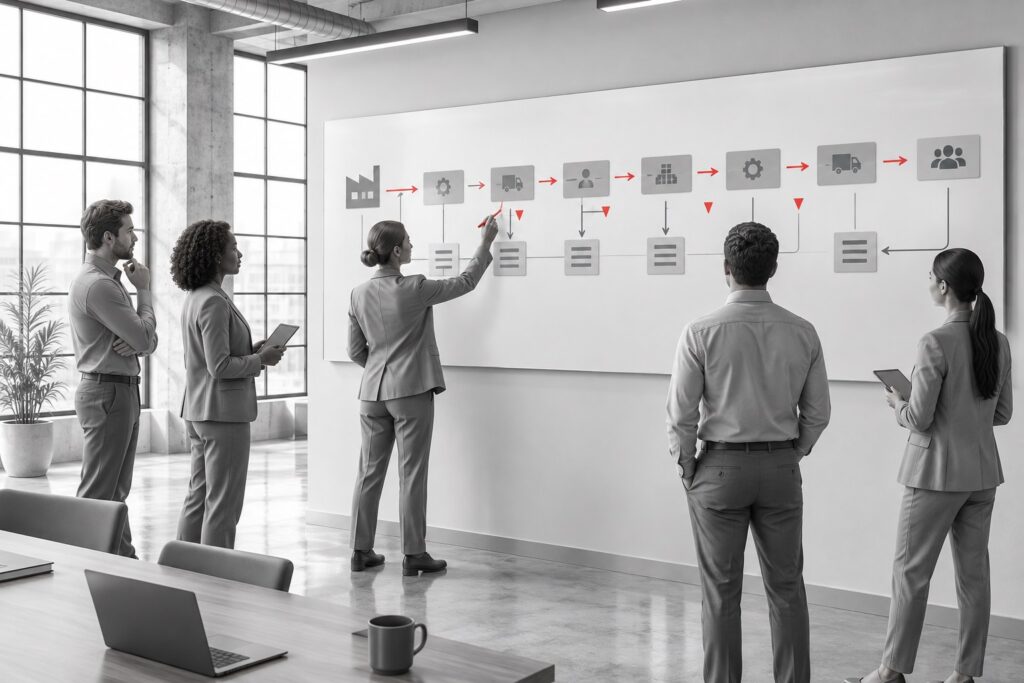
Work with facts from gemba
A future state is a management hypothesis, not a wall poster
The team follows one defined product or service family, captures actual demand, process time, waiting, WIP, information flow, quality losses and availability, and distinguishes observed facts from assumptions.
The future state then specifies how work should move, where pull or FIFO is needed, how the constraint is protected and which short PDCA experiments will test the design. Owners and review dates turn the map into an executable plan.
Pilot, learn, scale
From one value stream to a repeatable flow-improvement system
Start with a bounded stream and a measurable business need. Learn in the real process before extending the design to other families or areas.
Choose the stream and target
Define the customer, product or service family, boundaries, business problem and measures. Avoid mapping an organisation that is too broad to act on.
Map the current state in gemba
Observe the actual flow of work and information. Capture process data, queues, decisions, rework, constraints and demand rather than relying only on procedures.
Design and test the future state
Set the intended flow, pull, FIFO, levelling and buffer logic. Prioritise changes and test the highest-risk assumptions through short PDCA cycles.
Stabilise and scale
Standardise effective routines, assign ownership, review balanced measures and use what the pilot teaches before adapting the design elsewhere.
Management evidence
Measure flow, not isolated activity
A balanced set of measures should reveal whether the whole stream serves the customer better. Avoid targets that reward local utilisation or overproduction while queues grow elsewhere.
| Measure | What it reveals | Management question |
|---|---|---|
| Customer lead time | Elapsed time from an agreed demand signal to completed delivery. | Is value reaching the customer faster and more predictably? |
| WIP or inventory | Work waiting or moving between process steps. | Are pull limits and release rules reducing queues rather than relocating them? |
| On-time delivery | Orders or cases completed to the committed date and definition. | Has flow stability improved promise reliability? |
| First-pass yield and rework | How much work passes through the stream without correction or repetition. | Are faster flows also protecting quality? |
| Constraint throughput | Useful output generated by the system constraint in the relevant period. | Are improvement actions increasing total-system performance? |
Evidence, not decoration
Documented results—and a clear boundary around every claim
The strongest evidence states what was changed, which measures moved and whether the example is a direct VSM result or related operating-system evidence.
 Furniture industry · VSM + layout97 m to 47 m of operator travel per cycleThe documented project also shortened operator cycle time from 17 to 12 minutes, reduced visualised hazards from 10 to 2 and moved OEE from 62% to 67%—an increase of 5 percentage points.Read the case study →
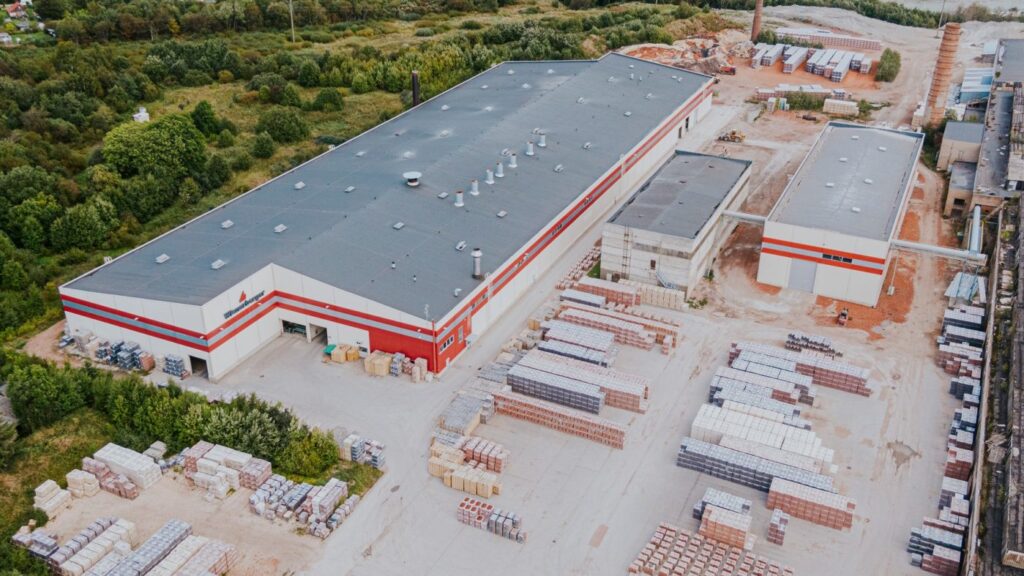 Related system evidence · WienerbergerStable work across 13 sites and 22 linesThis is TPM and TWI evidence rather than a stand-alone VSM result. It shows why a future-state flow design must be supported by reliable equipment, standards and workplace learning.Read the related case study →
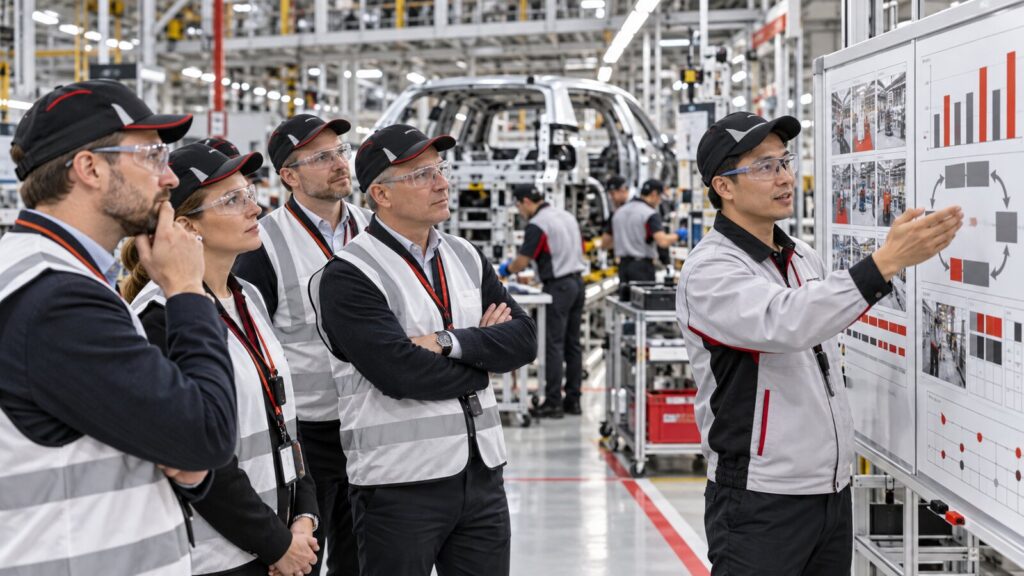 LeanTrix · evidence libraryImplementation evidence across industriesExplore documented Lean, TWI, TOC and operational-transformation programmes and the conditions that made the results sustainable.Explore the case-study library →
Signed client references and verified testimonials
See original client documents and named testimonials covering Lean, TWI, leadership development, quality and operational transformation.
People behind the work
Practitioners who connect the map with the operating system
The work combines value-stream diagnosis, material-flow design, implementation discipline and capability building—not workshop facilitation alone.
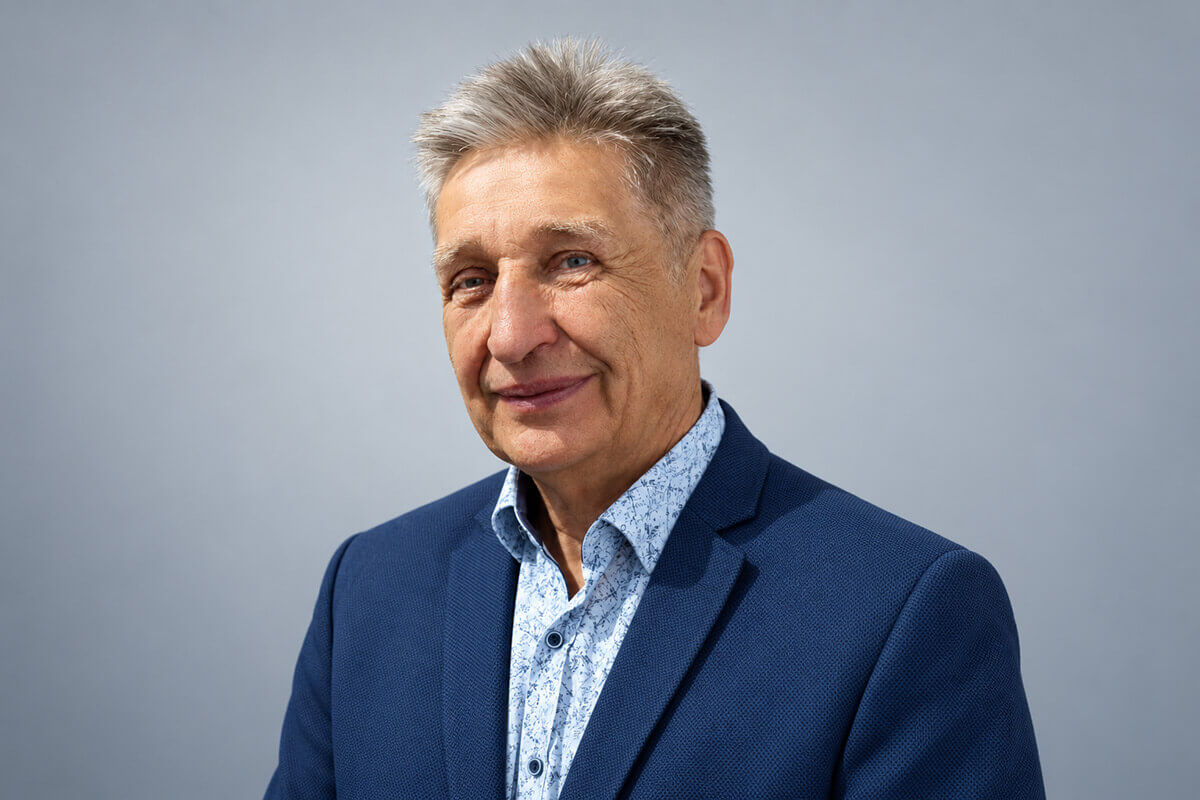
Andrzej Bielewski
LeanTrix VSM and flow-improvement practitioner who helps cross-functional teams turn current-state facts into an executable future-state plan.
View expert profile →
Rafał Wrona
LeanTrix practitioner combining TWI, SMED, Six Sigma, problem solving, TPM, VSM and material-flow experience.
View expert profile →Connected capabilities
Continue with a related method
A strong operating system links flow, standard work, leader routines and problem solving instead of treating each method as a separate initiative.
FAQ
Questions about VSM and value stream improvement
The right scope, data and implementation rhythm matter more than producing a visually impressive map.
What is value stream improvement?
It is the systematic redesign of the complete material and information flow from customer demand to delivery. It uses methods such as VSM, pull, FIFO, levelling and constraint management to improve end-to-end performance.
How is VSM different from a standard process map?
A process map usually describes activities and decisions. VSM also connects them with demand, elapsed time, process time, WIP, information signals and the intended future-state flow, so it supports system-level design.
How do VSM, Kanban and Heijunka fit together?
VSM helps the team see the stream and design the future state. Kanban controls replenishment and limits WIP through pull. Heijunka levels volume and mix where the demand pattern and process capability make levelling useful.
Is VSM only for manufacturing?
No. The same end-to-end logic can be used in logistics, offices and services, provided the team defines the customer, unit of flow, demand signal, queues, hand-offs and completion criteria.
What data do we need before a workshop?
Start with actual demand, available time, process and waiting times, WIP, quality losses, availability, staffing, changeovers and the information used to release or prioritise work. Missing data can be measured in gemba rather than estimated silently.
Will Kanban alone fix a long lead time?
Not necessarily. Kanban can limit WIP and create a pull signal, but it will not by itself solve unstable processes, poor quality, an unmanaged constraint, unsuitable batch rules or a layout that prevents flow.
How long does implementation take?
It depends on the stream, data quality, technical changes and decision speed. A useful approach is to establish a bounded pilot, test the highest-risk assumptions quickly and scale only after the new rules work in daily operations.
Start with the business problem
Turn the value-stream map into a working flow system
Bring us the stream that has too much WIP, missed commitments or constant expediting. We will help define the right boundary, verify the facts and choose a practical first implementation step.
Free consultation
We first understand the process, expected result and implementation conditions. Then we propose the right expert and a practical next step.
Discuss your challenge