


Specifications exist, but the operator cannot see which job details create the quality result or why they matter.
Quality at source · proprietary LeanTrix method
TWI Job Quality is LeanTrix's proprietary extension of TWI learning logic for built-in quality. It is not one of the original U.S. TWI Job programs. The method combines clear work standards, hands-on instruction, workplace observation and PDCA with quality-at-the-source practices.
TWI Job Quality – Build Quality at the Source
Translate product and process requirements into behaviour people can learn, observe and improve at the workplace. TWI Job Quality connects quality points, OK/NOK criteria, operator self-checks and a clear reaction to nonconformity.
4 stepsPrepare requirements, teach quality, control the process and improve continuously
3 self-check pillarsWork instruction, defect catalogue and physical or visual OK/NOK samples
LeanTrix-developedA proprietary extension inspired by TWI learning logic—not a historical official TWI module
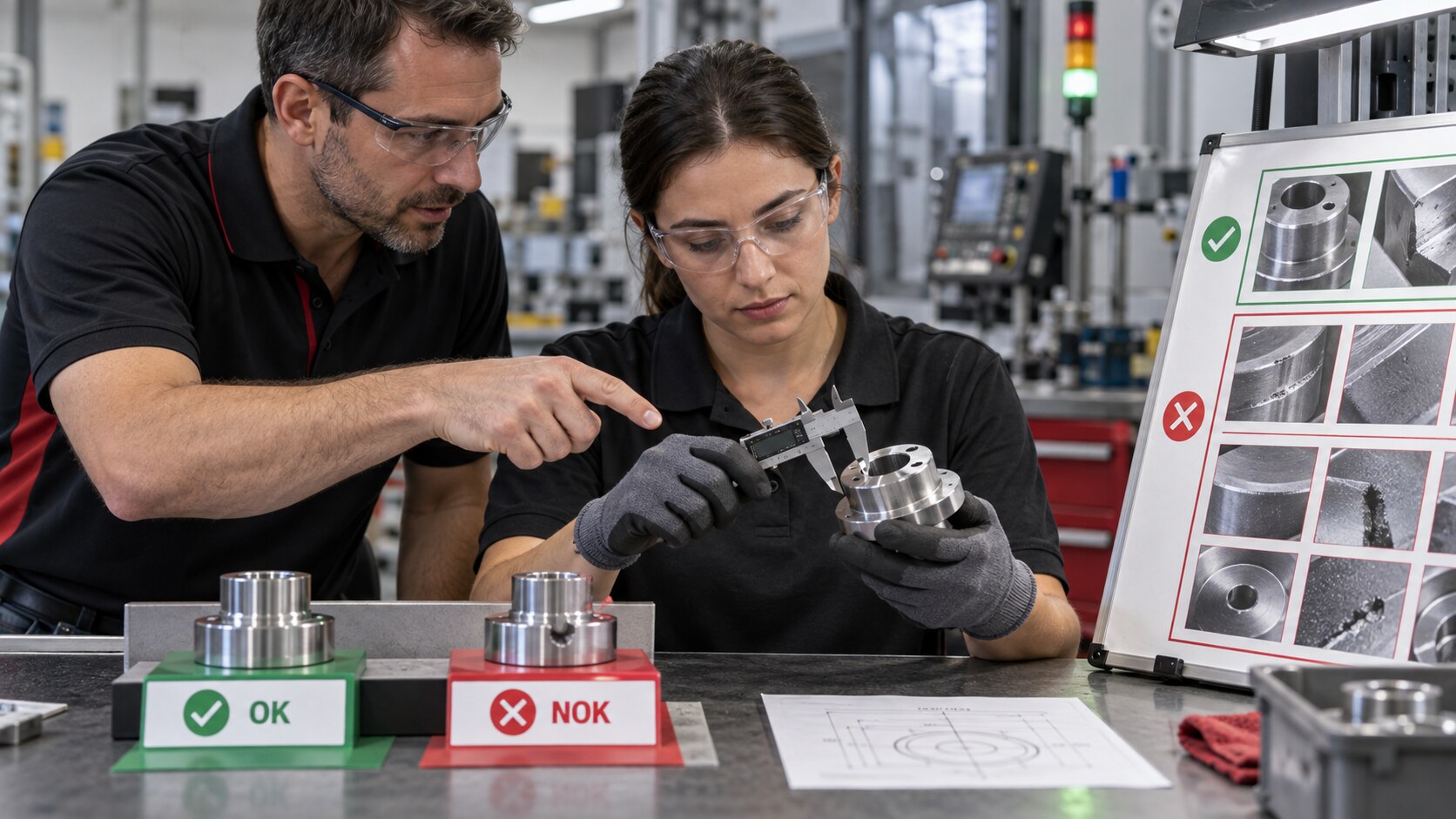
Start with the operating problem
When inspection finds defects after value has already been lost
Final control and quality documentation remain important, but they cannot replace competence at the point where the product or service is created.
Teams rely on memory or opinion because acceptance criteria, defect catalogues and boundary samples are missing or outdated.
Self-checks and stop-escalate-protect routines do not identify abnormality where it originates.
The defect is repaired, but instruction, poka-yoke, process settings and work standards are not improved.
The working logic
Four steps connect competence with process control
The method turns quality requirements into observable work, a practical learning process and a standard reaction when the condition is not acceptable.
Prepare, teach, control and improve
Quality is built at source when people understand what is critical, can distinguish an acceptable condition from a defect, perform the correct self-check and trigger a defined response before the abnormality moves downstream.
- Prepare the process, product and workplace requirements
- Identify key quality points and the reasons behind them
- Define special characteristics and unambiguous OK/NOK criteria
- Teach with real examples, defects and boundary samples
- Develop operator self-checks within the normal work cycle
- Specify stop, protect, escalate and containment actions
- Observe performance and confirm competence at the workplace
- Improve standards, poka-yoke and instruction through PDCA
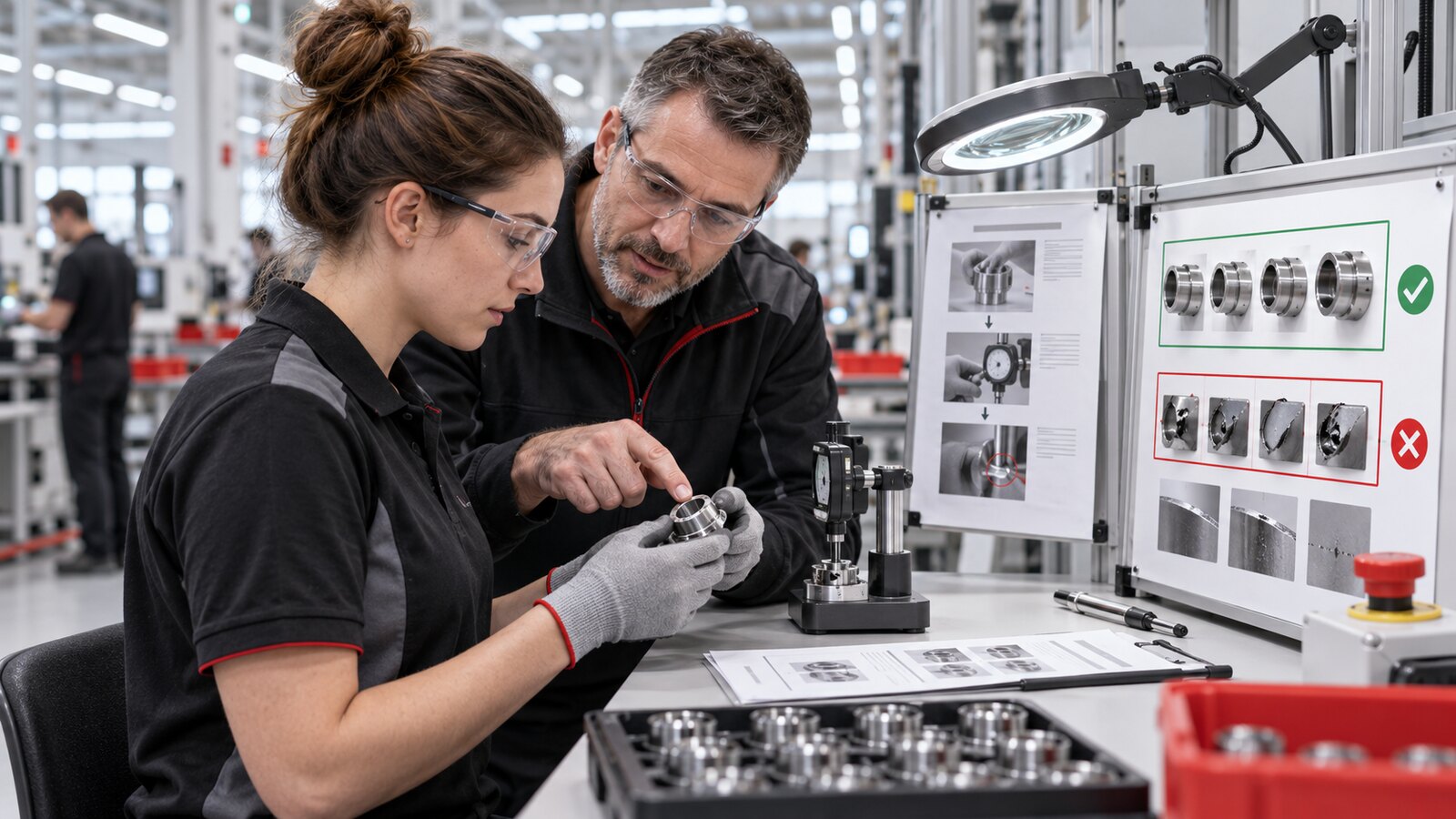
Built-in quality
Three pillars make operator self-check practical
The first pillar is a work instruction that identifies key quality points and explains the reasons behind them. The second is a defect catalogue that gives the team a shared language. The third is a set of physical or visual OK/NOK samples, including boundary conditions where judgement is most difficult.
Together, these elements support a predictable decision: continue, correct within the standard, or stop and escalate. The team leader then protects the process, verifies competence and uses recurring abnormalities to improve the standard rather than normalise the defect.
Pilot, learn, scale
Pilot at one quality-critical operation, then scale
The fastest way to test the method is to select a process with known defect modes, accessible data and a team willing to redesign both learning and reaction at the workplace.
Select the quality gap
Use defect, rework, complaint, audit and process-confirmation data to choose one meaningful pilot operation.
Translate requirements into work
Define quality points, reasons, special characteristics, OK/NOK criteria, samples and the reaction standard.
Train and confirm competence
Prepare instructors and team leaders, teach through demonstration and practice, then observe performance in real work.
Improve and expand
Review FPY, source detection and escapes; strengthen standards and poka-yoke, then scale through a controlled replication plan.
Management evidence
Measure quality where it is created
Lagging measures such as complaints and scrap remain essential, but early indicators show whether competence, source detection and reaction are improving before the customer sees the effect.
| Measure | What it reveals | Interpretation guardrail |
|---|---|---|
| First Pass Yield | How much output meets requirements without repair or rework | Define the process boundary and rework treatment consistently |
| Defects detected at source | Whether abnormality is found where it is created | An initial increase can reflect better visibility rather than worse quality |
| Escape rate | How often a defect reaches the next process or customer | Track both internal and external escape points |
| Scrap, rework and complaints | The cost and customer impact of quality loss | Separate volume effects and classify the same defect mode consistently |
| Quality-competence coverage | Whether operators and leaders are confirmed on critical quality points | Do not equate course attendance with demonstrated workplace competence |
| Reaction and containment time | How quickly the process protects the customer after NOK is detected | A fast reaction does not replace permanent cause removal |
Evidence, not decoration
Related evidence from TWI, standard work and quality systems
These sources demonstrate measurable results from TWI, workplace learning and standardisation. Unless a source explicitly says otherwise, they are related evidence—not claims that the client implemented LeanTrix's proprietary TWI Job Quality method as a stand-alone programme.
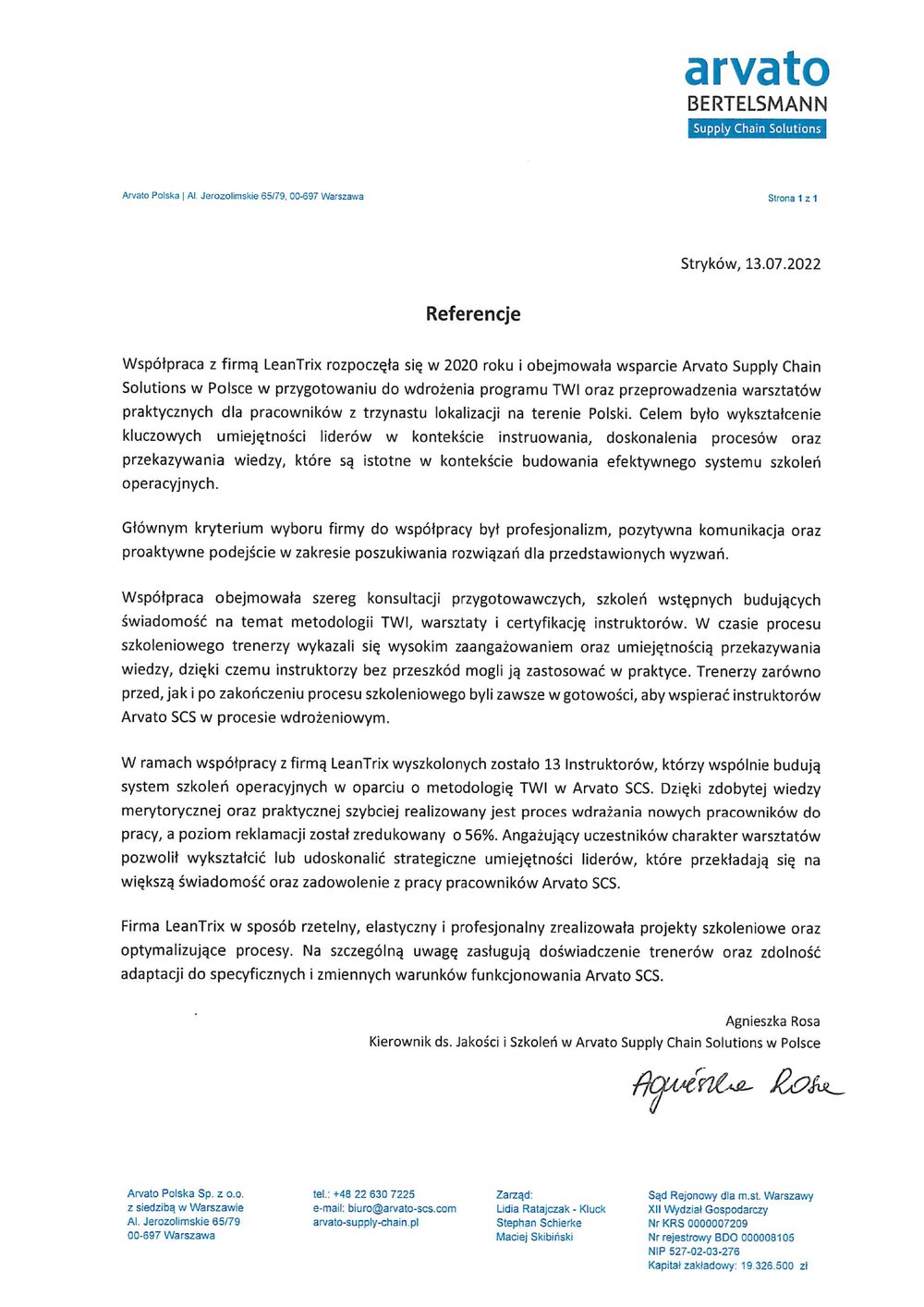 Arvato · signed TWI reference56% fewer complaints and faster onboardingThe signed reference reports 13 trained instructors, faster onboarding and 56% fewer complaints. It documents a broader TWI system and is not labelled as a stand-alone TWI Job Quality deployment.Read the English translation and signed original →
 Cooper Standard · related TWI evidenceScaled capability with measured quality resultsThe English case documents a multi-plant TWI and Lean transformation with measurable quality and productivity outcomes. It is related evidence, not presented as an isolated TWI Job Quality implementation.Read the English case study →
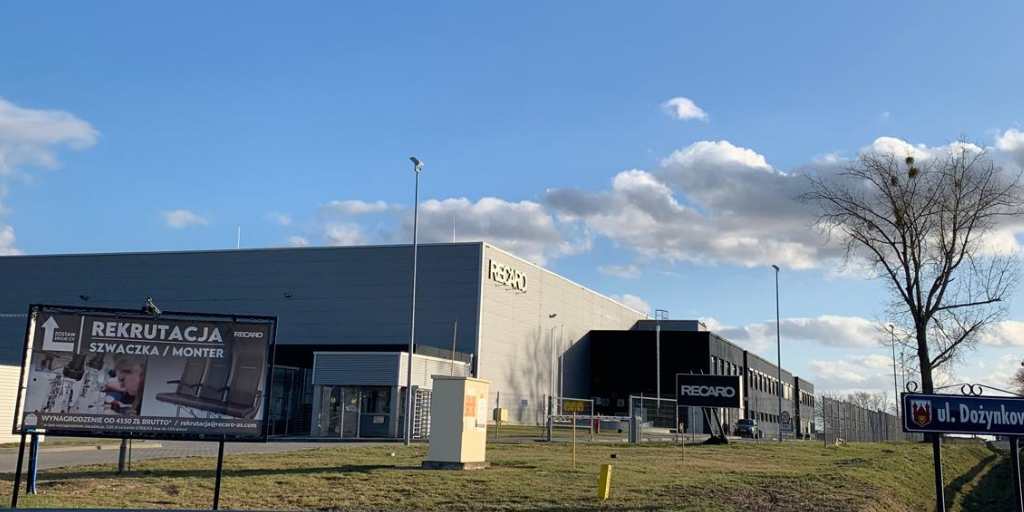 RECARO · related standard-work evidenceFaster learning with fewer errors and reworkThe case connects teachable standards with faster onboarding and lower error-related rework. It illustrates the wider system around quality at source without being labelled a TWI Job Quality deployment.Read the English case study →
Signed client references and verified testimonials
See original client documents and named testimonials covering Lean, TWI, leadership development, quality and operational transformation.
People behind the work
TWI and quality-system expertise in one implementation team
LeanTrix combines the authors of the proprietary method, practical TWI implementation experience and formal quality-system discipline so that standards work both in the process and in governance.

Dr Bartosz Misiurek
LeanTrix CEO and TWI Master Trainer. He builds scalable systems for standard work, workplace learning and operational capability.
View expert profile →
Kamil Müller
LeanTrix Board Member and TWI Master Trainer working with leaders, instructors and frontline teams on standard work and improvement.
View expert profile →
Dr Marcin Paska
Quality and management-systems practitioner working with ISO, IATF, risk, audit readiness and disciplined problem solving.
View expert profile →Connected capabilities
Continue with a related method
A strong operating system links flow, standard work, leader routines and problem solving instead of treating each method as a separate initiative.
FAQ
TWI Job Quality – frequently asked questions
The first question makes the method's origin explicit; the remaining answers cover purpose, roles, implementation and measurement.
Is TWI Job Quality an original official TWI module?
No. TWI Job Quality is LeanTrix's proprietary extension inspired by TWI learning logic. It is not one of the original U.S. TWI Job programs. LeanTrix developed it to connect workplace learning with built-in quality, self-checks and reaction to nonconformity.
What business problem does TWI Job Quality address?
It addresses the gap between documented quality requirements and what people can recognise, execute and respond to at the workplace. The objective is earlier detection, fewer escapes and stronger process learning.
How is TWI Job Quality different from final inspection?
Final inspection detects some defects after work has been completed. TWI Job Quality develops standards, competence, self-checks and reaction where quality is created, while final inspection remains one element of the wider control system.
What are the four steps of the method?
Prepare the process, product and workplace; deliver quality training; control the process through self-check and reaction; and continuously improve standards, error-proofing and the way work is performed.
What are the three operator self-check pillars?
A work instruction with quality points and reasons, a defect catalogue, and physical or visual OK/NOK samples. Together they make judgement and response more consistent.
Does the method replace PFMEA, control plans or ISO and IATF requirements?
No. It helps translate their relevant requirements into observable workplace behaviour, instruction and reaction. Formal quality planning and management-system obligations remain in force.
Who owns TWI Job Quality in daily work?
Operators perform standard work and self-checks; team leaders maintain the standard and confirm competence; Quality and TWI trainers translate requirements into teachable work and improve the system together.
How does implementation begin?
Start with one quality-critical operation, a known defect family and available evidence. Define quality points and reaction, build the learning materials, train the team and evaluate source detection, escapes, FPY and competence before scaling.
Start with the business problem
Turn quality requirements into reliable workplace decisions.
Bring one quality-critical operation, its known defect modes and the current instruction or control plan. We will help you assess whether a TWI Job Quality pilot can strengthen competence, source detection and reaction without creating another parallel system.
Free consultation
We first understand the process, expected result and implementation conditions. Then we propose the right expert and a practical next step.
Discuss your challenge