




























Why do you need this service?

A maintenance audit connects technical machine analysis with business priorities. We do not begin by creating identical plans for every machine. Our Lean Maintenance approach assesses machine criticality, while the Theory of Constraints (in Polish) identifies bottlenecks whose availability determines overall process performance.

What does a maintenance audit check?

  • Machine criticality and the effect of breakdowns on flow, safety, quality and customers.
  • OEE and its components, particularly availability and performance.
  • Breakdowns, microstoppages, MTBF, MTTR, backlog and planned inspection adherence.
  • Autonomous and planned maintenance maturity.
  • Cleaning, inspection, lubrication, adjustment and deviation-response standards.
  • Spare parts requests, ordering, storage and replenishment.
  • Operator, technician and maintenance leader competence.
  • KPI management, audits and TPM improvement.

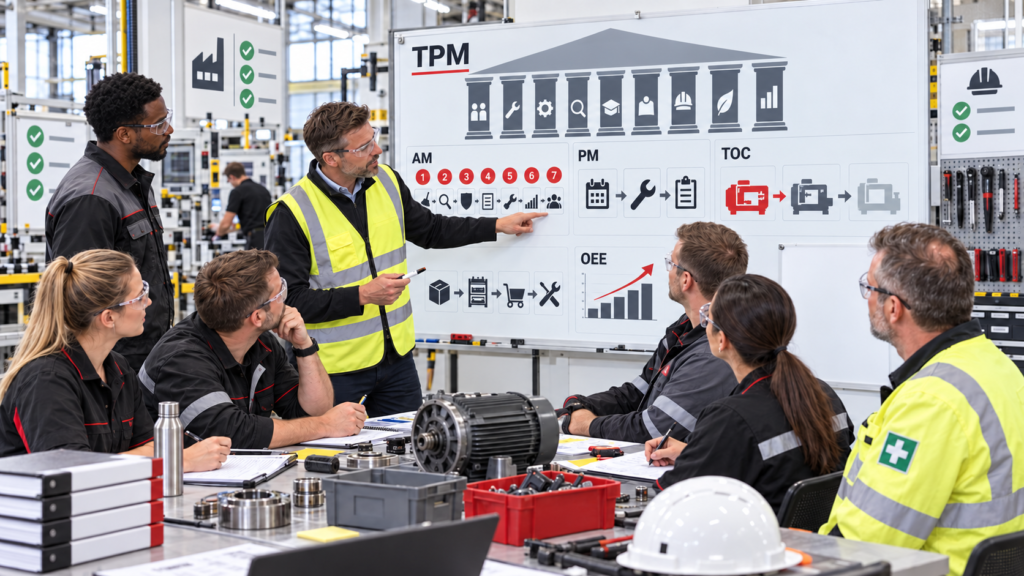
Eight TPM pillars covered by the audit

We assess the organisation as a whole through the eight Total Productive Maintenance pillars:

  • Focused improvement: eliminating specific losses and root causes.
  • Autonomous maintenance: operators’ everyday care for equipment condition.
  • Planned maintenance: data-based preventive and predictive maintenance.
  • Quality maintenance: preventing equipment-related defects.
  • Early equipment management: designing and purchasing machines that are easy to operate and maintain.
  • Education and skill development: training operators, technicians and leaders.
  • Safety, health and environment: safe work and risk elimination.
  • Office TPM: efficient planning, purchasing, data and support processes.

Explore the complete TPM—Total Productive Maintenance system and how it connects operators’, maintenance teams’ and leaders’ responsibilities.

We have completed more than 40 maintenance audits. Our recommendations combine TPM, TWI and TOC into one plan for improving OEE and critical machine utilisation. Also explore the Asahi Group 5S and TPM case, OEE improvement at Czanieckie Makarony and our TWI Job Instruction approach.

Audyt utrzymania ruchu i analiza maszyn krytycznych w Gemba – Leantrix
Projektowanie TPM i rollout autonomicznego oraz planowego utrzymania ruchu – Leantrix

What is our role?

Our role is to build a maintenance system that focuses resources where they have the greatest effect on flow and organisational performance. The audit ends with a practical roadmap from a critical-machine pilot to TPM rollout across the equipment base.

  • We create a Lean Maintenance machine criticality matrix.
  • We identify process bottlenecks through the Theory of Constraints.
  • We observe the gemba and analyse OEE losses and microstoppages.
  • We assess all eight TPM pillars and programme management.
  • We design the seven autonomous maintenance steps and planned maintenance process.
  • We organise inspections, backlog, spare parts and production and maintenance responsibilities.
  • We build work standards and training using TWI Job Instruction.
  • We establish KPIs: OEE, availability, performance, MTBF, MTTR, plan adherence and operator task duration.
  • We run the pilot, audit standards and reduce maintenance task time through Kaizen.
  • We prepare rollout from critical to medium- and low-criticality machines.

A handful of facts

0
+ maintenance audits completed
0
average OEE improvement (%)
0
improvement in critical machine utilisation (%)

Implementation support

We provide support based on the Kata process, which allows us to adapt our activities to the specifics of your organization, taking into account the jointly set goals. The Kata process consists of four key elements that enable effective implementation of assumptions.

Determining the course of action

Designing a concept that responds to the organization's goals and challenges.

Determining the current state

Learning about the current situation and collecting input data to define the next step.

Determining the target state

Determining the desired and measurable end result and a plan for its implementation.

Experiments - consultations

Implementation of activities in accordance with the established cooperation model, based on PDCA cycles.

We operate according to PDCA

P

PLAN

  • Define the audit’s business objective and expected flow improvement.
  • Develop machine criticality criteria and a matrix using Lean Maintenance.
  • Identify the bottleneck and resources constraining process throughput.
  • Select the pilot machine or line with the greatest effect on performance.
  • Collect OEE data: availability, performance, quality, breakdowns and microstoppages.
  • Analyse MTBF, MTTR, backlog, inspection plans and maintenance costs.
  • Review spare parts ordering, storage and availability.
  • Assess roles, skills, safety and the maturity of all eight TPM pillars.
  • Agree the pilot scope, KPIs, team and action schedule.

D

DO

  • Observe machines, operators and maintenance teams in the gemba.
  • Build an OEE loss tree and analyse breakdowns and microstoppages.
  • Restore basic equipment operating conditions and tag abnormalities.
  • Implement the seven autonomous maintenance steps: initial cleaning; eliminate contamination sources and hard-to-access areas; cleaning and lubrication standards; general inspection; autonomous inspection; standardisation; full self-directed maintenance and improvement.
  • Design planned maintenance using criticality, breakdown history and technical data.
  • Organise spare parts processes, stock levels and reorder points.
  • Create standards for cleaning, inspection, lubrication, adjustment and responses to deviations.
  • Prepare operator instructions and training using TWI Job Instruction.
  • Develop focused improvement, quality maintenance, education, safety, early equipment management and office TPM pillars.
  • Launch visual management, TPM boards, audits and team routines.

C

CHECK

  • Verify adherence to autonomous and planned maintenance standards.
  • Compare OEE before and after the pilot, particularly availability and performance.
  • Check changes in breakdown and microstoppage frequency and duration.
  • Analyse MTBF, MTTR, inspection plan adherence and backlog.
  • Assess TPM’s effect on bottleneck throughput.
  • Audit standard quality, operator competence and TWI training effectiveness.
  • Check spare parts availability and ordering lead time.
  • Measure operator task duration—for example, reducing a maintenance standard from 10 to 5 minutes through Kaizen.
  • Identify causes of deviations and further improvement experiments.
  • Review all eight TPM pillars and programme management.

A

ACT

  • Update standards using pilot and audit findings.
  • Establish the best autonomous and planned maintenance methods.
  • Continue reducing cleaning, inspection and lubrication time while maintaining quality.
  • Adjust inspection frequency to breakdown and criticality data.
  • Improve spare parts processes and inventory management.
  • Develop the skills matrix, trainers and TPM education system.
  • Standardise KPIs, boards, meeting rhythms and responsibilities.
  • Roll out solutions from the most critical machines to medium-criticality equipment.
  • Extend standards to low-criticality machines and the full equipment base.
  • Review criticality, bottlenecks and further OEE opportunities regularly.

Want to learn more? Contact us!

    Name and surname *
    Email address *
    Phone number *

    What are you interested in? *

    Additional message (optional)

    * required fields


    Our clients

    Wedel
    Geberit
    Viessmann
    Lajkonik
    Sumito Electric
    Tarczyński
    Autoliv
    Stadler
    UPM Raflatac
    Jost
    BSH
    Danone
    e-obuwie
    Kompania Piwowarska
    Recaro
    Tenneco
    Titanx
    ABM Leantrix Lean Management TWI Toyota Kata TOC
    Amazon Leantrix Lean Management TWI Toyota Kata TOC
    blum Leantrix Lean Management TWI Toyota Kata TOC
    Ikano Leantrix Lean Management TWI Toyota Kata TOC
    Kruk Leantrix Lean Management TWI Toyota Kata TOC
    Lincoln electronic Leantrix Lean Management TWI Toyota Kata TOC
    Sanden Leantrix Lean Management TWI Toyota Kata TOC
    Serpol Leantrix Lean Management TWI Toyota Kata TOC
    Stock Leantrix Lean Management TWI Toyota Kata TOC
    Velux Leantrix Lean Management TWI Toyota Kata TOC

    Our Customers' Opinions