



























TWI Implementation Audit

Why do you need this service?

A TWI implementation audit is for organisations that have launched Training Within Industry but stopped at training, instructions or a single pilot. We identify why new leadership behaviours have not become part of daily management and what needs to change for TWI to influence results sustainably.

TWI is a leadership development system

Organisations frequently launch TWI programmes and often let them fade after the first kickoff. The most common mistake is equating TWI solely with writing work instructions and on-the-job training. Documentation matters, but it is one part of the system. In practice, TWI develops six complementary leadership capabilities:

We believe that strong relationships mean strong results. Technical and relational capabilities belong together. Leaders need to teach, improve, care for safety and quality, build partnership and respond to problems.

TWI implementation audit: where does the system get stuck?

The most common constraint is an incorrectly defined leadership role. We analyse organisational structure, the responsibilities of managers, supervisors, foremen and team leaders, span of control and actual time allocated to employee development. We check whether leaders have the skills, authority and management support needed to apply TWI.

During a TWI implementation audit, we also assess instructions and Job Breakdown Sheets, instruction practice, Kaizen, safety and quality standards, problem solving, team relationships and the instructor training and certification system. We examine current and desired culture through OCAI, because TWI works most effectively in an environment of partnership, cooperation and responsibility rather than a purely transactional culture.

In PLAN, we establish business and implementation KPIs: productivity, scrap and rework, time to independence, accidents and hazards, improvements, turnover, absence and leaders’ actual frequency of using TWI methods.

The result is a current-state diagnosis, causes of previous failures, a recommended pilot area, a competence map, programme management arrangements and a plan towards organisational autonomy. Explore the main Training Within Industry programme, the Certified TWI Trainer pathway (in Polish) and the VELUX TWI reactivation case study.

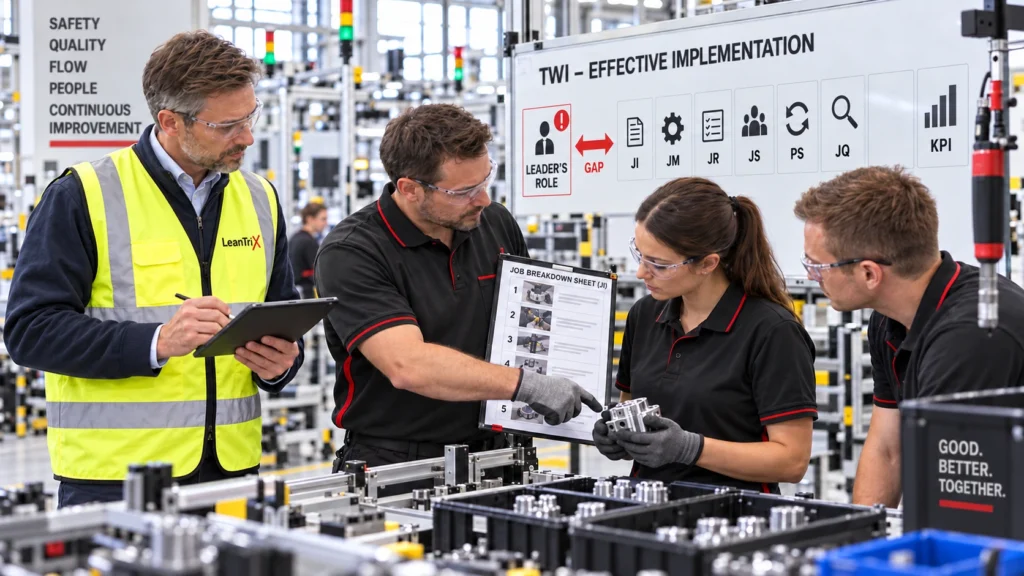
TWI – EFFECTIVE IMPLEMENTATION – LEADER'S ROLE – JOB BREAKDOWN SHEET (JI)
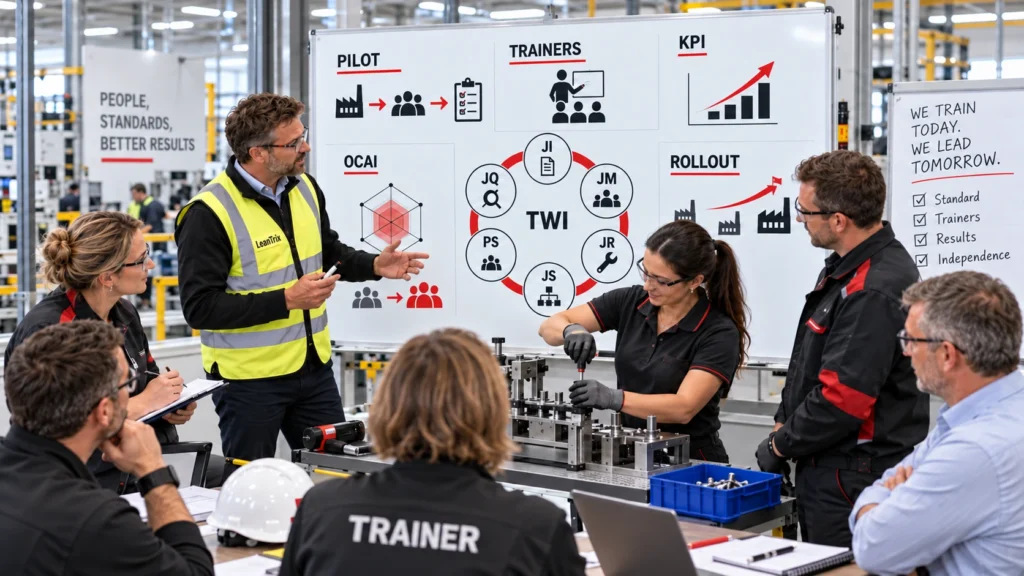
PILOT – TRAINERS – WE TRAIN TODAY. WE LEAD TOMORROW.

What is our role?

Our role is to turn TWI from a collection of training courses and forms into an everyday system for developing leaders and employees. We conduct the audit with management, HR, Lean, internal trainers, frontline supervisors and gemba employees.

  • We determine why the earlier implementation or kickoff failed to create lasting change.
  • We assess organisational structure and leaders’ actual role in team development.
  • We verify instructions, Job Breakdown Sheets and instruction quality.
  • We check practical use of six methods: JI, JM, JR, JS, PS and proprietary JQ.
  • We establish baseline KPIs and implementation outcome measures.
  • We assess OCAI culture and readiness to move from transactional relationships towards partnership.
  • We deliver kickoffs, workshops, training, consultation and coaching directly in the gemba.
  • We select a pilot area and jointly solve real organisational problems.
  • We develop leaders, instructors, practitioners and internal trainer candidates.
  • We transfer responsibility to the client team so the organisation achieves autonomy.
  • We verify outcomes, adjust the model and support rollout to further areas, plants and countries.

We draw on experience from more than 300 organisations in 12 countries. We evaluate implementation through business results, including productivity and defect levels, rather than the number of training sessions alone.

A handful of facts

0
+ organisations supported with TWI implementation in 12 countries
0
% average productivity improvement
0
% average defect reduction

Implementation support

We provide support based on the Kata process, which allows us to adapt our activities to the specifics of your organization, taking into account the jointly set goals. The Kata process consists of four key elements that enable effective implementation of assumptions.

Determining the course of action

Designing a concept that responds to the organization's goals and challenges.

Determining the current state

Learning about the current situation and collecting input data to define the next step.

Determining the target state

Determining the desired and measurable end result and a plan for its implementation.

Experiments - consultations

Implementation of activities in accordance with the established cooperation model, based on PDCA cycles.

We operate according to PDCA

P

PLAN

  • Define the business objective, audit scope, pilot area and expected outcomes.
  • Review the history of kickoffs, training, certification and previous TWI implementation attempts.
  • Analyse the organisational structure and the actual roles of managers, supervisors, foremen and team leaders.
  • Assess responsibilities, span of control and the time leaders have for teaching and developing employees.
  • Review instructions, Job Breakdown Sheets, skills matrices and instruction practices.
  • Assess current use of JI, JM, JR, JS, PS and the proprietary TWI Job Quality method.
  • Diagnose current and desired organisational culture using OCAI.
  • Establish baseline business and implementation KPIs for verification in the CHECK phase.
  • Select a sponsor, steering team, change leaders and internal trainer candidates.
  • Prepare the kickoff, communication, pilot plan and TWI implementation roadmap.

D

DO

  • Conduct a kickoff for management and leaders explaining the business purpose of TWI and expected KPIs.
  • Deliver practical workshops and training in TWI methods selected for the organisation’s real problems.
  • Improve instructions and Job Breakdown Sheets and conduct instruction directly at workstations.
  • Launch a pilot where improvement can quickly produce a visible business effect.
  • Coach leaders in teaching, improvement, relations, safety, problem solving and quality.
  • Develop and certify TWI instructors and practitioners using real processes.
  • Prepare candidates for the Train the Trainer pathway and programme ownership.
  • Bring supervisors, HR, Lean and management into one implementation management rhythm.
  • Collect KPI data, observations and feedback from the pilot area.

C

CHECK

  • Audit the actual application of TWI in the gemba alongside training numbers.
  • Verify leadership roles, available time, management support and daily behaviours.
  • Assess instruction and Job Breakdown Sheet quality and how employees are taught.
  • Compare productivity, defects, time to independence and other KPIs with the baseline.
  • Check the quantity and quality of improvements, hazard responses and problem solving.
  • Measure TWI understanding and leader engagement before implementation and after the pilot.
  • Compare OCAI profiles and assess progress from transactional relationships towards partnership.
  • Verify the competence of instructors, practitioners and internal trainer candidates.
  • Assess readiness to sustain the programme independently and continue rollout.
  • Report findings, gaps, outcomes and recommended adjustments to the TWI system.

A

ACT

  • Standardise the proven pilot model and integrate it into daily management.
  • Close gaps in leadership roles, responsibilities, workload and management support.
  • Transfer responsibility to certified instructors and internal trainers.
  • Maintain the rhythm of audits, coaching, KPI reviews and PDCA cycles.
  • Develop further TWI methods according to organisational maturity and business needs.
  • Continue strengthening a culture of partnership, cooperation and responsibility in line with OCAI.
  • Roll out to further teams, departments, plants, functions and international locations.
  • Build autonomy so the organisation can train, certify and develop successive generations of leaders itself.
  • Begin the next improvement cycle once pilot objectives have been achieved.

Want to learn more? Contact us!

    Name and surname *
    Email address *
    Phone number *

    What are you interested in? *

    Additional message (optional)

    * required fields


    Our clients

    Wedel
    Geberit
    Viessmann
    Lajkonik
    Sumito Electric
    Tarczyński
    Autoliv
    Stadler
    UPM Raflatac
    Jost
    BSH
    Danone
    e-obuwie
    Kompania Piwowarska
    Recaro
    Tenneco
    Titanx
    ABM Leantrix Lean Management TWI Toyota Kata TOC
    Amazon Leantrix Lean Management TWI Toyota Kata TOC
    blum Leantrix Lean Management TWI Toyota Kata TOC
    Ikano Leantrix Lean Management TWI Toyota Kata TOC
    Kruk Leantrix Lean Management TWI Toyota Kata TOC
    Lincoln electronic Leantrix Lean Management TWI Toyota Kata TOC
    Sanden Leantrix Lean Management TWI Toyota Kata TOC
    Serpol Leantrix Lean Management TWI Toyota Kata TOC
    Stock Leantrix Lean Management TWI Toyota Kata TOC
    Velux Leantrix Lean Management TWI Toyota Kata TOC

    Our Customers' Opinions