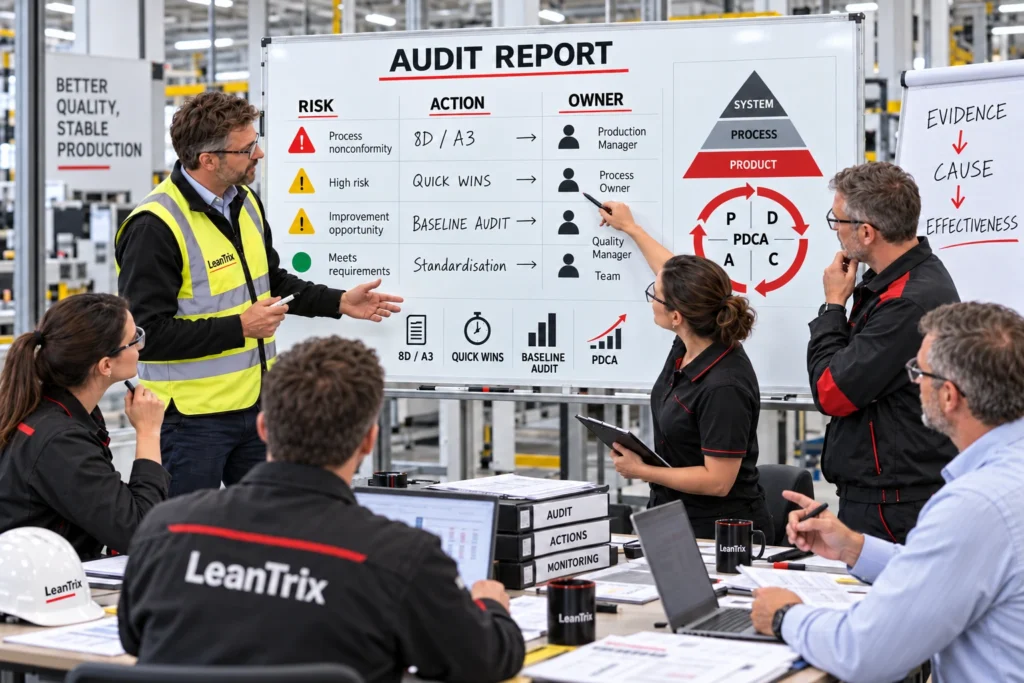
A quality management audit answers a fundamental question: does the system really protect the customer, the process and company performance, or does it merely look good in the documentation? We check compliance and, above all, effectiveness: decision-making, risk management, process stability and the organisation’s ability to prevent errors.
Quality management audit: ISO 9001 and IATF 16949 in practice
LeanTrix and QualiTeam experts conduct audits against the applicable requirements of ISO 9001 and, in automotive, IATF 16949, current Sanctioned Interpretations and FAQs and customer-specific requirements (CSR). We build the audit programme in line with ISO 19011:2026 guidelines, using a process approach, risk, auditor competence and objective evidence.
ISO 9001 provides a universal quality management foundation: customer focus, leadership, the process approach, evidence-based decisions and continual improvement. IATF 16949 extends this for automotive with requirements covering product safety, special characteristics, Core Tools, suppliers, contingency plans, complaints and OEM requirements, among other areas. We tailor the scope to the industry, product, location and audit objective.
What do we check during an audit?
- System, process and product: whether the three levels form one functioning mechanism.
- Leadership and quality objectives: their links with KPIs, management review and process owner accountability.
- Voice of the customer: contractual requirements and CSR, satisfaction, complaints, PPM, returns and warranties.
- Risk: product safety, special characteristics, traceability, changes and contingency plans.
- Core Tools consistency: the chain APQP → PFMEA → Control Plan → work instruction → MSA/SPC → PPAP.
- The process in the gemba: alignment of actual shift practices with agreed standards and records.
- Suppliers and outsourced processes: qualification, development, quality performance and risk response.
- Nonconformities and corrective actions: root cause analysis quality, 8D/A3, non-recurrence and evidence of effectiveness.
- The internal audit programme: scope, risk-based frequency, independence and auditor competence.
Depending on needs, we extend the quality management audit with a VDA 6.3 process audit, VDA 6.5 product audit, AIAG CQI special process assessments, a supplier audit or a rehearsal Audit 0 before certification.
What does the organisation receive?
The report goes beyond a list of comments. Each finding is linked to a requirement, objective evidence and business risk. The organisation receives a maturity map, priorities, quick wins, systemic actions, owners, deadlines and effectiveness measures. The quality management audit therefore begins improvement rather than ending as a one-off inspection.
Explore our support for ISO, IATF and VDA certification and implementation (in Polish) and Lean Six Sigma.