

























FMEA Training – AIAG & VDA PFMEA and DFMEA

Why do you need this service?

FMEA Training helps the team turn risk analysis from a mandatory document into a practical tool for preventing problems. In many organisations, an FMEA worksheet exists but does not reflect the actual process, is not updated after changes and does not lead to actions that reduce customer complaints, defects, rework and product launch risk.

The most common constraint is not a missing form but a lack of shared understanding of process functions, failure effects and the relationships between the flow diagram, PFMEA, the Control Plan, work instructions, MSA and SPC. Our FMEA Training therefore combines a short methodological introduction with facilitated analysis of an actual customer product or process.

When is FMEA Training worthwhile?

  • before launching a new product, process or machine, or transferring a line,
  • when the existing PFMEA or DFMEA is a formality, inconsistent or out of date,
  • after a customer complaint, major non-conformity, design change or supplier change,
  • when actions recorded in the FMEA have no owners, deadlines or confirmed effectiveness,
  • when the PFMEA, Control Plan and work instructions describe different risks and safeguards,
  • when the organisation is preparing to meet ISO 9001 or IATF 16949 requirements or for a process audit.

What does the service cover?

  • the seven-step AIAG & VDA approach,
  • analysis of structure, functions, failure modes, effects and causes,
  • assessment of risk and action priorities,
  • selection of prevention and detection actions,
  • connections between DFMEA, PFMEA, the Control Plan and work standards,
  • practice in facilitating a cross-functional team meeting,
  • rules for updating FMEA after changes and new experience.

We connect the service with the quality management system (in Polish) and, where a broader diagnosis is needed, with a quality management audit.

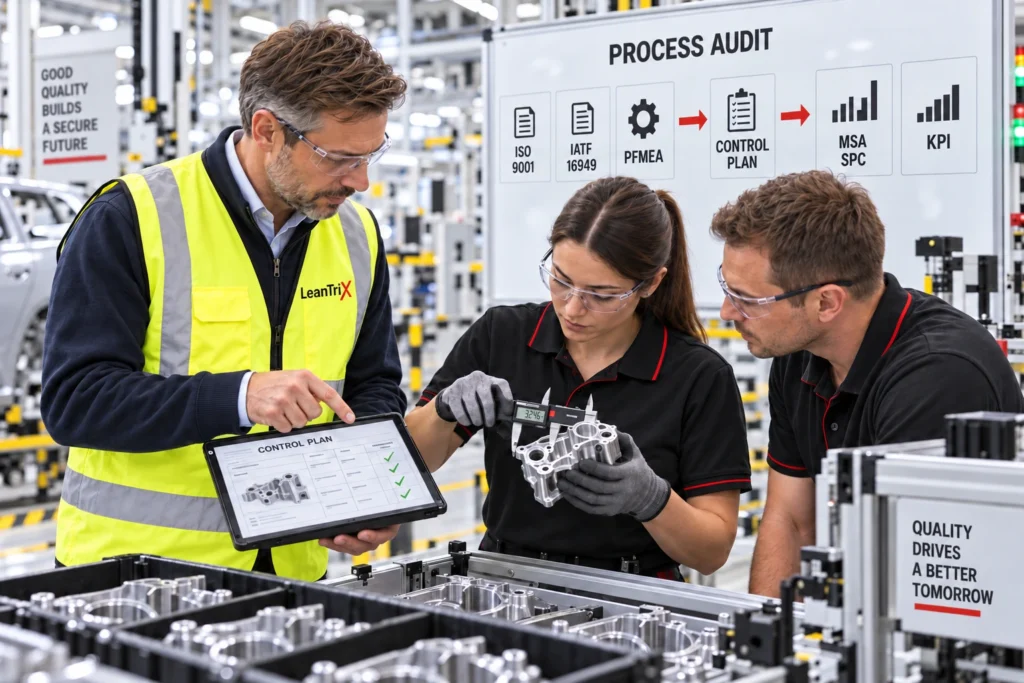
LeanTrix consultant and production team reviewing a process audit, control plan and quality measures.
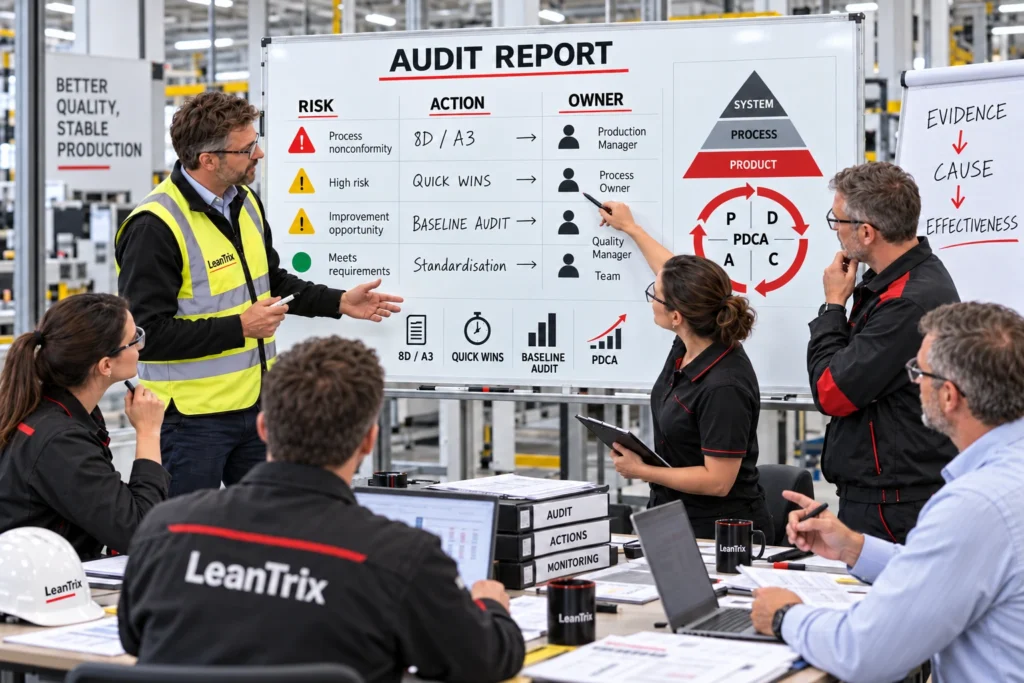
LeanTrix team reviewing an English audit report with risks, actions, owners and the PDCA cycle.

What is our role?

From training to a functioning risk analysis

The role of LeanTrix and its quality experts is to prepare the team to develop, facilitate and update FMEA independently. We work with the customer’s actual data, process and problems so that participants not only learn the terminology but also create a useful section of DFMEA or PFMEA.

During FMEA Training, we focus on cause-and-effect logic, language that production teams understand and the translation of risk into specific safeguards. We bring together the perspectives of quality, process engineering, design, production, maintenance, logistics and operators.

What does the organisation receive?

  • an agreed scope and prepared inputs,
  • a workshop based on a real example,
  • a section or complete FMEA analysis for the pilot area,
  • a list of actions with owners, deadlines and verification methods,
  • a standard for running meetings and updating the document,
  • recommendations for linking FMEA to the Control Plan and work instructions,
  • a plan for developing internal facilitators.

A handful of facts

0
steps in the AIAG & VDA FMEA approach
0
main applications: DFMEA and PFMEA
0
pilot area analysed using actual data

Implementation support

We provide support based on the Kata process, which allows us to adapt our activities to the specifics of your organization, taking into account the jointly set goals. The Kata process consists of four key elements that enable effective implementation of assumptions.

Determining the course of action

Designing a concept that responds to the organization's goals and challenges.

Determining the current state

Learning about the current situation and collecting input data to define the next step.

Determining the target state

Determining the desired and measurable end result and a plan for its implementation.

Experiments - consultations

Implementation of activities in accordance with the established cooperation model, based on PDCA cycles.

We operate according to PDCA

P

PLAN

Scope, team and criteria for a good FMEA

In the PLAN phase, we establish whether the objective is DFMEA, PFMEA or analysis of a specific change. We define the system or process boundaries, customer expectations, a shared language for assessing risk and the workshop outcome.

  • we select a product, product family or pilot process,
  • we gather the process flow diagram, requirements, customer complaints, defect history and audit data,
  • we appoint a cross-functional team and a facilitator,
  • we establish functions, interfaces and the appropriate level of detail,
  • we define KPIs, such as action completeness, on-time closure, defect levels and customer complaints,
  • we plan how to connect the analysis with APQP, the Control Plan, MSA, SPC and work standards.

D

DO

The seven AIAG & VDA steps applied to a real process

In the DO phase, we deliver FMEA Training and a facilitated workshop. The team works through planning and preparation, structure analysis, function analysis, failure analysis, risk analysis, optimisation, and documentation and communication of the results.

  • we build the product or process structure,
  • we describe functions and requirements in measurable terms,
  • we connect effects, failure modes and their root causes,
  • we assess existing prevention and detection actions,
  • we establish action priorities and owners,
  • we design safeguards, standards and additional measurements,
  • we update related documents and teach the facilitator how to lead the team.

C

CHECK

Consistency of the analysis and effectiveness of actions

In the CHECK phase, we verify not only the completeness of the worksheet, but above all the quality of the team’s reasoning and the presence of safeguards in the actual process.

  • we verify the chain: process flow – PFMEA – Control Plan – work instruction,
  • we check whether ratings follow evidence and shared criteria,
  • we monitor the timeliness and effectiveness of optimisation actions,
  • we confirm at the Gemba that safeguards actually function,
  • we analyse quality KPIs before and after implementation,
  • we assess the facilitator’s independence and the involvement of the cross-functional team.

A

ACT

An update standard and facilitator development

In the ACT phase, we embed the way of working so that FMEA remains a living part of risk management. We define events that trigger a review, version control, the owner’s responsibilities and periodic consistency audits.

  • we standardise the agenda, roles, assessment criteria and recording of decisions,
  • we create a quality checklist for DFMEA and PFMEA,
  • we update the Control Plan, instructions and reaction plan,
  • we develop further facilitators through subsequent projects,
  • we scale the approach to product families and further locations,
  • we connect FMEA with the Automotive Core Tools service.

This means that FMEA Training concludes with both participant knowledge and a ready-to-use approach to managing risk in the organisation.

Want to learn more? Contact us!

    Name and surname *
    Email address *
    Phone number *

    What are you interested in? *

    Additional message (optional)

    * required fields


    Our clients

    Wedel
    Geberit
    Viessmann
    Lajkonik
    Sumito Electric
    Tarczyński
    Autoliv
    Stadler
    UPM Raflatac
    Jost
    BSH
    Danone
    e-obuwie
    Kompania Piwowarska
    Recaro
    Tenneco
    Titanx
    ABM Leantrix Lean Management TWI Toyota Kata TOC
    Amazon Leantrix Lean Management TWI Toyota Kata TOC
    blum Leantrix Lean Management TWI Toyota Kata TOC
    Ikano Leantrix Lean Management TWI Toyota Kata TOC
    Kruk Leantrix Lean Management TWI Toyota Kata TOC
    Lincoln electronic Leantrix Lean Management TWI Toyota Kata TOC
    Sanden Leantrix Lean Management TWI Toyota Kata TOC
    Serpol Leantrix Lean Management TWI Toyota Kata TOC
    Stock Leantrix Lean Management TWI Toyota Kata TOC
    Velux Leantrix Lean Management TWI Toyota Kata TOC

    Our Customers' Opinions