



























External Audit of a Manufacturing Company

Why do you need this service?

An external audit of a manufacturing company provides a comprehensive view of the organisation through strategy, flow, technology, people and results. We combine data analysis with Gemba work to reveal visible losses and, above all, the constraint currently limiting the whole system’s ability to achieve better outcomes.

This goes beyond a one-off assessment ending in a presentation. During the audit, we prepare a sponsorship charter, KPI tree, pilot area and implementation plan. We can then provide consulting and implementation support alongside the client’s team, verify the effect and build internal resources for further rollout.

When should you carry out an audit?

  • strategy does not translate into daily production priorities and management decisions,
  • the company runs many Lean initiatives without a consistent impact on overall plant results,
  • delays, excessive WIP, downtime, defects, rework or productivity problems recur,
  • local KPIs are met while throughput, timeliness or financial results fail to improve,
  • the organisation needs an independent diagnosis before transformation, investment or production scaling,
  • management wants to select the right pilot area instead of launching many disconnected projects.

What does an external manufacturing company audit cover?

  • Strategy and management: Hoshin Kanri direction, priorities, roles, management routines and KPI alignment.
  • Planning: the transition from demand and the order portfolio to production planning, scheduling and delivery.
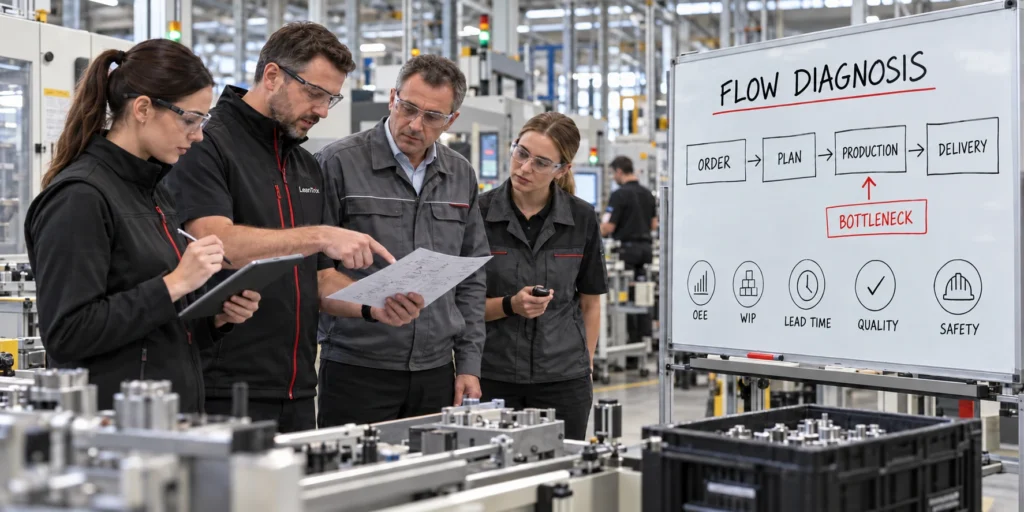
  • Flow: value-stream mapping, bottlenecks, queues, WIP, lead time, intralogistics and work balancing.
  • Machines: OEE, availability, micro-stoppages, changeovers, maintenance and the significance of critical equipment.
  • Quality: defects, rework, complaints, control points and root causes of problems.
  • People and standards: work standards, TWI, leadership and instructor capabilities, problem-solving and engagement.
  • The improvement system: the initiative portfolio, project selection, change management and the ability to sustain results.

Depending on the diagnosis, we can examine selected areas further through a process management audit, maintenance audit or Lean implementation audit.

Factory team analysing flow from order through planning and production to delivery, with a bottleneck and quality and safety measures – LeanTrix
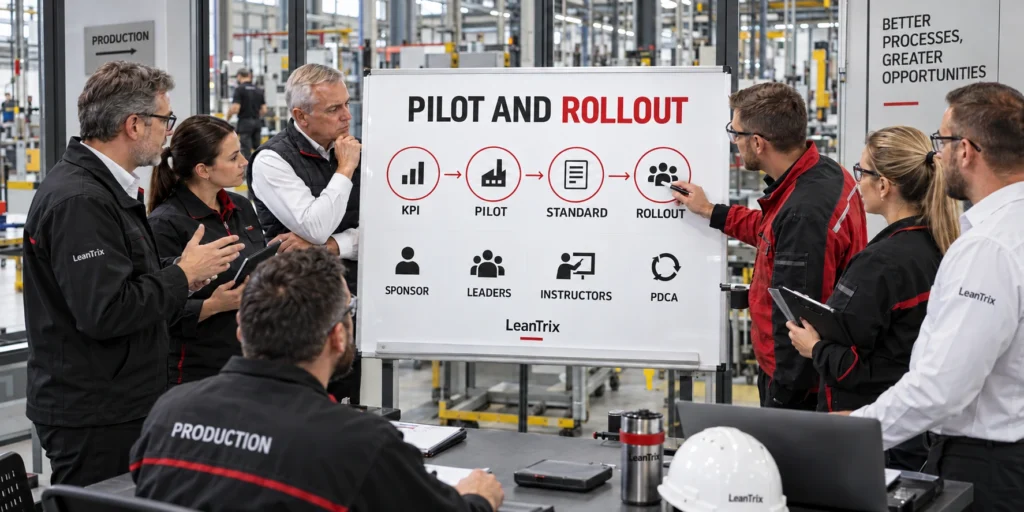
LeanTrix pilot and rollout workshop showing KPI, pilot, standard, rollout, sponsor, leaders, instructors and PDCA in English.

What is our role?

From independent diagnosis to measurable implementation

LeanTrix connects management’s perspective with process reality. We reveal cause-and-effect relationships, help select the most important constraint and take responsibility for leading consulting and implementation work with the client’s team.

An external audit of a manufacturing company goes beyond a catalogue of Lean tools. We select methods only after understanding the problem and assess effectiveness through system results, standard stability and the independence of internal leaders.

What does the organisation receive?

  • a management report mapping constraints, risks and key relationships,
  • a sponsorship charter and clear accountability model,
  • a KPI tree and verified baseline,
  • a pilot-area charter and implementation plan covering quick wins and systemic actions,
  • consulting and implementation support in Gemba,
  • an assessment of internal leader and instructor readiness,
  • a standardisation package and rollout roadmap for further areas or plants.

The result is a shared answer to three questions: where the company currently loses the most capacity, what should change first, and how to build an organisation capable of independently sustaining and developing the result.

A handful of facts

0
diagnostic levels: strategy, value stream and Gemba
0
PDCA phases from diagnosis to rollout
0
pilot area with KPIs, an owner and success criteria

Implementation support

We provide support based on the Kata process, which allows us to adapt our activities to the specifics of your organization, taking into account the jointly set goals. The Kata process consists of four key elements that enable effective implementation of assumptions.

Determining the course of action

Designing a concept that responds to the organization's goals and challenges.

Determining the current state

Learning about the current situation and collecting input data to define the next step.

Determining the target state

Determining the desired and measurable end result and a plan for its implementation.

Experiments - consultations

Implementation of activities in accordance with the established cooperation model, based on PDCA cycles.

We operate according to PDCA

P

PLAN

Direction, sponsor and success criteria

In PLAN, we translate the business challenge into a precise audit scope. We agree a sponsorship charter with management defining the expected outcome, project boundaries, available resources, decision rights, escalation and the sponsor’s accountability.

  • analyse strategy, demand, plant performance and key operational data,
  • use the Theory of Constraints and Gemba to form a hypothesis about the current bottleneck,
  • build a KPI tree connecting business outcomes with process parameters,
  • establish baseline measurements, data sources, measurement frequency and indicator owners,
  • select a pilot area according to its impact on the constraint, feasibility and potential for subsequent scaling,
  • appoint a sponsor, pilot owner and implementation team, and establish review routines.

KPIs may include throughput, OTIF, lead time, WIP, OEE at the constraint, defect levels, productivity and safety. The final set follows the business objective; we do not apply one indicator list to every factory.

D

DO

Gemba diagnosis and pilot implementation

In DO, we follow the actual value stream from order to delivery. We observe the process, speak with employees and leaders, measure times and compare system data with what actually happens on the shop floor.

  • map material and information flow and the relationships between sales, planning, logistics, production, quality and maintenance,
  • measure cycle times, waiting, queues, changeovers, downtime, rework and resource workload,
  • confirm the constraint and the losses reducing its utilisation,
  • develop a pilot plan with tasks, owners, deadlines and expected KPI impact,
  • implement solutions appropriate to the cause: TOC, standardised work, TWI, TPM, SMED, visual management, problem-solving or Improvement Kata,
  • work with the client’s team rather than implementing change separately from the organisation.

We develop leaders and future internal instructors from the outset. Knowledge of measurement, standards and experimentation therefore remains in the company, and the pilot becomes a learning environment for the whole organisation.

C

CHECK

Results, adherence to standards and team readiness

In CHECK, we compare results against the baseline and success criteria agreed in the sponsorship charter. We examine process stability and whether results follow from the new working method as well as changes in the numbers.

  • verify before-and-after KPIs while accounting for changes in volume, mix and process conditions,
  • audit adherence to standards and the effectiveness of daily management routines,
  • check whether the bottleneck is used better, relieved or has moved elsewhere in the system,
  • assess the independence of process owners, leaders and internal instructors,
  • analyse problem-solving quality, responses to deviations and the completeness of implementation evidence,
  • review the pilot with the sponsor and decide whether to adjust, sustain or scale it.

An internal-team assessment shows who can already maintain standards, coach and lead further PDCA cycles independently, and where further support is needed.

A

ACT

Standardisation and organisation-wide rollout

In ACT, we stabilise solutions whose impact on results has been confirmed. We update standards, roles, training, the KPI system and oversight, then plan rollout in successive waves.

  • close pilot actions and incorporate new rules into daily management,
  • create a skills matrix and development plan for leaders, instructors and internal change owners,
  • sequence subsequent areas according to the current constraint and business potential,
  • prepare an implementation package: standards, training materials, KPIs, audit checklists and escalation rules,
  • support subsequent implementations through coaching, Kata and periodic sponsor reviews,
  • launch the next PDCA cycle when the constraint, market conditions or organisational priorities change.

Rollout does not mean copying the pilot exactly. We transfer proven principles while adapting solutions to the process, people and new constraint. An external audit of a manufacturing company therefore becomes the start of a sustainable improvement system.

Want to learn more? Contact us!

    Name and surname *
    Email address *
    Phone number *

    What are you interested in? *

    Additional message (optional)

    * required fields


    Our clients

    Wedel
    Geberit
    Viessmann
    Lajkonik
    Sumito Electric
    Tarczyński
    Autoliv
    Stadler
    UPM Raflatac
    Jost
    BSH
    Danone
    e-obuwie
    Kompania Piwowarska
    Recaro
    Tenneco
    Titanx
    ABM Leantrix Lean Management TWI Toyota Kata TOC
    Amazon Leantrix Lean Management TWI Toyota Kata TOC
    blum Leantrix Lean Management TWI Toyota Kata TOC
    Ikano Leantrix Lean Management TWI Toyota Kata TOC
    Kruk Leantrix Lean Management TWI Toyota Kata TOC
    Lincoln electronic Leantrix Lean Management TWI Toyota Kata TOC
    Sanden Leantrix Lean Management TWI Toyota Kata TOC
    Serpol Leantrix Lean Management TWI Toyota Kata TOC
    Stock Leantrix Lean Management TWI Toyota Kata TOC
    Velux Leantrix Lean Management TWI Toyota Kata TOC

    Our Customers' Opinions