Process Management Audit

Why do you need this service?

Process management audit – from strategy to everyday work

A process management audit reveals whether the company operates as one coherent system: from strategic direction through objectives and process owners to work standards, daily decisions and measurable results. We assess more than procedures or the number of tools implemented. We examine whether strategy translates into operational priorities, processes create customer value and the organisation can quickly identify and remove constraints.

In many companies, Hoshin Kanri, Lean Management, KPIs, standardisation, Six Sigma and quality management operate alongside one another. Each area has its own projects and measures but lacks a shared operating logic. This produces local optimisation, initiative overload, conflicting priorities and improvements invisible in overall value-stream performance. Our audit structures these elements into one process-management system.

What does the audit cover?

  • Strategy and deployment – verifying whether organisational direction translates into measurable priorities, annual objectives and actions through Hoshin Kanri (in Polish). We also assess catchball, reviews and feedback.
  • Process architecture – identifying core, supporting and management processes, their customers, inputs, outputs, owners, responsibilities and interdependencies. We pay particular attention to handovers of work, decisions and information.
  • The system constraint – using the Theory of Constraints (TOC) (in Polish) to identify the bottleneck currently limiting overall organisational performance most. This may be a resource, capability, decision rule, planning method or conflict between local KPIs.
  • Objectives and KPI system – examining the connection between strategic, outcome and process measures, their definitions, data sources, review frequency and accountability for responses. We distinguish lagging from leading indicators.
  • Operational management – assessing meeting routines, visual boards, problem escalation, Leader Standard Work, data-based decisions and teams’ ability to respond quickly.
  • Standardisation and capability development – analysing work standards, employee training, leadership roles and sustained implementation. Where needed, we connect employee work standards with management standards and TWI.
  • Improvement and problem-solving – verifying whether the organisation addresses the right challenges. We use Improvement Kata and Coaching Kata to define the current condition, target condition, obstacles and next experiments.
  • Method selection – assessing where Lean and standardisation are sufficient, where variation analysis using Lean Six Sigma is needed, and where ISO 9001 or IATF 16949 quality-management requirements and risks are central.
  • Readiness for change – examining the sponsor’s role, stakeholders, communication, leadership involvement, implementation barriers and readiness for piloting and rollout. We connect the audit with a practical approach to change management (in Polish).

One shared logic rather than disconnected tools

Hoshin Kanri defines challenges and priorities. TOC identifies where intervention will have the greatest effect on the whole system. Lean Management improves flow and eliminates waste, while standardisation sustains the best known working method. Improvement Kata gives change a rhythm of small experiments, and Coaching Kata develops leaders’ habit of asking useful questions. Six Sigma helps solve chronic data-based problems, while quality management protects customer requirements, risk and compliance.

A process management audit helps match each method to a specific problem. The organisation builds a repeatable way to achieve objectives rather than implementing tools for their own sake.

What does the organisation receive?

  • a map connecting strategy, objectives, processes, KPIs and work standards,
  • a management-system maturity assessment and risk map,
  • identification of the main constraint and the reasoning behind it,
  • a KPI tree and recommended management-review routine,
  • a list of quick wins and systemic initiatives requiring greater commitment,
  • a recommended accountability model for process owners, leaders and the sponsor,
  • a pilot, capability-development and rollout plan for further areas,
  • a final report with priorities, action owners and success criteria.

The result is a practical implementation roadmap rather than another presentation to file away. It shows where to begin, what to measure, how to experiment and how to sustain change after the audit.

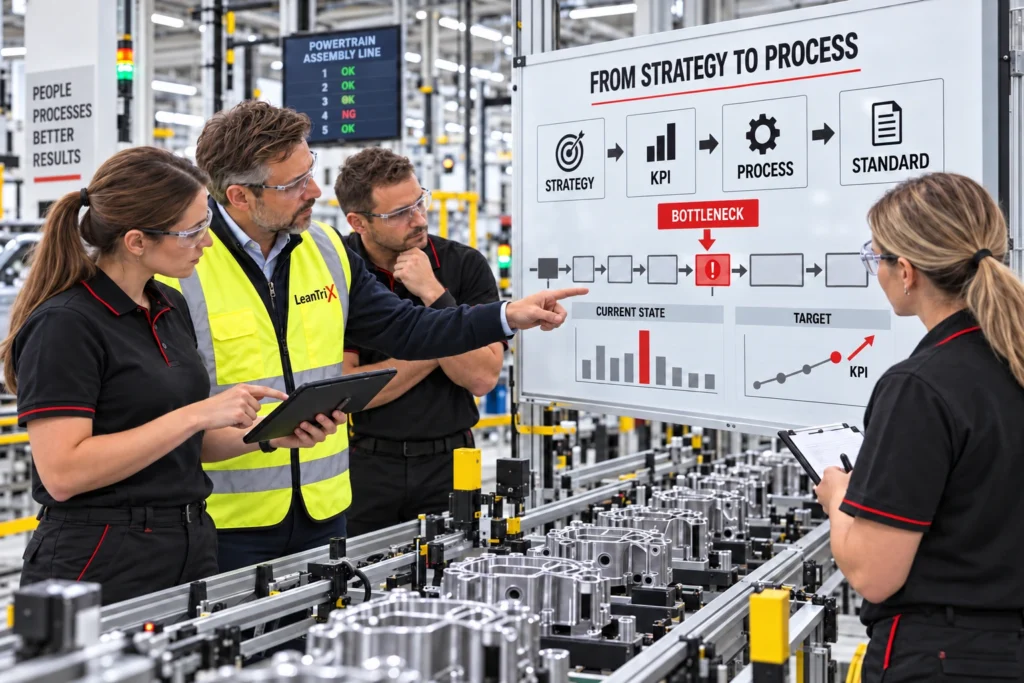
LeanTrix team connecting strategy, KPIs, process standards and bottleneck improvement on a factory board.
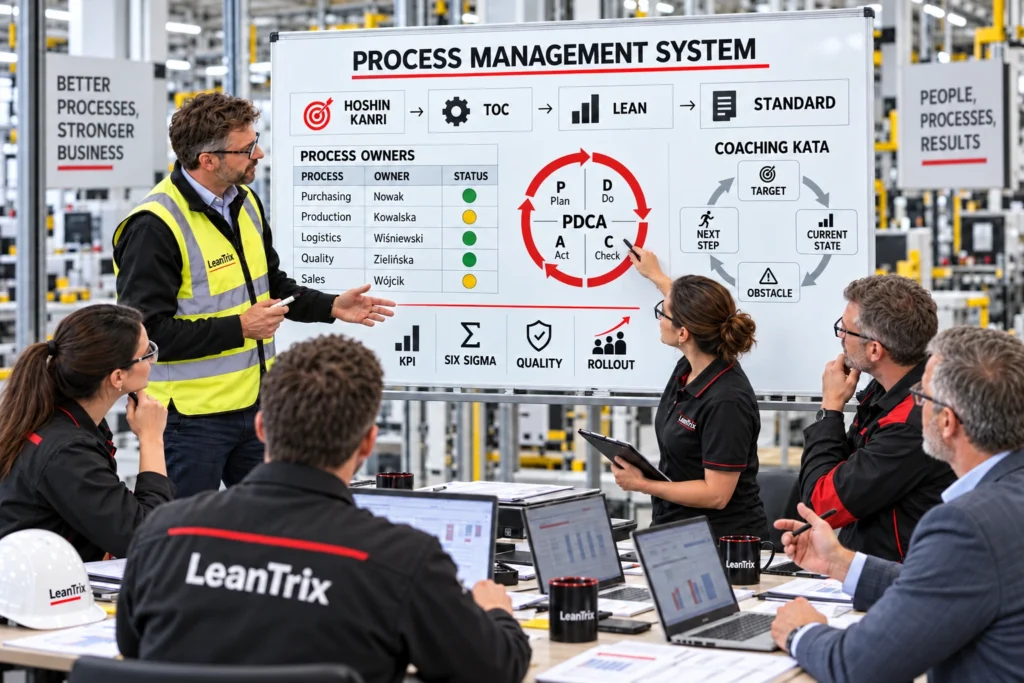
LeanTrix team reviewing an English process management system with process owners, PDCA and Coaching Kata.

What is our role?

Our role – integrating methods into one management system

We act as an independent partner connecting management, process owners, leaders and the employees doing the work. We help reveal individual problems and the relationships between strategic decisions, value flow, leadership behaviour, standards and business results.

We conduct the process management audit in Gemba using actual data. We speak with people at different organisational levels, observe work and management meetings, analyse material and information flow, review indicators and examine how quickly the organisation moves from detecting a deviation to an effective response.

Together with the organisation, we:

  • agree the audit mandate, sponsor’s role, scope, criteria and decision-making method,
  • conduct interviews, Gemba observations, data analysis and process mapping,
  • translate strategy into Hoshin Kanri priorities, process objectives and accountability,
  • identify the system constraint through TOC and focus resources on it,
  • clarify the KPI tree, measure definitions, data sources and review routine,
  • design a change pilot covering flow, work standards, visual management and escalation,
  • introduce Improvement Kata and develop leaders through Coaching Kata,
  • select Lean, Six Sigma or quality-system requirements according to the problem,
  • prepare change-management, communication and stakeholder-engagement plans,
  • support stabilisation and rollout of good practices to further processes and locations.

From diagnosis to independence

We do not prescribe one toolset to every organisation. If inconsistent strategy is the constraint, we clarify Hoshin Kanri and catchball. If a bottleneck blocks results, we subordinate other actions to it. For variation, we use Six Sigma analytical methods. If execution lacks stability, we develop standards and leadership capabilities. Where a technically sound solution is not adopted, we strengthen sponsorship, communication and daily management behaviours.

During the audit, we teach the team to identify obstacles, experiment and review KPIs independently. Leaders receive practical Coaching Kata routines, process owners clear responsibilities, and the sponsor a transparent decision and escalation system. Knowledge remains in the organisation, enabling subsequent improvement cycles without permanent dependence on a consultant.

We conclude with a joint management review, presenting facts, relationships, risks, quick wins and the recommended action sequence. We agree owners, deadlines, KPIs and conditions for moving from pilot to rollout. Subsequent reviews verify results, update the target condition and help sustain the improvement routine.

A handful of facts

0
levels: strategy, value stream, process and work standard
0
approaches connected in one system: Hoshin, TOC, Lean, Kata, Six Sigma and quality
0
shared map of KPIs, accountability and rollout

Implementation support

We provide support based on the Kata process, which allows us to adapt our activities to the specifics of your organization, taking into account the jointly set goals. The Kata process consists of four key elements that enable effective implementation of assumptions.

Determining the course of action

Designing a concept that responds to the organization's goals and challenges.

Determining the current state

Learning about the current situation and collecting input data to define the next step.

Determining the target state

Determining the desired and measurable end result and a plan for its implementation.

Experiments - consultations

Implementation of activities in accordance with the established cooperation model, based on PDCA cycles.

We operate according to PDCA

P

PLAN

PLAN – system diagnosis and selection of the key challenge

We begin PLAN by agreeing the business objective, scope, sponsor and success criteria. We relate the process management audit to strategy, customer expectations and the performance of the entire value stream.

  • analyse strategic direction and objective deployment through Hoshin Kanri,
  • examine catchball, responsibilities and Hoshin review routines,
  • create or clarify the map of processes, owners, customers, inputs, outputs and interfaces,
  • identify the system constraint using TOC, based on flow, queues, lead time, workload, decision quality and organisational rules,
  • establish baseline performance and a KPI tree covering strategic, outcome and leading process indicators,
  • define the challenge, current condition, target condition and initial obstacles through Improvement Kata,
  • assess maturity in operational management, standards, Lean, Six Sigma and the quality system,
  • analyse stakeholders, readiness for change, risks, communication and the sponsor’s role,
  • select the pilot process, scope of Gemba observation and further audit plan.

PLAN produces a shared hypothesis: what limits performance, which target condition we want to reach, which KPIs will confirm the change and who owns the next steps.

D

DO

DO – pilots, experiments and management-system implementation

In DO, we test hypotheses in practice. We conduct Gemba observations, interviews and team workshops, then launch actions focused on the constraint and strategic priorities.

  • deploy Hoshin objectives to processes, teams, owners and specific actions,
  • exploit the constraint and subordinate other decisions to it according to TOC,
  • remove conflicting local KPIs, unnecessary handovers, waiting and decision barriers,
  • design or improve flow, visual management, escalation and Leader Standard Work,
  • create and test work standards and methods for developing employee capabilities,
  • run small Improvement Kata experiments and document each step’s result,
  • develop leaders in Coaching Kata so they regularly support teams in reaching target conditions,
  • launch Six Sigma projects where the problem requires data analysis and reduced variation,
  • integrate quality objectives, risks, customer requirements and necessary ISO/IATF mechanisms,
  • deliver the change plan: communication, stakeholder preparation, training and transfer of accountability.

DO does not mean implementing everything at once. We test solutions within a selected process, gather feedback quickly and build a standard the organisation can sustain.

C

CHECK

CHECK – KPIs, management behaviours and process effectiveness

In CHECK, we assess execution and, above all, the effect on the entire system. We compare results with the baseline and target condition agreed in PLAN.

  • verify the connection between strategy, objective, process, KPIs and work standards,
  • analyse business measures and leading process indicators, including quality, currency and clarity of definitions,
  • check whether improvement affects the constraint and total system flow rather than local efficiency alone,
  • assess lead time, WIP, throughput, timeliness, quality or service levels as appropriate to the process,
  • audit standards in Gemba and verify process-owner accountability at interfaces,
  • review boards, meeting routines, escalation and decision speed,
  • assess Kata cycles: obstacles, experiments, lessons and coaching frequency,
  • examine change adoption, leadership involvement, team readiness and sustained new behaviours,
  • verify the effectiveness of Lean, Six Sigma and quality-system activities and possible side effects.

CHECK concludes with a clear map of facts: what works, what fails to deliver the expected effect, where the constraint has moved and which decisions are needed before scaling.

A

ACT

ACT – standardisation, system development and rollout

In ACT, we sustain effective solutions and correct those that failed to reach the target condition. We close one PDCA cycle while beginning the next improvement stage.

  • update the process map, work standards, roles, KPI definitions and review routines,
  • incorporate effective routines into management standards and leaders’ daily work,
  • correct ineffective actions and define the next target condition and Kata experiments,
  • identify the new constraint and return to the TOC cycle if the previous constraint has been broken,
  • update Hoshin priorities through review, catchball and Hansei reflection,
  • agree further initiatives, owners, resources, deadlines and transition criteria,
  • develop internal Kata coaches and process-owner capabilities,
  • transfer proven solutions through Yokoten to further areas, processes or locations,
  • connect rollout with the quality system, risk management and change-management plan,
  • schedule reviews and the next sustainment audit.

ACT produces a functioning development mechanism rather than a one-off corrective campaign. The organisation knows how to sustain change, respond to new constraints and scale good practices without losing quality.

Want to learn more? Contact us!

    Name and surname *
    Email address *
    Phone number *

    What are you interested in? *

    Additional message (optional)

    * required fields


    Our clients

    Wedel
    Geberit
    Viessmann
    Lajkonik
    Sumito Electric
    Tarczyński
    Autoliv
    Stadler
    UPM Raflatac
    Jost
    BSH
    Danone
    e-obuwie
    Kompania Piwowarska
    Recaro
    Tenneco
    Titanx
    ABM Leantrix Lean Management TWI Toyota Kata TOC
    Amazon Leantrix Lean Management TWI Toyota Kata TOC
    blum Leantrix Lean Management TWI Toyota Kata TOC
    Ikano Leantrix Lean Management TWI Toyota Kata TOC
    Kruk Leantrix Lean Management TWI Toyota Kata TOC
    Lincoln electronic Leantrix Lean Management TWI Toyota Kata TOC
    Sanden Leantrix Lean Management TWI Toyota Kata TOC
    Serpol Leantrix Lean Management TWI Toyota Kata TOC
    Stock Leantrix Lean Management TWI Toyota Kata TOC
    Velux Leantrix Lean Management TWI Toyota Kata TOC

    Our Customers' Opinions