





















Lean Logistics – Warehouse and Intralogistics Improvement

Why do you need this service?

Lean Logistics organises material and information flow from the supplier, through warehousing and production, to the customer. The aim is a shorter, more predictable flow across the whole value stream, with lower inventories and fewer urgent interventions, rather than locally accelerating one operation.

In many organisations, warehousing compensates for planning problems, process variability and missing standards. Inventory, space requirements and transport movements increase, yet production still experiences material shortages. Implementing Lean Logistics reveals these relationships and helps design replenishment based on actual consumption.

When should you implement Lean Logistics?

  • inventory and WIP are growing faster than sales,
  • production waits for materials despite a full warehouse,
  • picking is time-consuming and error-prone,
  • forklift routes, deliveries and staging locations lack standards,
  • planning generates frequent changes and expedited work,
  • the company wants greater throughput without expanding its space.

Service scope

  • mapping material, information and decision flows,
  • inventory segmentation and replenishment policies,
  • supermarkets, Kanban, Milk Run and pull principles,
  • warehouse layout, zones, location addressing and picking standards,
  • intralogistics and line replenishment,
  • KPIs: OTIF, lead time, inventory turnover, shortages and productivity.

The service complements our work in logistics and e-commerce (in Polish) and value-stream improvement (in Polish).

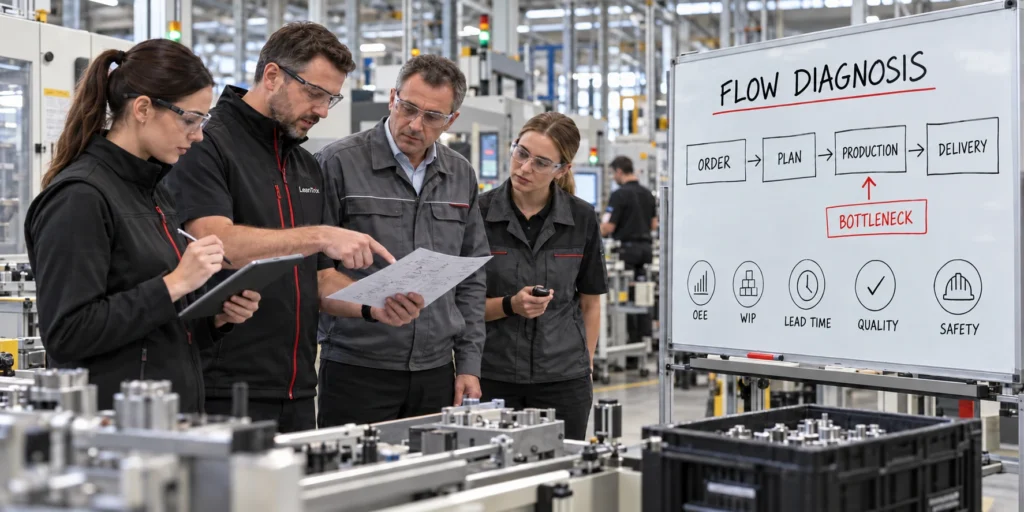
Factory team analysing flow from order through planning and production to delivery, with a bottleneck and quality and safety measures – LeanTrix
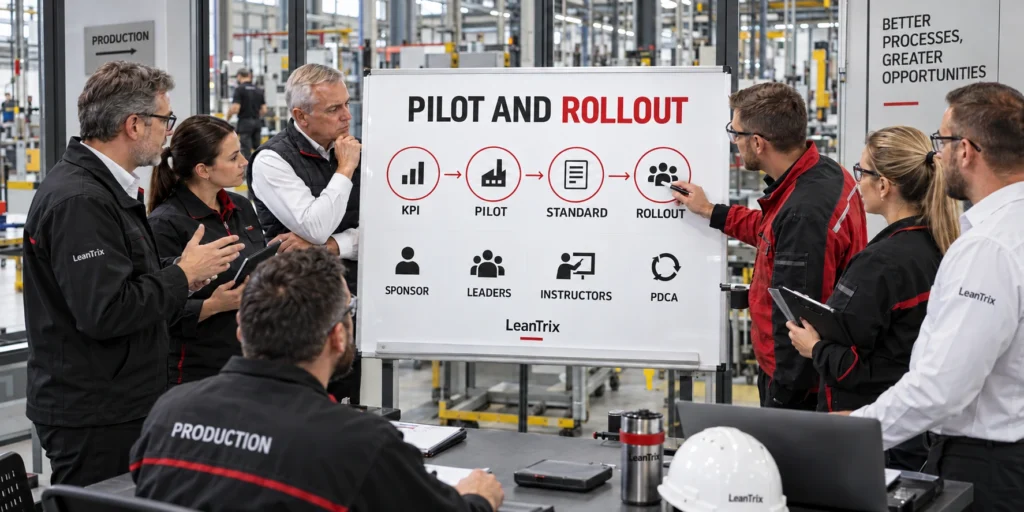
LeanTrix pilot and rollout workshop showing KPI, pilot, standard, rollout, sponsor, leaders, instructors and PDCA in English.

What is our role?

From value-stream analysis to stable replenishment

LeanTrix connects the perspectives of sales, S&OP, planning, purchasing, warehousing, production and transport. We identify the constraint affecting the entire flow, then design a pilot solution that can be tested against actual volume.

In a Lean Logistics project, we use VSM, TOC, Kanban, Heijunka, standardised work, visual management and problem-solving. We do not copy a predetermined card count or Milk Run route: parameters follow demand, replenishment time, capacity and process risk.

What does the organisation receive?

  • a flow map and constraint diagnosis,
  • a KPI baseline and analysis of inventory and movements,
  • a supermarket, Kanban or cyclic replenishment design,
  • warehouse standards, routes and responsibilities,
  • a pilot measured before and after,
  • a roadmap for implementation across further value streams.

A handful of facts

0
flows analysed together: material, information and decisions
0
PDCA phases from diagnosis to rollout
0
pilot value stream measured before and after

Implementation support

We provide support based on the Kata process, which allows us to adapt our activities to the specifics of your organization, taking into account the jointly set goals. The Kata process consists of four key elements that enable effective implementation of assumptions.

Determining the course of action

Designing a concept that responds to the organization's goals and challenges.

Determining the current state

Learning about the current situation and collecting input data to define the next step.

Determining the target state

Determining the desired and measurable end result and a plan for its implementation.

Experiments - consultations

Implementation of activities in accordance with the established cooperation model, based on PDCA cycles.

We operate according to PDCA

P

PLAN

Demand, flow and system parameters

In PLAN, we select the value stream, define customer needs and identify the constraint. We agree measurement rules and pilot boundaries.

  • analyse demand volume, mix, seasonality and variability,
  • map supply sources, warehouses, points of use and transport,
  • measure inventory, WIP, lead time, OTIF, shortages and movements,
  • define rules for classifying materials and risk,
  • appoint a value-stream owner and sponsor,
  • develop a target-state hypothesis.

D

DO

Designing and piloting pull flow

In DO, we observe work in the warehouse and on the lines, verify data and launch a controlled pilot.

  • organise storage locations, transport routes and staging points,
  • design supermarkets, Kanban cards and container sizes,
  • establish Milk Run frequency and replenishment standards,
  • simplify picking and delivery confirmation,
  • create visual priority and escalation rules,
  • train logistics staff, planners, leaders and operators.

C

CHECK

Throughput, inventory and on-time delivery

In CHECK, we compare pilot results against the baseline and assess system stability under different demand conditions.

  • analyse OTIF, lead time, inventory turnover and inventory value,
  • measure material shortages, urgent transport movements and errors,
  • assess space utilisation and picking productivity,
  • audit compliance with routes and replenishment standards,
  • evaluate whether Kanban parameters are appropriate,
  • adjust the solution after peak-load testing.

A

ACT

Standards, ownership and value-stream rollout

In ACT, we embed parameters and the method for updating them. We create standards for reviewing inventory, routes, cards and KPIs so that the system responds to changes in demand.

  • approve the layout and work standards,
  • establish a cycle for recalculating Kanban and capacity,
  • develop coordinators and layered audits,
  • connect logistics with daily management,
  • extend the pilot to further material families and locations,
  • launch subsequent improvement cycles.

This enables Lean Logistics to reduce firefighting and strengthen flow across the organisation.

Want to learn more? Contact us!

    Name and surname *
    Email address *
    Phone number *

    What are you interested in? *

    Additional message (optional)

    * required fields


    Our clients

    Wedel
    Geberit
    Viessmann
    Lajkonik
    Sumito Electric
    Tarczyński
    Autoliv
    Stadler
    UPM Raflatac
    Jost
    BSH
    Danone
    e-obuwie
    Kompania Piwowarska
    Recaro
    Tenneco
    Titanx
    ABM Leantrix Lean Management TWI Toyota Kata TOC
    Amazon Leantrix Lean Management TWI Toyota Kata TOC
    blum Leantrix Lean Management TWI Toyota Kata TOC
    Ikano Leantrix Lean Management TWI Toyota Kata TOC
    Kruk Leantrix Lean Management TWI Toyota Kata TOC
    Lincoln electronic Leantrix Lean Management TWI Toyota Kata TOC
    Sanden Leantrix Lean Management TWI Toyota Kata TOC
    Serpol Leantrix Lean Management TWI Toyota Kata TOC
    Stock Leantrix Lean Management TWI Toyota Kata TOC
    Velux Leantrix Lean Management TWI Toyota Kata TOC

    Our Customers' Opinions