

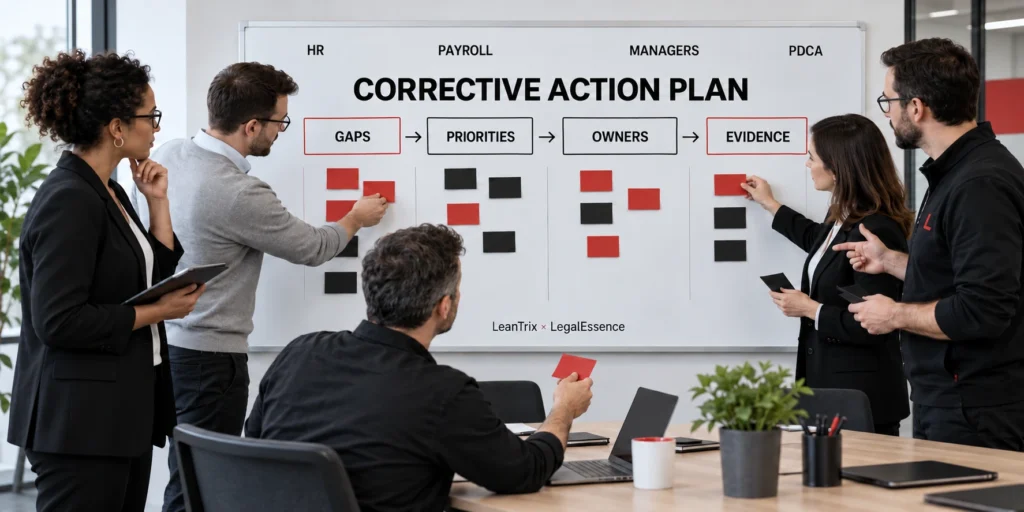



























Labour Law Audit – HR Documentation and Procedures

Why do you need this service?

A labour law audit is an independent, detailed review of a company’s HR and payroll documentation and HR procedures for compliance with Polish law. We compare legal requirements, internal regulations, process flow and the actual practices of managers, HR, personnel administration and payroll, going beyond checking files.

The organisation receives a risk assessment, root causes and an actionable corrective plan as well as a list of gaps. Read more about our approach to labour law in organisations (in Polish).

When should you carry out an audit?

  • before an inspection, organisational change, acquisition or rapid workforce growth,
  • following legislative changes or changes to the HR/payroll system or HR service provider,
  • when disputes, payroll corrections, overtime or employee complaints increase,
  • when procedures exist but are applied differently across departments, branches or companies,
  • when management needs an objective view of compliance and the most urgent risks.

What can a labour law audit cover?

  • recruitment, legal bases of employment, contracts, employee information and changes to employment terms,
  • personnel files, other employee documentation, job responsibilities and document flow,
  • working time, schedules, overtime, breaks, rest periods, leave and absences,
  • calculation of pay, allowances, deductions and benefits, and consistency between working-time data and payroll,
  • remote and hybrid work, occupational health and safety, preventive medical examinations and training,
  • equal treatment, prevention of discrimination and workplace bullying, reporting violations and data protection,
  • internal regulations, HR procedures, disciplinary liability and termination of employment,
  • legality of foreign-national employment and risks relating to civil-law and B2B contracts, where applicable.

We always adapt the scope to company size, sector, employment model and risk profile. We examine selected samples and may extend verification in high-risk areas.

For the wider diagnostic portfolio, see LeanTrix external audits.

COMPLIANCE MAP – DOCUMENTS – PROCESSES
HR – PAYROLL – MANAGERS

What is our role?

Law and process in one team

We deliver the service jointly with LegalEssence, with the participation of Marcelina Przykaza, a lawyer and psychologist specialising in systemic solutions in labour law and work psychology. LegalEssence contributes legal analysis and the workplace-relations perspective, while LeanTrix provides process mapping, standardisation, change management and PDCA implementation.

This combination ensures that a labour law audit continues beyond an opinion. We translate recommendations into practical HR and management standards, control mechanisms and an implementation plan.

What does the organisation receive?

  • a management report summarising the main exposures,
  • a matrix of requirements, evidence, gaps and risk levels,
  • a list of quick wins and systemic actions,
  • a corrective-action plan with owners, deadlines and closure criteria,
  • recommendations for changes to documents, procedures, systems and responsibilities,
  • a findings workshop for management, implementation support and a follow-up audit as agreed in the project scope.

The audit diagnoses compliance within the agreed scope. It is not an inspection by Poland’s National Labour Inspectorate or a guarantee of the outcome of proceedings before an authority or court; individual disputes and decisions may require separate legal analysis.

A handful of facts

0
verification layers: documents, processes and practice
0
PDCA phases from diagnosis to sustained compliance
0
coherent corrective-action plan with owners, deadlines and evidence

Implementation support

We provide support based on the Kata process, which allows us to adapt our activities to the specifics of your organization, taking into account the jointly set goals. The Kata process consists of four key elements that enable effective implementation of assumptions.

Determining the course of action

Designing a concept that responds to the organization's goals and challenges.

Determining the current state

Learning about the current situation and collecting input data to define the next step.

Determining the target state

Determining the desired and measurable end result and a plan for its implementation.

Experiments - consultations

Implementation of activities in accordance with the established cooperation model, based on PDCA cycles.

We operate according to PDCA

P

PLAN

Scope, criteria and risk map

We begin the labour law audit with an opening meeting involving management, HR, personnel administration and payroll. We agree objectives, organisational units, employee groups, the review period, sampling and confidential data-access rules.

  • create a requirements matrix based on current legislation and internal regulations,
  • map the employment lifecycle from recruitment and onboarding to changes in terms and termination,
  • identify areas particularly exposed to errors, backlogs or inconsistencies,
  • establish the documents, interviews and control tests required,
  • define KPIs: sample compliance, critical and significant gaps, timely corrections and action closure.

The review plan focuses effort where the potential impact on employees and the organisation is greatest. It also clearly distinguishes the audit scope from matters requiring a separate legal opinion.

D

DO

Documents, processes and practice

In DO, the LegalEssence and LeanTrix team reviews documentation, tests selected cases, conducts interviews and observes HR processes. Each finding is linked to evidence and a specific process stage.

  • check the completeness and consistency of personnel files, contracts, amendments, information notices, declarations and authorisations,
  • compare working-time records, schedules, requests and absences with payroll calculations in the agreed sample,
  • verify rules for remote work, occupational health and safety, examinations, training, leave and termination,
  • analyse regulations and procedures covering remuneration, reporting violations, equal treatment, prevention of workplace bullying and data protection,
  • interview HR, personnel administration, payroll and managers to establish whether documented processes operate the same way in practice,
  • identify manual workarounds, unclear accountability, conflicting document versions and missing controls.

We minimise access to data and maintain confidentiality. Findings in the management report do not disclose employee data beyond what is necessary to take action.

C

CHECK

Assessing compliance and priorities

We assess each finding according to its legal basis, scale, recurrence, employee impact, financial risk and likelihood of the practice being challenged. Gaps are classified as critical, significant, moderate or improvement observations.

  • compare KPIs with the baseline established in PLAN,
  • investigate root causes: knowledge, standards, systems, accountability or oversight,
  • separate urgent actions from systemic and developmental changes,
  • verify consistency between documentation and actual decision-making practices,
  • present management with a report, risk map, recommendations and quick wins.

The final report explains what is non-compliant, where the error arises, who should manage it, how to confirm correction and how to prevent recurrence.

A

ACT

Corrective action and sustained compliance

In ACT, we translate audit results into actions with owners, deadlines, priorities and required closure evidence. Depending on the agreed scope, we support corrections to documents, procedures and working methods.

  • organise document templates, version control and control points in HR and payroll processes,
  • design or update procedures and clearly allocate responsibilities,
  • prepare a safe correction path for identified irregularities,
  • train HR, personnel administration, payroll and managers in new standards and high-risk decisions,
  • introduce periodic reviews, an action dashboard and renewed verification of effectiveness,
  • roll out solutions to further departments, locations or companies once pilot results are confirmed.

The result is a system that helps sustain compliance after the project: clear standards, responsibilities, evidence of execution and a PDCA cycle responding to legislative and organisational changes.

Want to learn more? Contact us!

    Name and surname *
    Email address *
    Phone number *

    What are you interested in? *

    Additional message (optional)

    * required fields


    Our clients

    Wedel
    Geberit
    Viessmann
    Lajkonik
    Sumito Electric
    Tarczyński
    Autoliv
    Stadler
    UPM Raflatac
    Jost
    BSH
    Danone
    e-obuwie
    Kompania Piwowarska
    Recaro
    Tenneco
    Titanx
    ABM Leantrix Lean Management TWI Toyota Kata TOC
    Amazon Leantrix Lean Management TWI Toyota Kata TOC
    blum Leantrix Lean Management TWI Toyota Kata TOC
    Ikano Leantrix Lean Management TWI Toyota Kata TOC
    Kruk Leantrix Lean Management TWI Toyota Kata TOC
    Lincoln electronic Leantrix Lean Management TWI Toyota Kata TOC
    Sanden Leantrix Lean Management TWI Toyota Kata TOC
    Serpol Leantrix Lean Management TWI Toyota Kata TOC
    Stock Leantrix Lean Management TWI Toyota Kata TOC
    Velux Leantrix Lean Management TWI Toyota Kata TOC

    Our Customers' Opinions