


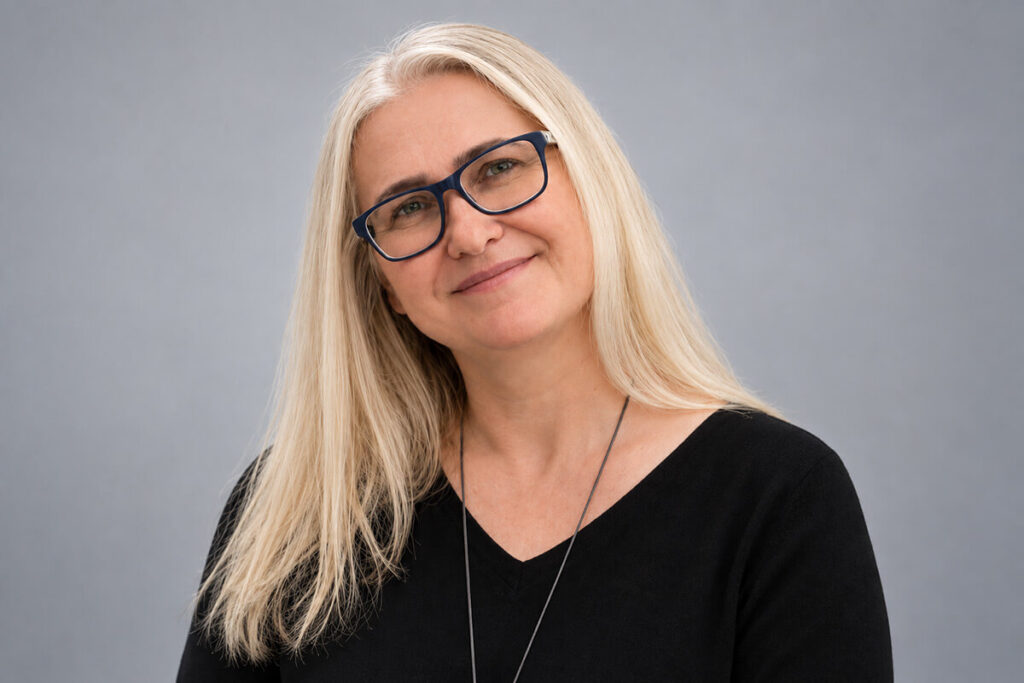
Dr. Iwona Burka is an academic lecturer, researcher, business trainer, and innovator. She specializes in Lean Management, the quality of thinking, problem-solving, and conscious human-AI collaboration.
For over 20 years, she has combined academia with the practice of management and organizational improvement. Her professional and research career is deeply rooted in Lean Management. She has worked on process optimization, the identification and elimination of waste, and systemic problem-solving. Her research has covered Lean Service, Lean Healthcare, A3 Thinking, sources of *muda* (waste) in organizations, and the application of the Kaizen philosophy beyond the organizational context. She is the co-author of the book *Lean Service in Theory and Practice* and the creator of the Personal Kaizen concept.
Over time, her focus shifted from the question “how do we improve the process?” to “how does a human think while executing the process?” The rise of artificial intelligence marked the next stage of this journey. Today, Dr. Burka is developing her proprietary “Human-AI Cognitive Lean Thinking” approach, which applies Lean logic to cognitive work performed jointly by humans and AI.
In this approach, the goal is not to reduce cognitive effort, but to distinguish between effort that creates no value and effort that is essential for sound reasoning, learning, and decision-making. She analyzes the workflow between humans and AI, identifies cognitive *muda*, and designs optimal task allocation and technology usage—ensuring that human judgment, responsibility, and understanding remain intact.
She is the creator of the Trigger Mind project, through which she develops initiatives such as “AI-Ready Mind”—focused on conscious human-AI collaboration—and “Auto-education 2.0,” which centers on learning in partnership with AI. She is also the creator of the Co-Thinking Compass (Kompas Współmyślenia z AI) and the Human+AI Thinking Lab course developed for CampusAI Poland. Her work integrates Lean Thinking, critical and creative thinking, reflection, metacognition, and Collaborative AI.
She shows organizations how to use AI not to reduce human thinking, but to ensure that the collaboration between humans and AI leads to better thinking, sounder decisions, and greater value.
She also fosters a community of parents focused on their children’s future and the question: “How do we prepare a child for a world we do not yet understand ourselves?”
Underpinning her work is the conviction that the future of education, work, and technology does not begin with tools, but with the ability to think responsibly alongside AI.