


























Organisational Culture Audit – OCAI

Why do you need this service?

An organisational culture audit reveals how people actually decide, cooperate, respond to problems and behave when their manager is absent. Diagnosis is needed alongside declared values to reveal dominant patterns and the gap between current and desired culture.

OCAI organisational culture audit: current and desired states

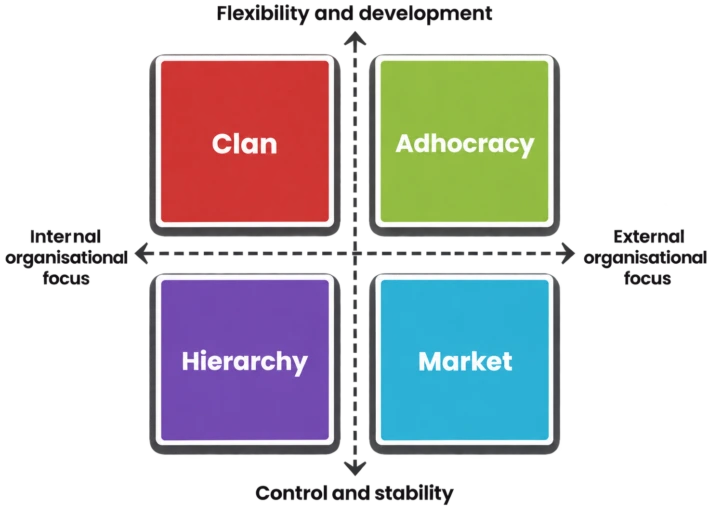
Our audit uses Cameron and Quinn’s OCAI—Organizational Culture Assessment Instrument. The model organises culture into four types: Clan—collaborate, Adhocracy—create, Market—compete and Hierarchy—control. It examines two tensions: internal versus external focus, and flexibility and discretion versus stability and control.

The OCAI audit compares current and desired states. We identify shifts needed to support strategy, develop people, sustain effective processes and increase learning and continuous improvement capability, rather than seeking one ideal culture. Findings can initiate broader work on organisational culture.

Relationships are also central. Our materials show how the supervisor–employee relationship affects information sharing, learning, responsibility and willingness to stop risks. We therefore translate OCAI findings into specific leadership behaviours, management routines and relationship-building practices, alongside the culture profile.

Organisational culture model with Clan, Adhocracy, Hierarchy and Market, and internal and external focus – English
Audyt kultury organizacyjnej OCAI – relacje i przywództwo

What is our role?

We conduct the organisational culture audit as a diagnosis-to-implementation process: from OCAI research design and interpretation to development activities and renewed measurement.

  • We design the OCAI audit: objective, scope, respondent groups, segmentation and participant communication.
  • We diagnose current and desired culture and prepare clear profiles for the whole organisation, selected areas or management levels.
  • We facilitate an interpretation workshop with management: explaining what dominance of Clan, Adhocracy, Market or Hierarchy means for leadership, success measures and daily management rules.
  • We translate findings into action: expected leader behaviours, management routines, cooperation principles and areas for change.
  • We work on relationships: helping move from transactional role-to-role relationships towards person-to-person partnership through TWI Job Relations, NVC and workshops.
  • We conduct CHECK and ACT reviews: returning to data after an agreed period, checking progress, updating the plan and embedding effective solutions.

A handful of facts

0
+ organisations assessed through an OCAI organisational culture audit
0
+ people included in comparative culture and relationship audits
0
%+ of our clients progressed to relationship level 2 or 3: partnership and mutual responsibility

Implementation support

We provide support based on the Kata process, which allows us to adapt our activities to the specifics of your organization, taking into account the jointly set goals. The Kata process consists of four key elements that enable effective implementation of assumptions.

Determining the course of action

Designing a concept that responds to the organization's goals and challenges.

Determining the current state

Learning about the current situation and collecting input data to define the next step.

Determining the target state

Determining the desired and measurable end result and a plan for its implementation.

Experiments - consultations

Implementation of activities in accordance with the established cooperation model, based on PDCA cycles.

We operate according to PDCA

P

PLAN

We begin the organisational culture audit by defining scope and measurement precisely.

  • We agree the objective: for example, prepare Lean transformation, improve cooperation, develop leadership, integrate after organisational change or assess readiness for the next development stage.
  • We define scope: the whole organisation, a plant, function, department, management level or selected teams.
  • We establish respondent groups and segmentation so senior management, managers and employees’ perspectives can be compared.
  • We prepare communication: why the audit is happening, how results will be used and how candour is protected.
  • We establish the reference point: behaviours, problems and organisational indicators to observe alongside OCAI.
  • We plan the interpretation workshop and the transition from diagnosis to a specific action plan.

D

DO

  • We conduct the OCAI assessment and collect ratings of current and desired culture.
  • We build the organisational profile across Clan, Adhocracy, Market and Hierarchy and show differences between respondent groups.
  • We add qualitative evidence: leadership conversations, short interviews or workshops explaining why the profile developed.
  • We facilitate a management workshop interpreting current culture, desired culture and key tensions.
  • We select a few key behavioural changes rather than creating a long list of general values and slogans.
  • We launch development activities covering leadership, cooperation, information flow, responsibility and relationships.
  • We work on the move from transactions to partnership: from role-to-role distance towards person-to-person relationships, mutual respect, accountability and cooperation.
  • Depending on needs, we combine the audit with TWI Job Relations, NVC, Toyota Kata, Hoshin Kanri, Kaizen or leadership development.

C

CHECK

  • After an agreed period, we measure again to check movement towards the agreed culture profile.
  • We compare the current state with the baseline: repeating the full OCAI or using a shorter follow-up measure where appropriate.
  • We verify leader behaviours and relationship quality: information flow, problem responses, cooperation, accountability and willingness to stop risks.
  • We analyse organisational data selected in PLAN: for example, absence, turnover, quality, problems and complaints, productivity or other relevant indicators.
  • We gather employee and leader feedback to understand which actions change everyday work and which remain declarations.
  • At CHECK, we identify gaps between expected and actual organisational behaviour and set priorities for the next cycle.

A

ACT

  • We update the culture transformation plan using CHECK findings, strengthening effective actions and adjusting those that do not work.
  • We standardise effective leadership behaviours and management routines so new practices extend beyond individual people.
  • We expand activities to further teams, departments or locations once the pilot confirms effectiveness.
  • We reinforce the relationship model through leader coaching, TWI Job Relations, NVC, feedback and work on real organisational situations.
  • We establish a rhythm of OCAI measurement and culture reviews extending beyond a one-off survey.
  • In subsequent PDCA cycles, we adapt the culture profile to changes in strategy, the environment and organisational development.

Want to learn more? Contact us!

    Name and surname *
    Email address *
    Phone number *

    What are you interested in? *

    Additional message (optional)

    * required fields


    Our clients

    Wedel
    Geberit
    Viessmann
    Lajkonik
    Sumito Electric
    Tarczyński
    Autoliv
    Stadler
    UPM Raflatac
    Jost
    BSH
    Danone
    e-obuwie
    Kompania Piwowarska
    Recaro
    Tenneco
    Titanx
    ABM Leantrix Lean Management TWI Toyota Kata TOC
    Amazon Leantrix Lean Management TWI Toyota Kata TOC
    blum Leantrix Lean Management TWI Toyota Kata TOC
    Ikano Leantrix Lean Management TWI Toyota Kata TOC
    Kruk Leantrix Lean Management TWI Toyota Kata TOC
    Lincoln electronic Leantrix Lean Management TWI Toyota Kata TOC
    Sanden Leantrix Lean Management TWI Toyota Kata TOC
    Serpol Leantrix Lean Management TWI Toyota Kata TOC
    Stock Leantrix Lean Management TWI Toyota Kata TOC
    Velux Leantrix Lean Management TWI Toyota Kata TOC

    Our Customers' Opinions