


Our services / Company training
Theory of Constraints training: improve the system's flow
Theory of Constraints training helps managers and teams focus improvement on the factor that limits the performance of the whole system. Participants learn how to identify the constraint, protect its work and align other activities with it.
A busy department is not necessarily helping the organisation deliver more. TOC training examines throughput, work in progress and delivery performance together, then uses a real process to show where focused action can change the result.
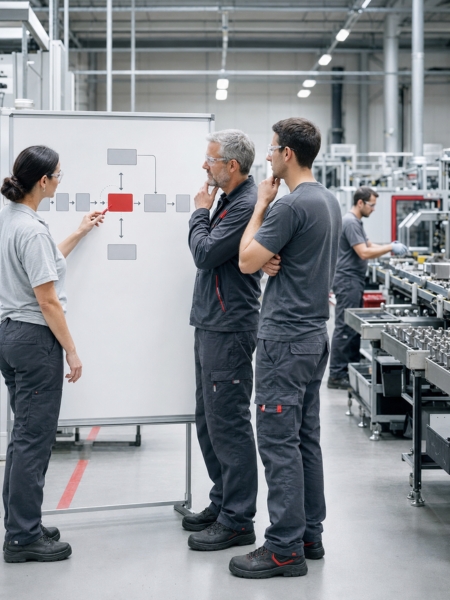
What participants will be able to do
- Identify a system constraint using observations and process data.
- Apply the five focusing steps to a practical company situation.
- Understand how release rules and buffers protect flow.
- Create a pilot with clear ownership and measures for the whole system.
Programme: practical modules
We agree the final scope around the team's experience, the selected process and the problem to solve.
01 · The system goal and performance measures
Clarify the result the organisation needs to improve. Discuss throughput, investment and operating expense, and why local utilisation alone can lead to poor decisions.
02 · Identify the constraint
Follow work through the process and examine queues, capacity, interruptions and demand. Distinguish symptoms from the factor currently limiting system performance.
03 · Exploit and protect existing capacity
Look for ways to use the constraint more effectively before adding resources. Consider priorities, preparation, quality at the constraint and interruptions that prevent productive work.
04 · Subordinate and elevate
Align the rest of the system with the constraint. Evaluate changes in release, sequencing and support, then consider additional capacity when existing capacity has been used effectively.
05 · Drum, buffer and rope
Introduce the logic of setting the pace, protecting flow with a buffer and controlling the release of work. Discuss which rules fit the process and where adaptation is needed.
06 · Repeat the cycle and plan a pilot
Check what changes when the constraint moves. Define an initial experiment, responsibilities, measures and a review routine that prevents old assumptions from becoming a new restriction.
Who is it for?
Operations and production managers, planners, process owners, logistics teams and improvement leaders. The workshop is most useful when decision-makers and people who know the actual flow work together.
How to prepare
Select a process and bring data on demand, output, work in progress, delays and capacity. The available information helps the team test its assumptions about the constraint instead of selecting it by opinion alone.
How the training works
We combine an explanation of the method with practical exercises and analysis of a company process. The group develops a first pilot and discusses the management decisions needed to apply the findings.
How to measure progress
Track system throughput, lead time, work in progress and delivery performance. Review the constraint's lost productive time and the causes of disruption, while checking that an improvement in one area benefits the whole flow.
Frequently asked questions
How does TOC relate to Lean?
TOC helps decide where improvement has the greatest effect on the system. Lean methods can help stabilise and improve the work at and around that priority.
Is a bottleneck always a machine?
No. A limiting factor may involve capacity, a decision rule, information or another part of the system. The diagnosis should test what is actually limiting the result.
How long does TOC training take and what does it cost?
We agree the scope, duration and quotation after discussing the process, participants and desired depth of practical work.
Does the workshop include implementation?
The training develops understanding and an initial pilot plan. Extended diagnosis, workplace implementation and follow-up are scoped as a separate consulting programme.
Related expertise and next steps
For scheduled editions, check open workshops and confirm the delivery language shown for the selected event. Company programmes are scoped individually.
Build a programme around your team's challenge
Tell us about the process, the people involved and the result you want to improve. We will agree a practical scope and the next step.