


Our services / Company training
Lean Management training built around your processes
Lean Management training helps a team recognise customer value, understand how work flows and remove the causes of waste. LeanTrix combines practical methods with exercises based on the organisation's own processes.
The starting point is a business problem, such as long lead times, repeated corrections, unstable output or work that depends on a few experienced people. We choose the tools needed for that problem and turn the workshop into a plan for a manageable improvement pilot.
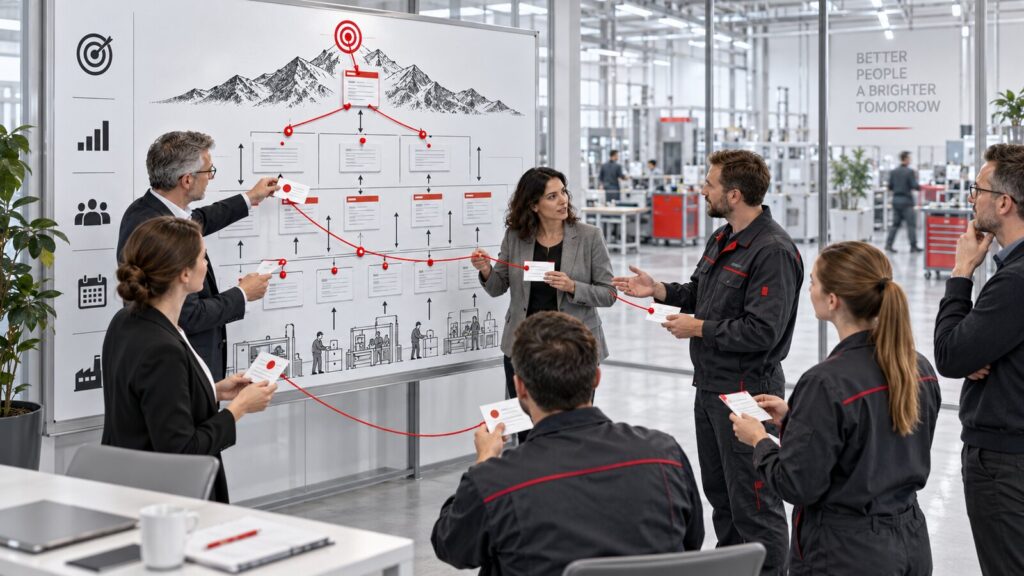
What participants will be able to do
- Distinguish customer value from activities that consume time without creating value.
- Observe a process and describe its main losses with evidence.
- Select appropriate Lean methods and define a pilot with an owner and measures.
- Connect improvements with standard work and daily leadership routines.
Programme: practical modules
We agree the final scope around the team's experience, the selected process and the problem to solve.
01 · Value, waste and workplace observation
Start with the customer’s requirement. Follow how work is actually performed and identify waiting, excess movement, rework, inventory and other sources of loss. Separate facts from assumptions.
02 · Process flow and value stream mapping
Explore the connection between material or service flow and information flow. Use a current-state view to understand queues, handovers and lead time before proposing changes.
03 · Stable work and visual management
Link workplace organisation, clear standards and visible abnormalities. Discuss how 5S and standard work help people perform consistently and notice when the process needs attention.
04 · Kaizen and practical problem solving
Define a gap, investigate causes and test countermeasures through PDCA. Practise checking whether a change solved the problem and what needs to be standardised.
05 · Equipment and changeover losses
Introduce the role of TPM, OEE and SMED where equipment availability or changeovers affect the process. Select relevant measures rather than using every tool in every area.
06 · Leadership and sustaining improvements
Clarify the role of team leaders, review routines and coaching. Turn workshop ideas into a pilot plan with responsibilities, deadlines and a way to learn from results.
Who is it for?
Managers, supervisors, team leaders, process owners and cross-functional improvement teams. Manufacturing, logistics and service teams can use the same logic while working with different examples and measures.
How to prepare
Bring one clearly defined process, its customer requirement and available data on lead time, quality, output or workload. Include people who perform the work and people responsible for the decisions that shape it.
How the training works
The programme combines short explanations, observation, practical exercises and discussion of the team's own process. The scope is selected after an initial conversation; an introductory workshop and a deeper implementation programme serve different needs.
How to measure progress
The pilot may track lead time, on-time delivery, defects, work in progress or time spent on non-value-adding activities. Record the starting point and check the effect on the whole process, not only on one workstation.
Frequently asked questions
Is this a fixed programme for every company?
No. The modules form a starting point. We adapt the exercises and depth to the process, participants and operational problem.
Do participants need previous Lean experience?
An introductory programme can start from the fundamentals. For experienced teams, we focus more deeply on process analysis, practical application and the barriers to sustaining improvements.
How long does the training take and what does it cost?
Duration and price depend on the selected scope, group and workplace exercises. We prepare a company quotation after clarifying these requirements.
What should happen after the training?
The team should run the agreed pilot, review the measures and update its standards. LeanTrix can support this through a wider implementation and coaching programme.
Related expertise and next steps
For scheduled editions, check open workshops and confirm the delivery language shown for the selected event. Company programmes are scoped individually.
Build a programme around your team's challenge
Tell us about the process, the people involved and the result you want to improve. We will agree a practical scope and the next step.