


Every initiative is urgent, so resources become fragmented and the team does not know what to deliberately set aside.
Hoshin Kanri is a strategic management system that selects a few essential priorities, aligns objectives through catchball and connects them to daily actions, measures and PDCA cycles. For a practical example of choosing priorities and protecting resources from being spread too thinly, read our article Effective Lean Strategy (in Polish).
Organisational culture · direction
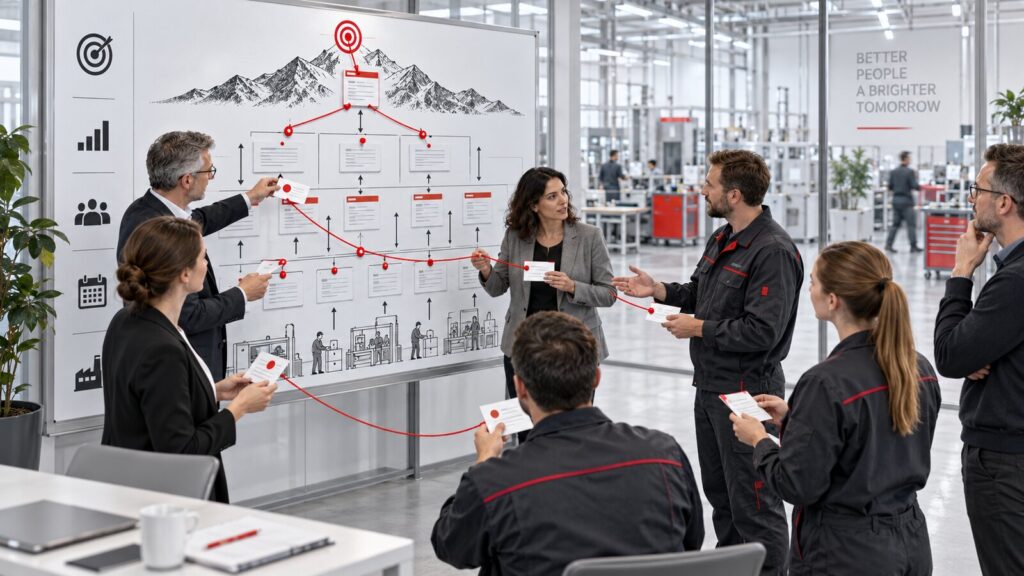
Hoshin Kanri — translating strategy into daily action
We help boards and leaders turn long-term direction into aligned objectives, clear ownership and a regular review cycle. Strategy becomes a visible basis for decisions rather than remaining a presentation.
3–5key priorities instead of a long list of initiatives
PDCAshort cycles of learning and adjusting direction
X-Matrixa clear connection between objectives, actions and measures
Start with the problem
When does an organisation need Hoshin Kanri?
The most common problem is not a lack of objectives. It arises when objectives compete, departments interpret them differently and projects fail to change everyday decisions.
Employees know the measures but cannot see the connection between their own process and the organisation’s direction.
A local improvement in one area damages flow, quality or the customer’s outcome elsewhere.
Reporting describes the past but leads to no experiment, adjustment or clear accountability.
How it works
How does Hoshin Kanri work in practice?
The system combines choosing a direction, dialogue between organisational levels and a consistent rhythm of learning. Visual tools help, but they cannot replace discussion of interdependencies.
Strategy as a system of hypotheses
A strategic plan rests on predictions. Hoshin Kanri therefore requires regular checks against facts, learning and adjustments to action while maintaining direction.
- a clear vision and breakthrough objectives
- a limited number of priorities
- connected outcome and process measures
- an owner for every objective
- regular PDCA reviews
- visible dependencies between departments
Direction and focus
The board defines the few changes that truly determine the organisation’s future. Selection criteria are explicit, and other initiatives receive lower priority.
The X-Matrix and dependencies
The matrix connects long-term objectives, annual objectives, projects, measures and owners. It is a map for discussion rather than an end in itself.
Catchball
Leaders and teams exchange proposals, constraints and data. Commitment grows from understanding rather than instruction alone.
Reviews and hansei
Regular reviews compare assumptions with results. Reflection helps teams adjust action, develop leaders and update their understanding of the system.
From diagnosis to independence
How do we implement Hoshin Kanri?
We begin with a real business direction and leaders’ readiness to make decisions. We then choose the X-Matrix, meeting formats and the level of detail in the measures.
Strategy diagnosis
We clarify the vision, customer needs, results, constraints and existing initiatives. We identify where a shared direction is missing.
Selecting priorities
We define breakthrough and annual objectives. Each has a rationale, a measure and boundaries that protect against local optimisation.
Catchball and action planning
Teams agree on their contribution, owners, dependencies and initial experiments. We check the organisation’s capacity to deliver.
A regular review cycle
We establish monthly and quarterly reviews, escalation rules and annual reflection. Leaders learn to respond to facts.
Facts rather than declarations
How should Hoshin Kanri implementation be measured?
Annual results matter, but they arrive too late. Measures of processes, collaboration quality and response time to deviations are also needed.
| Measure | What it checks | How to use it |
|---|---|---|
| Achievement of the strategic objective | Is the breakthrough result moving in the intended direction? | Assess the effectiveness of the portfolio of priorities. |
| Process measure | Is the new way of working actually in place? | Detect divergence early, before the final result appears. |
| Pace of experiments | Are teams testing hypotheses and completing PDCA cycles? | Assess the ability to learn rather than the number of slides. |
| Cross-departmental dependencies | Are agreed handovers and decisions working? | Remove conflicting objectives and silos. |
| Quality of reviews | Does the meeting end with a decision, an owner and a deadline? | Distinguish active management from passive reporting. |
Case studies and references
Strategy works when an organisation can execute it
Explore examples of scaling standards, building accountability and leading transformation: the capabilities that turn Hoshin Kanri objectives from plans into practice.
One development system across four continents
A ten-year programme demonstrated how to scale standardised work, skills and leadership development across a global organisation.
Transformation built on process ownership
This example shows the sequence from skills and stable standards to working with data and digital solutions.
Explore organisations’ experiences
Client feedback shows how LeanTrix consultants work, the quality of collaboration and how well solutions are sustained.
These case studies illustrate broader transformations and organisations’ ability to execute strategy. We always tailor the scope of a specific Hoshin Kanri implementation to the client’s management system.
The organisational culture cluster
Connect strategy with a culture of execution
Hoshin Kanri establishes direction. Change management, Toyota Kata, onboarding and a Kaizen system build the behaviours needed to execute and sustain that direction.
Organisational cultureThe parent page for this areaChange management (in Polish)From decisions to new behavioursToyota KataExperimentation and coachingCompany vision (in Polish)How to define a shared directionSMART objectives (in Polish)Setting precise objectivesHoshin Kanri and TPS (in Polish)Strategy connected to the operating system
Roles in the system
Hoshin Kanri changes how leaders work
Strategy works when responsibility extends beyond the board and project office. Each level has a distinct role and shares a regular rhythm of dialogue.
The board
Selects direction, resolves priority conflicts and provides resources. Protects the organisation’s focus.
Objective owners
Connect results with processes, coordinate dependencies and lead fact-based reviews.
Leaders and teams
Translate objectives into process conditions, run experiments and quickly expose obstacles.
FAQ
Frequently asked questions about Hoshin Kanri
Hoshin Kanri is more than a one-off strategy workshop. It establishes a rhythm for managing direction and learning.
How does Hoshin Kanri differ from traditional strategic planning?
It connects a few selected priorities with catchball dialogue, process measures and regular PDCA cycles. Strategy is tested in daily action rather than only described in an annual plan.
Do we have to use an X-Matrix?
Not always. An X-Matrix helps make the connections between objectives, actions, measures and owners visible. The quality of decisions, catchball and reviews remains essential.
How many strategic priorities should we choose?
Usually a few, often three to five. The number depends on the organisation’s scale, but it must allow resources to be focused and less important activities to be deliberately deferred.
How often should reviews take place?
Review progress towards annual objectives monthly, and review dependencies and direction quarterly. The frequency should match the pace of the process and enable action before the period ends.
Can Hoshin Kanri be used outside manufacturing?
Yes. The system works in services, healthcare, public administration and project organisations when objectives can be connected to processes, accountability and measurable outcomes.
From method to results
Translate strategy into aligned action
Describe your direction, the number of initiatives and the barriers to execution. We will help plan a Hoshin Kanri workshop, catchball and a review cycle suited to your organisation.
Free consultation
We first understand the problem, desired result and process conditions. We then select the right expert and the next useful step.