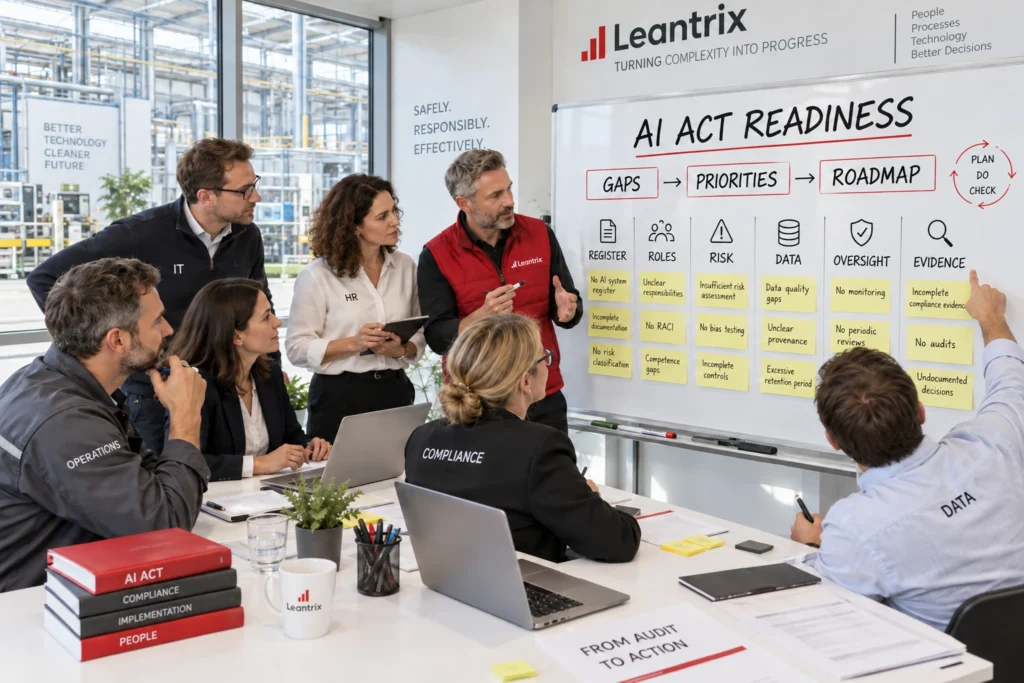
AI Act audit – from invisible shadow AI to a controlled system
An AI Act audit systematically assesses how an organisation designs, purchases, deploys and uses artificial intelligence. It shows where AI actually operates, the company’s regulatory role, the risk level of each application and the obligations, evidence and actions to assign to owners.
Regulation (EU) 2024/1689—the AI Act— is in force in its current consolidated version (Polish text) and applies in stages. Prohibited practices and the obligation to ensure an appropriate level of AI literacy began applying on 2 February 2025; obligations concerning general-purpose models on 2 August 2025; and the main provisions and transparency obligations on 2 August 2026. Following the 2026 changes, requirements for high-risk applications listed in Annex III are due to apply from 2 December 2027, and those for AI systems related to Annex I products from 2 August 2028. The current timetable is published by the European Commission.
Work should not be postponed until the final date. An organisation may already be using a prohibited practice, processing confidential or personal data in a public model, using AI without informing recipients or lacking evidence of required AI literacy. Some key obligations already apply, while preparing governance, data, oversight and documentation for high-risk systems takes time.
The AI Act concerns more than technology companies
Obligations may affect manufacturing, service, financial, healthcare, logistics and construction companies, employers, public bodies or software providers. The relevant factors are the specific system use and the organisation’s role rather than the sector’s name. A company may be a provider, deployer, importer, distributor, authorised representative or product manufacturer. In certain circumstances, changing the intended purpose, making a substantial modification or supplying a solution under its own brand can change its role and responsibilities.
One of the greatest obstacles is often shadow AI: tools introduced without the knowledge of IT, compliance or management. Generative AI can appear in recruitment, quality, sales, marketing, document analysis, maintenance, forecasting, customer service, programming and decision-making. We therefore begin an AI Act audit with a map of actual applications rather than a policy review alone.
What does the audit cover?
- AI inventory – in-house and purchased systems, AI embedded in equipment and applications, GPAI models, generative solutions, AI agents and tools used outside official purchasing processes.
- System qualification – checking whether a solution meets the AI-system definition and which exclusions may apply.
- Role mapping – assigning the organisation’s and providers’ roles throughout the value chain for each application.
- Risk classification – prohibited practices, high-risk systems, transparency-related risks and minimal-risk applications.
- AI governance – management mandate, system and risk owners, RACI, AI policy, tool-admission criteria and escalation paths.
- Data and individuals’ rights – provenance, quality, representativeness, confidentiality, intellectual property, personal data protection and the need for a DPIA or fundamental-rights impact assessment.
- Human oversight – supervisors’ capabilities, their ability to understand limitations, challenge outputs, stop a system safely and preserve human accountability.
- Transparency – informing people about interaction with AI, marking synthetic content where required, user instructions and communication with employees or recipients.
- Security and quality – accuracy, robustness, cybersecurity, logging, monitoring, testing, model-change management and incident response.
- Providers and contracts – due diligence, documentation, allocation of responsibilities, access to logs and information, model changes, subcontractors, portability and exit planning.
- AI literacy – roles, capability levels, training appropriate to the use context and evidence of effectiveness.
- Documentation and evidence – registers, assessments, decisions, instructions, consents, logs, test results, oversight records and corrective actions.
Four risk levels require different actions
Not every system requires the same documentation package. A prohibited practice must be stopped or redesigned. A high-risk system requires extensive management of risks, data, documentation, records, human oversight, accuracy, robustness and cybersecurity. A system subject to transparency obligations must inform people or mark content appropriately. Minimal-risk applications still benefit from ownership, basic security rules and proportionate monitoring.
Audits, conformity assessment and ISO/IEC 42001: three different purposes
- An AI Act audit assesses readiness and compliance, identifying gaps, risks and actions to implement.
- Conformity assessment of a high-risk system is a formal AI Act process depending on the role, system category and applicable procedure. We do not present our audit as a formal assessment by a notified body.
- ISO/IEC 42001 helps build a certifiable AI management system, but certification does not replace analysis of a particular system’s AI Act obligations.
The scope can be integrated with GDPR, cybersecurity, KSC/NIS2, ISO/IEC 27001 and quality-management requirements, avoiding several parallel registers and control processes. Read more about LeanTrix’s approach on the AI Act and AI governance (in Polish) page and in our ISO/IEC 42001 (in Polish) service.
What does the organisation receive?
- a register of AI systems and applications, including shadow AI,
- a map of processes, data, users, owners and providers,
- identification of the organisation’s role for every application,
- risk classification and an applicable-obligations matrix,
- a gap report with evidence and reasoning,
- a management risk heatmap,
- a list of practices requiring immediate suspension or change,
- a roadmap of quick wins, urgent actions and systemic projects,
- proposed policies, roles, KPIs, training and review cycles,
- a package preparing for AI governance or ISO/IEC 42001 implementation.
We conclude the AI Act audit with a management review. Each significant gap receives a priority, owner, deadline, expected closure evidence and a link to a specific business risk.
For implementation beyond compliance, explore Digitalisation and AI for organisations.